
How Modern B2B Billing Helps Telcos Win the Enterprise Race
Move over, B2C. The future of telecom is in enterprise, and the market is only getting started. According to Omdia, telco B2B currently represents just 40% of global telco industry revenue, but holds 80% of future growth potential .
For telcos that jump on this opportunity early, the upside is massive. Because enterprise customers don’t just need connectivity. They need managed security, IoT platforms, cloud communications, and third-party SaaS tools that you can bundle and resell as their single provider.
On paper, the path forward looks obvious: lean into B2B and ride the growth wave. But the reality isn’t so simple.
Enterprise customers look great on paper with their huge contracts, long terms, and predictable revenue. But for telcos, they introduce a ton of complexity that makes profitability difficult (particularly for telcos relying on legacy technology).
The challenges of B2B are manageable. Telcos like M1 in Singapore and PLDT in the Philippines have already figured this out. They’re launching new products in days, opening up their partner ecosystem through APIs, and scaling their enterprise practices across some of the fastest-growing markets in the world.
What are these three telcos doing differently to succeed? They all have one thing in common: modern B2B billing.
This unassuming function actually holds the key to unlocking the enormous revenue potential in the B2B telco sector. Here’s why: if you want to scale your enterprise business, that means your B2B billing has to keep up. The more products, partners, and pricing models you layer into enterprise deals, the heavier the load on your billing operations. And if your operations aren’t built for that, you can’t retain the enterprise customers you fought to win; let alone support new ones.
Better yet, modern B2B billing takes telcos from just “staying out of trouble” to actively getting ahead by innovating and operating faster and leaner . Below, we examine the most common pain points in B2B billing, then show how modern approaches and platforms can turn your B2B billing from a cost center to an engine for enterprise revenue growth.
The B2B Billing Problem Holding Telcos Back
The real issue with B2B billing for most telcos isn’t only that their tools are outdated. It’s that there are so many of them—patchworked together over decades—that pulling one piece out or adding one more configuration on top could be what brings the whole thing down.
As one telecom leader put it : “[You’ve got] multiple decades of legacy systems piled on top of legacy systems, held together with middlewares of tape and bubblegum.”
For a long time, that wasn’t a dealbreaker. When B2C was driving the business, systems could be “good enough”—the high volume and healthy margins would make up for inefficiencies.
Now telcos need B2B to grow topline. And that duct tape won’t hold up against 5G (soon to be 6G) requirements, IoT, and the demand for real-time, usage-based pricing across multi-partner bundles. The further telcos move into enterprise, the more clearly cracks will start to show :
Slow time to market will cost deals. Sales can close a complex enterprise deal, but if your billing system can’t support the pricing model they sold, your back office is stuck manually configuring the first invoice. This delays revenue recognition and frustrates the customer.
Revenue leakage will add up. Batch processing engines can’t accurately meter real-time IoT usage or apply dynamic pricing rules mid-cycle. When the math is wrong (over and over), profitability and trust take a hit.
Manual processes will cap growth. Wherever your process breaks down, a human picks up the slack: manually provisioning accounts, reconciling invoices, investigating pricing discrepancies. That eats time and introduces compliance and audit exposure.
Data silos will impede agility. Enterprise contracts aren’t static—new employees get hired and new offices come online all the time. Ideally, you’re proactively scaling capacity or recommending new services based on historical trends. But when data lives in disconnected systems, you’re always a step behind, creating a more disruptive customer experience.
Outdated infrastructure will increase OPEX. Each workaround, custom integration—and vendor brought on to fix them over time—adds to your operating costs. So does the ongoing training and support to maintain it all, diverting precious budget from new products and services that could give you an edge in the enterprise market.
How a Modern B2B Billing System Gives Telcos a Competitive Advantage
Telcos gaining ground in the enterprise aren’t just swapping out old B2B billing software for new B2B billing software. They’re taking the time to rethink how they serve enterprise customers end to end and pairing that revised system with a platform purpose-built to handle the complexity of enterprise accounts .
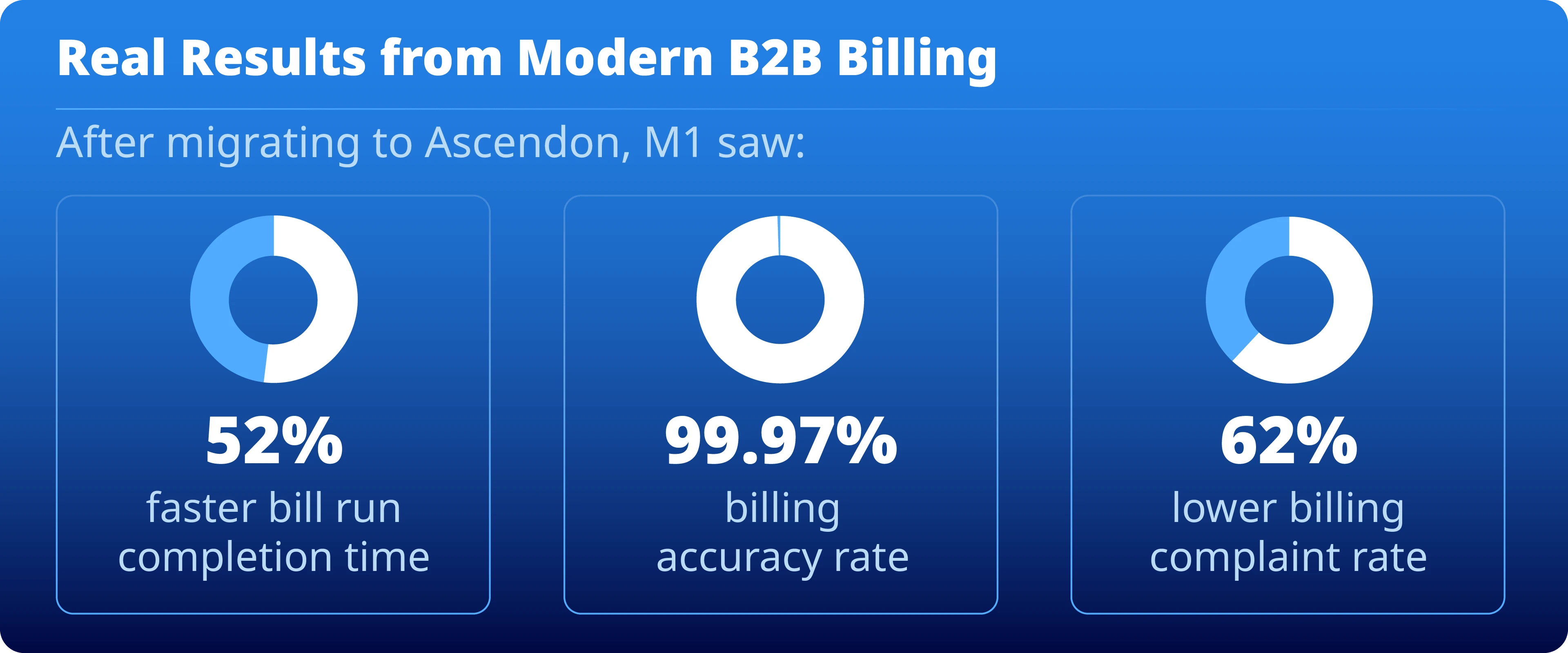
Here’s how B2B billing modernization is helping telcos win the enterprise race, with M1, Singapore’s first digital network operator, as a prime case study of what success can look like:
Greater operational efficiency
When a signed contract flows straight into provisioning, rating, and invoicing (without manual intervention at every step), much of the day-to-day pain of managing enterprise B2B billing goes away. Your team spends less time reconciling spreadsheets, dealing with customer escalations, or preparing for audits—and more time finding ways to serve your enterprise customers better, deepen the relationship, and grow the account.
Rapid time to market
Enterprise customers are hungry for telcos that can support their growing needs, and they’re not going to wait around for more RFPs. Getting a custom offer out the door quickly takes two things:
1. Fewer manual handoffs and checks between sales, product, and IT
2. A platform that lets product teams assemble offers from modular components (pricing rules, service bundles, SLA terms, etc.)
When M1 did both, they achieved faster time-to-revenue on 5G offers. That kind of speed opens the door to develop new enterprise offerings and revenue models that wouldn’t have been worth pursuing before (as the ROI on niche products didn’t justify months of configuration), and lets you get them to market before everyone else does.
More focus on innovation
In B2B, customer experience isn’t about sleek apps or personalized marketing. It’s about making your products and services as operational and efficient as possible.
Can your enterprise customers make account changes without calling someone? Do they receive proactive notifications about maintenance or upgrades?
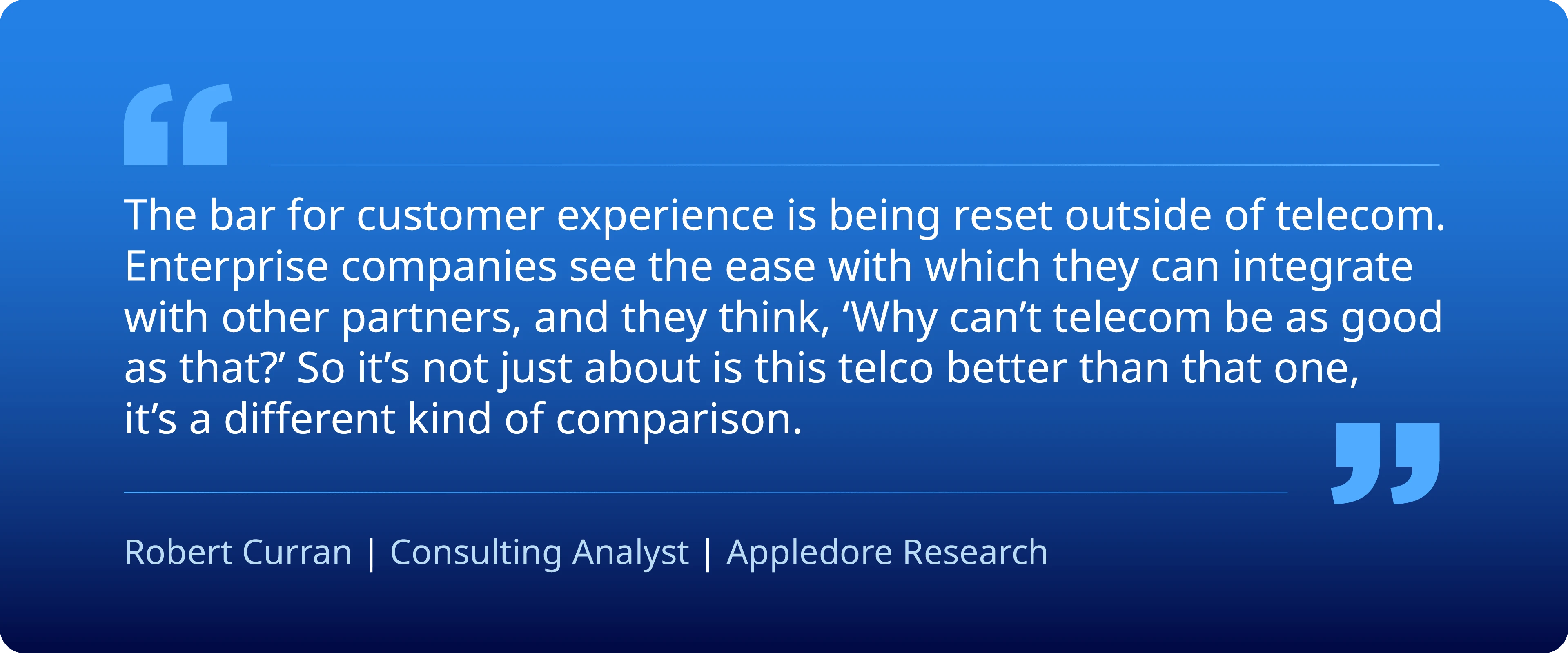
The telcos getting this right become indispensable to how their enterprise customers operate day to day. And they’re turning that stickiness into more revenue over time. An enterprise customer who sees the immense value you’re providing to their business might be more likely to consider additional services—especially if they can do it on their own with a self-serve UI.
Building that kind of experience takes bandwidth that your resources don’t have if they’re buried in dispute resolution, billing fixes, and other minutiae. A simplified billing process allows them to
reinvest time into thinking carefully about what enterprise customers want, how to design new products that meet those needs, and how to pitch an upsell or cross-sell at the right time.
Even better if they have a platform at their disposal that supports flexible configurations out of the box. Even better if they have a platform at their disposal that supports digital self-service and flexible configurations out of the box, without custom development.
Faster ecosystem growth
Enterprise deals often involve multiple partners. Which means there’s a different revenue split , settlement cycle, and contract terms for every account. Handling this manually works for maybe three or four partners. But it doesn’t work with thirty.
And the number of partners is only going to go up. Internationally, we’re seeing telcos effectively becoming the “app store” for their enterprise customers, reselling not just connectivity-adjacent services, but utilities, insurance, even financial products. The operator becomes the single storefront, managing the customer relationship while capturing margin from every partner transaction.
That’s an incredibly powerful business model, but only if your billing infrastructure can handle the partner integrations, revenue splits, and settlement cycles that come with it.
The largest wireless operator in Brazil is moving in this direction. They’ve opened up their network to bring on new partners (including outside of telecom) to drive more cross-sell and upsell to their existing customer base.
Other telcos around the world are taking a similar approach. M1 got there using CSG’s ODA-aligned API framework to connect with partners directly, and integrate billing across upstream and downstream systems—without the expensive custom work that typically comes with it.
A modern B2B billing system has enabled them to reimagine what they offer enterprise customers and how they can deliver it through the product and partners.
Fix Your B2B Billing, Win the Enterprise
To drive real change, you have to focus on simplifying the complexity of your business processes first . That doesn’t mean you have to rip and replace everything overnight. But you do need to decide whether your current B2B billing setup is going to help you lead in enterprise, or keep you stuck managing workarounds, revenue leakage, and slow time to market while competitors move faster.
Modern, simplified B2B billing is how you flip that script. If you can get your business to work hand in hand with your technology and ecosystem partners, you can see tremendous value from that upfront investment and fully capitalize on the enterprise growth opportunity at hand.
Achieving this is entirely within reach. But having a partner who’s already helped some of the biggest telcos in the world make this shift can make or break your success.
Ready to Modernize Your B2B Billing?
If you’re ready to see what a simplified B2B billing process could look like for your enterprise practice, schedule a personalized demo of CSG’s modern billing and monetization solutions today.