
What Is Composability in Telco CPQ Software and Why Does It Matter?

Key Takeaways
Composability in CPQ means telcos build offers from reusable “building blocks” (like standard products, options, terms and workflows) instead of creating a brand‑new bundle and custom logic every time.
In a composable setup, teams define these building blocks once and then mix and match them wherever customers buy, so the same rules and prices show up consistently everywhere without rework.
For the business, composability means you can launch new B2B and B2B2X offers faster, say “yes” to complex deals with more confidence, scale across markets without duplicating systems, give customers a consistent experience across channels, and reduce both vendor lock‑in and the cost of ongoing change.
What Is Composability in Telco CPQ Software and Why Does It Matter?
Do you remember playing with LEGO sets as a kid?
You could pour out a pile of bricks, click them together, and create anything your mind dreamed up. Then, just as easily, you could pull them apart and turn them into something completely different—a spaceship, a castle, a city. But the magic wasn’t in any single brick. It was in how perfectly the pieces fit together, and how many different ways you could reuse them.
That’s the core principle behind composability in Configure, Price, Quote (CPQ) software for telcos. Instead of treating every new offer as a bespoke build, a composable CPQ lets you work from a shared set of well-defined building blocks—products, options, rules, workflows—that fit together cleanly. You assemble and reassemble them to serve different customers, markets, and channels without starting from scratch each time.
When telcos start using a highly composable CPQ system, the impact is immediate. New B2B offers go out the door faster, pricing and rules stay consistent wherever the customer buys, and changing course doesn’t automatically trigger a six‑month project.
In this post, learn what composability is and how it directly impacts launch speed, complex deal execution, global scalability, and the ongoing cost of change for telcos investing in B2B.
What Composability Really Means in Telco CPQ
So, what exactly is composability? In plain terms, composability is a design principle that lets telcos build systems from modular, reusable components that can be assembled and reassembled in many ways, instead of from one‑off, hard‑wired bundles.
In a truly composable CPQ and order management system, you’re not constantly inventing new “mega products.” You can quickly structure your commercial landscape–products, offers, pricing, rules, and orders–from the same components over and over again.
Composability gives telcos a well‑defined set of building blocks:
Base products: Access types, connectivity, core services
Options and features: Bandwidth tiers, add‑on services, security layers
Commercial policies: Terms, SLAs, discounts, eligibility rules
Market variations: Regional price books, tax rules, regulatory constraints
Process components: Validation steps, approval flows, orchestration rules
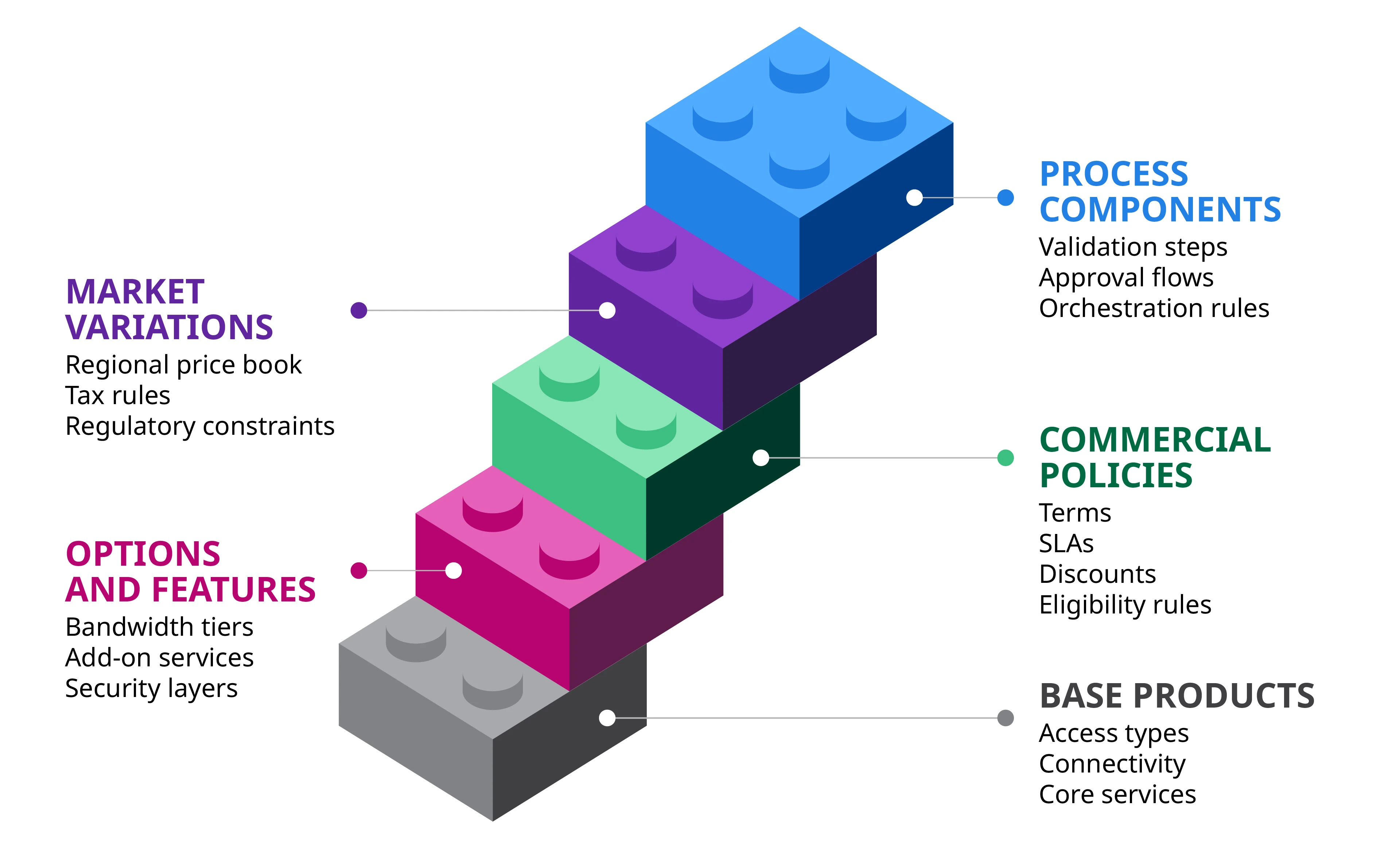
You then assemble quotes and orders by combining these building blocks just like LEGO bricks, rather than engineering each offer from scratch.
Contrast that with a traditional, monolithic approach where:
Every new offer becomes its own bundle, with its own logic embedded in product definitions, UI flows, and custom code
Changes to a rule or option force you to touch multiple bundles and channels to stay in sync
Reuse is the exception; duplication is the norm
Composability flips that model. Reuse of both the product components and the telco network is baked in from day one, saving countless hours and resources as you innovate with new offers.
Design Time vs. Runtime: Where Composability Comes into Play
To understand why composability matters, it helps to separate two moments in a telco’s CPQ lifecycle:
Design time: When you model products, offers, and commercial rules
Runtime: When salespeople, partners, or customers actually configure and order services
A composable CPQ and order platform has to work well at both layers.
Design time: Assembling offers from reusable components
At design time, you’re essentially architecting the hotel before any guests arrive. You decide what you’ll offer and how it should behave.
In a composable setup, this process becomes much easier. Product and architecture teams can:
Define modular components once (base services, options, policies, SLAs) and use them across many offers and segments.
Create families of offers from the same building blocks (e.g., small business, enterprise, wholesale) without creating separate product stacks for each.
Adjust a component –for example, a security option or bandwidth tier–and have that change automatically reflected wherever it’s used, with proper governance.
This is how large operators move from dozens of slightly different, siloed product variants to a small number of shared “underlying products” that serve many markets, significantly reducing complexity and cost.
Run time: Reusing logic everywhere customers buy
Composability doesn’t stop at the catalog. It also has to show up at run time, when a salesperson, partner, or customer is actually configuring and ordering services.
Many CPQ systems expose APIs for easier integration , but still force you to rebuild all the pricing, configuration, and validation logic in each front end, such as the sales desktop and customer or partner portal.
In a truly composable architecture, the vendor’s CPQ and order management engine provides two important capabilities:
Web components and SDKs that encapsulate the quoting and ordering logic you’ve already configured in the core system.
A way to embed those components directly into your own branded front ends —the digital experiences your customers already use—instead of forcing you into a generic vendor UI.
You configure the rules once in the CPQ and order system, then reuse that intelligence everywhere instead of rebuilding it channel by channel.
That’s run time composability.
5 Reasons Why CPQ Composability Is Critical for Telcos
CSPs don’t invest in composability because it looks clever on an architecture slide. They do it because it changes three things that matter every day: how fast you can launch, how safely you can say “yes” to complex deals, and how painful it is to keep changing. Here are five key benefits to a highly composable CPQ solution for telcos:
1. Launch new offers faster
In B2B and B2B2X, portfolios only move one way: up. More sites, services, and partners means more complex requirements for telcos to satisfy. In a non‑composable world, every new idea is held back by the same limitations—change requests piling up, custom code in multiple systems, and the fear that one tweak will break something you can’t see.
A composable CPQ breaks down those walls. New offers are assembled from existing parts, not hand‑built each time. Product teams start with known building blocks and add only what’s truly new. Because those parts and rules are reused everywhere, changes behave more predictably instead of exploding three integrations away.
This way, you can try more ideas, from pilots to bundles to vertical variants, without turning every launch into a mini‑transformation.
2. Say “yes” to large enterprise deals, profitably
The big B2B and wholesale deals are exactly where static CPQ systems start to creak . They aren’t designed to manage so many locations, multiple services, layered SLAs, and tight approvals. Every exception pushes you back into one‑off products or spreadsheet workarounds, and somewhere along the way it stops being clear whether the deal is still good business.
A composable system solves this by defining enterprise‑grade components (such as access types, bandwidth tiers, security levels, SLAs, and terms) once, as configurable pieces, then assembling the deal from that library. You can flex the configuration as much as you’d like, but the pricing and guardrails stay in one place.
What does that mean for operators? Quicker quotes, fewer nasty surprises in delivery, and far less “did we just give away our margin?” after the fact.
3. Scaling globally without cloning your stack
Most large communications service providers (CSPs) are really a collection of markets and operating companies. Without composability, each one ends up with its own CPQ flavor, its own catalog, and its own version of “the same” offer. That’s how you wake up with ten stacks doing 80% of the same thing.
A composable approach draws a clean line:
Global: Shared product foundations, options, and baseline SLAs
Local: Pricing, tax, and regulatory rules layered on top
Instead of copying the whole model for every market, local teams extend the global pieces where they need to. You get one coherent story with controlled variation, instead of several different stories that almost match.
4. Delivering consistent experiences across channels
Customers and partners don’t care which system is behind the screen. They care that they see the same price, the same rules, and that a change on Monday doesn’t vanish by Friday.
In a composable setup, the same CPQ and order intelligence shows up everywhere. The engine exposes configuration, pricing, and validation as reusable components, so sales desktops, partner portals, and customer portals all plug into the same logic, not their own homemade version.
Think of it as one brain and many faces: channels can look different, but they all think the same way.
5. Avoiding lock‑in and hidden costs
This is where composability and transparency meet. In a closed, “walled garden” model, key logic lives in proprietary UIs, data is technically there but too expensive to use, and simple asks, like “reuse that in this channel” or “send that field to this system,” turn into long projects.
A composable, open CPQ system behaves differently:
APIs and web components are first‑class, not an afterthought
The platform is built to sit alongside CRM, billing, OSS/BSS, and custom portals, not to swallow them
Basically, what you configure is what you can actually use. You aren’t forced to pay again (and again, and again) just to get access. Over time, that’s what keeps your CPQ and order management system evolving with the business instead of becoming the next legacy problem.
What To Look for in a Composable CPQ Platform
When you’re evaluating CPQ and order management solutions through a composability lens, you need to be sure that what you see is what you get. Begin evaluating vendors with a few sharp questions:
1. Can we define components once and reuse them everywhere?
What to look for: Products, options, rules, and SLAs should be modeled once and applied across offers, markets, and channels—not copied and pasted.
2. Can the same logic power every channel?
What to look for: Quoting and ordering intelligence should be exposed via APIs/SDKs/web components you can drop into your own experiences, without re‑implementing rules per channel.
3. Will the platform stay open as our architecture evolves?
What to look for: You’ll want to see documented, supported integration points and real deployments where the CPQ system participates cleanly with existing CRM, billing, and OSS/BSS—not slideware.
A vendor may claim to have these capabilities, but if they can’t demonstrate them live, you’re likely not looking at a truly composable platform.
CSG Quote & Order Leads with Composability in CPQ
At CSG, we’ve built our industry-leading CPQ solution, CSG Quote & Order , around these composability principles from the start. That’s why our platform fundamentally features:
Modular product and offer modeling that lets telcos design reusable components and assemble offers quickly.
Design‑time and run time composability , so the same intelligence that powers configuration in the back end can be embedded in your own portals and tools on the front end.
A commitment to openness and participation , not lock‑in—which is a key reason major global operators have chosen us for complex B2B and multi‑market transformations.
Don't just take our word for it. In its 2026 Critical Capabilities report for CPQ, Gartne r recognized CSG in all Use Cases and with the highest score for Composable Use Case , which to us is reflecting the strength of this architecture in real‑world telco deployments.
Composability won’t appear as a neat line item on your financial statements. But it will show up in how fast you can launch, how confidently you can sell, how consistently you can operate across markets, and how much it costs to evolve your stack over time.
Gartner, Magic Quadrant for Configure, Price and Quote Application Suites, Mark Lewis, Luke Tipping, 22 January 2026.
Gartner, Critical Capabilities for Configure, Price and Quote Applications, By Mark Lewis , Luke Tipping , 26 January 2026
Gartner and Magic Quadrant are trademarks of Gartner, Inc. and/or its affiliates. Gartner does not endorse any company, vendor, product or service depicted in its publications, and does not advise technology users to select only those vendors with the highest ratings or other designation. Gartner publications consist of the opinions of Gartner’s business and technology insights organization and should not be construed as statements of fact. Gartner disclaims all warranties, expressed or implied, with respect to this publication, including any warranties of merchantability or itness for a particular purpose.
Related Resources

The CPQ Bottleneck: 5 Ways Telco B2B Deals Go Wrong

CSG named a Challenger in the Gartner® Magic Quadrant™ for CPQ

Appledore Research: Telco-Specific CPQ Systems