
What Is Intelligent Routing?

“Please hold while I transfer you to someone who can help.”
Contact centers tend to consider that moment a failure. But is it necessarily a failure of the live agent who has to transfer the caller? Or of the system that sent the caller to that agent in the first place?
Too often, it’s the system.
That’s why call routing has become one of the most important (and most underestimated) levers in contact center optimization. The routing decision happens early, quietly, and at scale. Get it right, and everything downstream (self-service, agent effectiveness, resolution rate and speed) gets easier. Get it wrong, and you introduce rework: transfers, repeat explanations, and preventable contacts.
But there’s intelligent call routing: a combination of technologies that’s designed to minimize the “let me transfer you” failure state, creating better outcomes for customer and agent alike.
Here, you’ll learn what intelligent call routing is, how it works, and what to look for if you’re evaluating it as part of a contact center AI and modernization strategy.
What We Mean by Call Routing
Call routing is the logic that decides where an inbound call goes—whether that’s a self-service flow, a queue, or a specific team or agent. In practice, call routing is the front door of the contact center: it’s where the routing system makes the first decision to direct each customer interaction to the right destination.
In simpler terms: It’s the system that answers, “What happens next?” after a customer dials in.
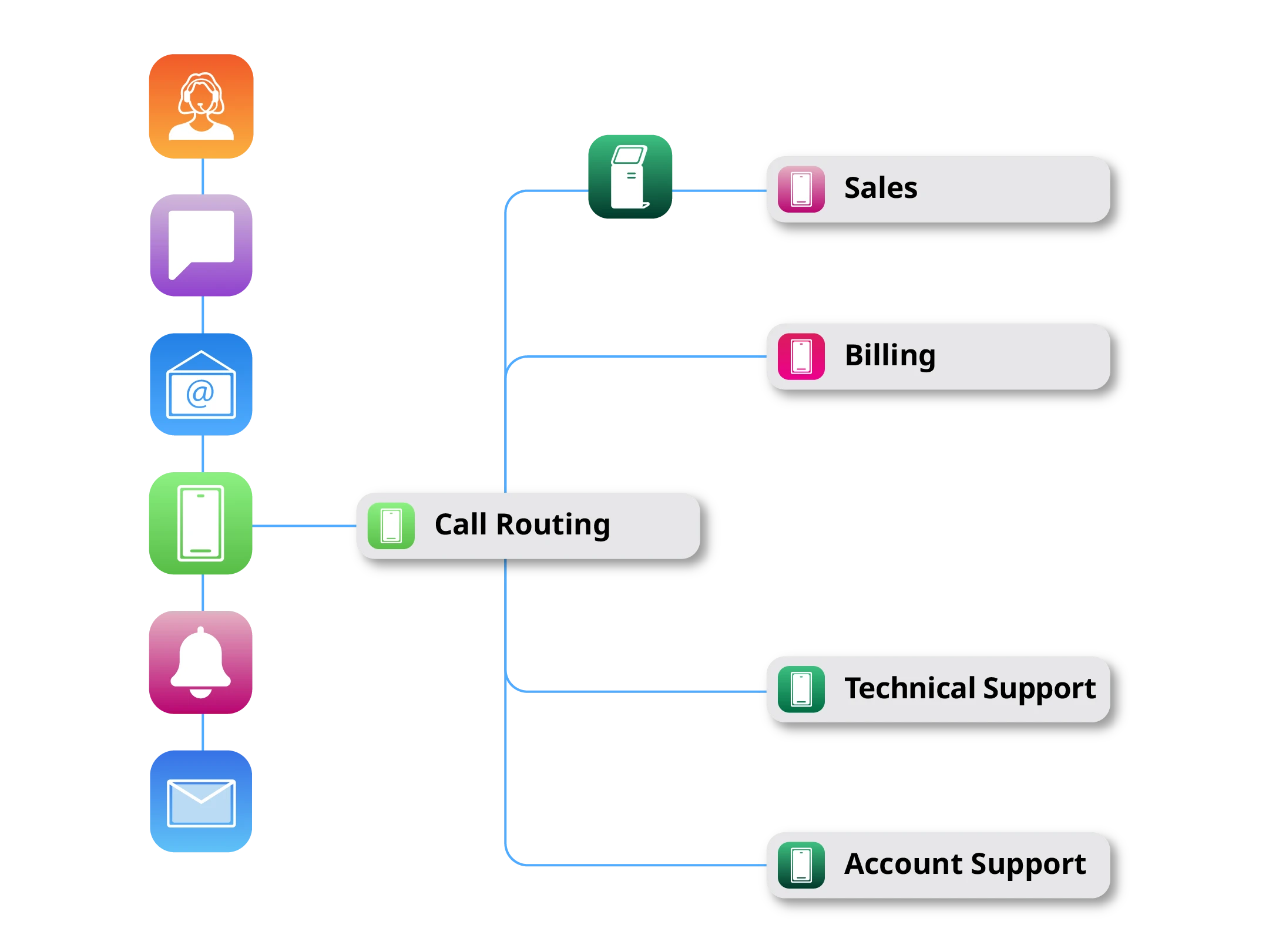
Traditional routing commonly relies on inputs like:
The number dialed (line of business, region, brand)
Caller ID or account lookup
Static IVR trees (“Press 1 for billing…”)
Skills-based rules (language, product expertise)
Availability and priority rules (VIP handling, escalations)
This approach can work. Until it doesn’t—and customer conversations get stuck in the wrong queue or the wrong department. At enterprise scale, routing processes tend to grow increasingly complex through exceptions, quick fixes, and legacy technology, which makes call center optimization harder and reduces efficiency.
Why Call Routing Struggles in Large Enterprise Contact Center Operations
Most contact centers don’t have one routing system, but a collection of them.
Over time, large organizations accumulate:
Multiple inbound numbers across brands, business units, and geographies
Different IVRs created at different times (often by different teams)
Multiple CCaaS platforms and queues
BPO partners with their own processes
Exceptions stacked on exceptions (“route these calls to Team A… unless it’s after 6pm… unless the customer is in Region X…”)
The result is what many operations leaders recognize immediately: a fragmented voice environment where customers bounce between systems and teams. It then becomes difficult to manage routing changes consistently across the whole enterprise.
That fragmentation is costly. In a contact center study, Deloitte found that organizations that better coordinate experiences across channels can reduce cost per assisted contact by around 9%.
Fragmented contact center operations create these common operational symptoms:
Higher transfer rates (agent-to-agent, queue-to-queue)
Longer handle times because agents have to “re-triage”
Repeat contacts because the first path wasn’t the right one
Underused self-service because callers never reach it (or don’t trust it)
Higher compliance risk when decisions can’t be explained or audited end to end
If you’re trying to improve metrics like FCR, containment, or cost per contact, this fragmentation puts a ceiling on your contact center performance because the front door keeps sending the wrong traffic downstream.
A contact center optimization approach using an intelligent routing system can provide consistent decisions across channels and reduce avoidable transfers, which doesn’t just lower costs but also improves customer satisfaction.
What Intelligent Call Routing Is (and What Makes It Different)
Intelligent call routing (sometimes called intent-based routing) improves routing by understanding what the caller is trying to do, then selecting the best resolution path based on intent, context, and business rules.
The key difference is that routing isn’t driven primarily by “Which menu did they choose?” or “Which agent has Skill [X]?”
Instead, routing becomes a structured decision informed by:
What the customer is actually asking for (intent)
What you know about the customer (context)
What your operation wants to happen next (policy and rules)
This is where contact center AI can play a key role. AI helps interpret what the caller says, so the system can capture intent more accurately than “press 1, press 2” trees.
But it’s important to draw a clean line: AI can help with understanding (speech recognition, transcription, and intent classification). Operations should still control decisioning (routing policies, escalation rules, compliance guardrails).
Done well, intelligent routing isn’t a model making choices in a black box. It’s automated call routing that uses AI to interpret the request, while your team defines the logic that determines what happens next.
How Intelligent Routing Works End to End
If you zoom out, intelligent routing is best understood as a front-door flow:
Receive the call The system answers consistently (across brands, regions, languages, and entry numbers) so the experience doesn’t depend on where the caller happened to land.
Understand what the caller said Speech is transcribed and interpreted. This is a core contact center AI capability—turning messy, real-world speech into something the system can act on.
Determine intent through dialogue (not just menus) Instead of forcing callers through rigid branching trees, the system can ask clarifying questions when needed (especially for ambiguous requests).
Route, resolve, or take action Based on intent and policy, the system can:
Send the caller to the right queue the first time
Redirect to a digital or self-service path when appropriate
Escalate to a human agent with the right skills and full context
Trigger an operational step (e.g., identity verification) when your rules allow it
This is why the “front door” matters: the goal isn’t simply routing calls faster, but also selecting the right resolution path earlier. That way, fewer interactions require rework later. You can see how this reduces costs for contact center operations: this end-to-end routing strategy is designed to reduce wait times, improve efficiency, and keep customers satisfied by keeping conversations on the shortest path to resolution.
What Intelligent Routing Improves (and How to Talk About It in Plain Terms)
Let’s put the benefits of intelligent routing in concrete terms. The beauty of contact center optimization, after all, is that most changes can be mapped to specific metrics.
Intelligent call routing tends to improve contact center operations in these ways:
1. Fewer transfers and misroutes
Fewer “warm handoffs” where the next live agent has to re-triage
Less agent time spent fixing a routing mistake
2. Higher first-contact resolution
The right team sees the interaction first, and with better context
Customers don’t get stuck in dead-end paths
3. Lower cost per contact
Fewer repeat calls
Better containment when self-service is a legitimate resolution path
4. More consistent operations across complexity
This one often gets overlooked. For large enterprises with multiple CCaaS platforms and BPO partners, the big win is consistency: one place to define routing intent and policy, even when execution spans multiple systems.
That consistency is especially important to contact center optimization. It reduces the variance that makes performance unpredictable. In fact, Deloitte’s research shows that top-performing contact centers (those that coordinate experiences effectively) are 4.6 times more likely to report excellent customer satisfaction.
What to Look for When Evaluating Intelligent Call Routing
Not all “intelligent routing” is actually intelligent, and not all automation is operationally safe. Here are the practical criteria to evaluate:
Can it unify fragmented entry points?
If your environment includes multiple phone numbers, multiple IVRs, or multiple platforms, ask:
Can routing be managed as a single layer across these environments?
Does it work with existing CCaaS and BPO models?
How does it handle ambiguity?
Real callers don’t speak in neat labels. Look for:
Clarifying dialogue when intent is unclear
Graceful fallback paths (including human escalation) that preserve context
Who controls the rules?
For operations leaders, “intelligence” without control is a risk. Ask:
Can our team define and adjust routing logic without vendor services?
Are policies configurable and testable before we deploy changes?
Is it auditable?
Especially in regulated environments, you need to know why a decision was made.
Are routing decisions logged with context?
Can compliance or QA review what happened and why?
Does it support multiple resolution paths (not just “send to an agent”)?
Intelligent routing should support a broader set of outcomes:
Self-service / digital redirection when appropriate
AI-assisted flows for structured tasks
Human escalation with full interaction history intact
Intelligent Routing: Not a Feature, but the First Decision
The most useful way to think about intelligent call routing isn’t as an upgrade to an IVR tree, but as the system that governs the first decision of the customer interaction: “What is this customer trying to do, and what should happen next?”
With the right combination of contact center AI for understanding and automated call routing policies for control, routing becomes a practical way to reduce transfers, improve resolution, and create a more consistent experience across complex contact center environments.