
What Is Voice Over Wi-Fi?
Has your connection ever suddenly dropped when you're making an important business call? You check your signal—while your cell signal is dead, your device still has a strong internet connection.
You could wait for your cell service to come back, which could end up in a canceled or rescheduled call. Or, with a telecommunications provider that offers voice over Wi-Fi (VoWiFi) capabilities, you could call back right away over the internet and pick up where you left off.
Voice over Wi-Fi is a next-generation voice service that can help telecommunications providers enhance their offerings and become more competitive in the market. This guide explains everything you need to know about incorporating it into your business offerings.
How Does Voice Over Wi-Fi Work?
A typical voice over Wi-Fi call flow follows this sequence.
1. Voice signal conversion
The caller initiates a call on their connected device, and the device's microphone captures their voice as an analog signal.
2. Digitization
Before the system can transmit the call over the internet, it performs an analog-to-digital conversion to digitize the voice data. This process works by sampling the analog signal at regular intervals and assigning a digital value to each signal.
3. Packetization
To make the digital signal easier to transmit, the VoWiFi system divides it into small packets of data. Each packet contains a piece of voice data along with transmission information, such as the source and destination address.
4. Internet transmission
Once the voice data packets are ready for transmission, the device sends them over the Wi-Fi network as Internet Protocol (IP) packets. It completes this step by establishing a link to the internet using the existing Wi-Fi connection and routing the packets to their destination via the Wi-Fi router.
5. Reception and reassembly
The recipient's device receives the digital packets and reassembles them in the correct order based on the information included in each packet.
6. Digital-to-analog conversion
After reassembly, the recipient's device uses digital-to-analog conversion to convert the digital data packets back into an analog signal. This process enables the voice data to play through the device's speaker, enabling the recipient to hear the caller's voice just like in a traditional phone call.
VoWiFi vs. VoIP: What's the Difference?
Although they're similar concepts, VoWiFi and Voice over Internet Protocol (VoIP) are fundamentally different communication technologies. Understanding how they differ can help your business choose the right solution.
What Is Voice Over Internet Protocol?
VoIP is a broad and flexible technology that enables users to make and receive voice calls over any IP network, including:
Internet
Local area network (LAN)
Wide area network (WAN)
Wi-Fi
Cellular data
It's usually app-based, which requires users to download additional applications before using the technology. Its app-based architecture also means VoIP is carrier-agnostic, and it's most commonly used for business phone systems like Skype and Zoom.
What Is Voice Over Wi-Fi Calling?
VoWiFi is a more specific service that enables users to make and receive calls over the internet in situations where cellular reception may be spotty or unavailable. It's a carrier-native technology, which means it integrates completely with your existing phone system.
When calling via VoWiFi, you can use the same phone number and dialer as you would when making a conventional phone call—no additional apps or devices needed. Simply enable the feature on your device and begin calling.
Unlike VoIP, VoWiFi also supports automatic handoff between Wi-Fi and cellular connections. This capability allows you to transfer calls between systems without interruption for easy, continuous conversations.
What Are the Benefits of Voice Over Wi-Fi?
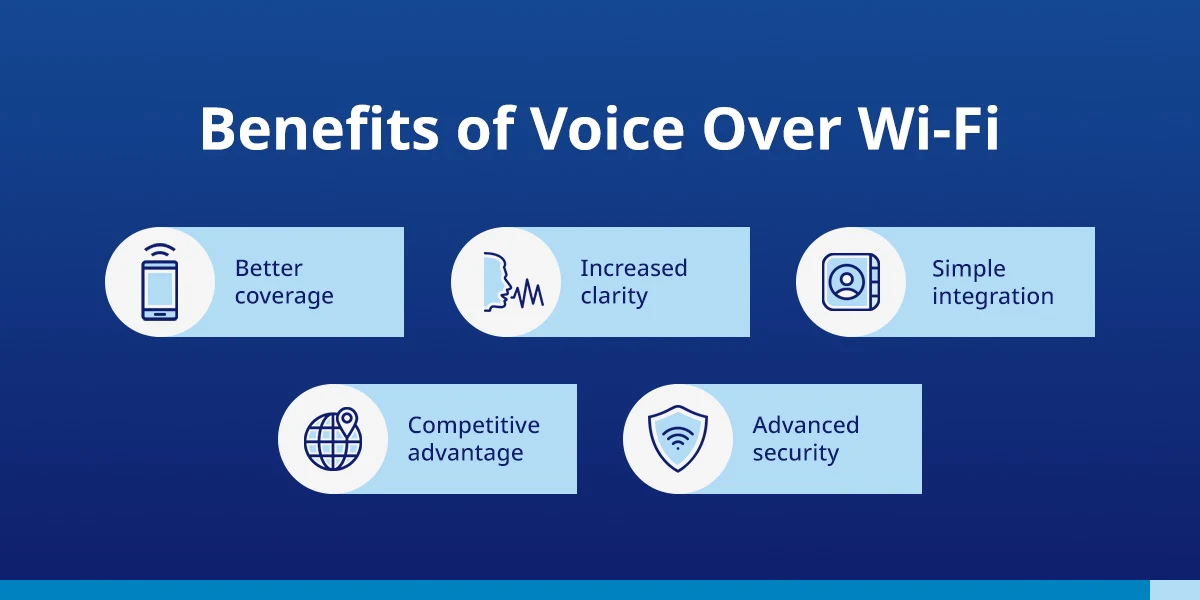
The most significant benefits of voice over Wi-Fi include:
Better coverage: While traditional voice calling and VoIP require a cellular signal, VoWiFi enables users to communicate on any voice-capable device from any location with an internet connection. VoWiFi calls can also bypass cellular roaming charges, making it a more cost-effective solution for long-distance and international calls.
Increased clarity: VoWiFi uses high-bandwidth Wi-Fi networks, which can help reduce distortion, interference and dropped calls for clearer conversations.
Simple integration: Rather than requiring users to set up multiple accounts on different applications, VoWiFi systems integrate directly with your existing cellular carrier for instant access to existing contact lists, call logs and other native phone functions.
Competitive advantage: Offering VoWiFi capabilities helps you differentiate your company from others in the telecommunications space by expanding your coverage area to anywhere wireless internet is available.
Advanced security: VoWiFi systems use secure communication protocols like Secure Real-time Transport Protocol (SRTP) and Transport Layer Security (TLS) to establish and maintain encrypted connections between devices and networks. These protocols reduce the risk of outsiders intercepting or tampering with calls, protecting your data and enabling compliance with key security regulations.
Using Wi-Fi Calling in Your Business
The primary use case for VoWiFi is extending mobile voice coverage for both consumers and business users, especially indoors or in areas with poor cellular signal. Here are more specific ways to use Wi-Fi calling in your business:
Call centers: Tech support desks, customer service lines and other call centers can benefit from enabling voice over Wi-Fi by reducing the number of dropped calls and improving call clarity.
Telecommunications: Telecom providers can offer VoWiFi capabilities as a value-added service, improving the customer experience and increasing satisfaction.
Internal communications: VoWiFi enhances call clarity and enables users to continue conversations even when cell coverage is spotty, which can help workers in office settings stay up to date on important business processes.
To enable voice over Wi-Fi, you'll need to adjust the settings in your mobile device after signing on to the service.
For example, if consumers want to enable VoWiFi on their iPhone, they would open the Settings app and navigate to Cellular settings. Then, they would tap the toggle next to the Wi-Fi Calling option to activate it.
Unlock the Power of VoWiFi With CSG Advanced Convergent Platform
If you're looking to add VoWiFi to your list of telecommunications service offerings, investing in a robust business support system (BSS) like CSG's Advanced Convergent Platform (CSG ACP) can help you develop the infrastructure needed to deliver those next-generation voice services.
At CSG, our goal is to develop innovative solutions that help businesses like yours provide superior experiences everywhere, whether you're a small business just getting started or an enterprise looking to expand into international markets.
Learn how CSG can help your organization deliver seamless, cost-effective voice calling solutions. Request your CSG ACP demo today to see our technology in action.
Once this option is turned on, consumers can make the most of VoWiFi using the same device they would use for traditional voice calls.

Related Resources

How Investing in Recurring Billing Applications Can Help Your Company Scale for Growth

How Integrated Capabilities Accelerate Your Fiber Network Launch

5 Questions to Ask a New Billing System Vendor