
The Real Test of Journey Orchestration Software: Post-Acquisition Experiences

Can you describe what your customer journeys look like? Can you map them, measure them, and even optimize individual steps using customer experience analytics and orchestration?
Plenty of organizations can answer yes to those questions. Except even then, they’re often thinking of just their acquisition journeys.
Here’s the real test: Can you map, measure, and optimize post-acquisition experiences? Because that’s when journeys stop behaving like campaigns and start behaving like operations.
Think of service escalations, where a typical journey cuts across systems and teams. One customer action can trigger activity in the contact center, the billing platform, and the communications stack at the same time. It’s the complexity of post-acquisition journeys that causes so many customers to get stuck.
Each team sees its part of the journey, but no one has shared, end-to-end visibility (let alone a coordinated way to make improvements) across the full experience as it happens. That’s the gap that post-acquisition journeys expose.
I would argue that this gap is exactly what makes the Gartner® Magic Quadrant™ for Customer Journey Analytics & Orchestration, the first ever report in this category, so significant. Let’s look at the category definition:
“Gartner defines customer journey analytics and orchestration (CJA/O) as solutions that track and analyze how customers and prospects interact with an organization across multiple channels over time. These solutions subsequently enable organizations to prioritize and orchestrate real-time improvements to the customer experience in multichannel journeys throughout the end-to-end customer life cycle.”
CSG was recognized as a Leader in this Magic Quadrant, and to us, the report underscores the need for platforms that combine journey-level analysis with the ability to orchestrate improvements across channels and time.
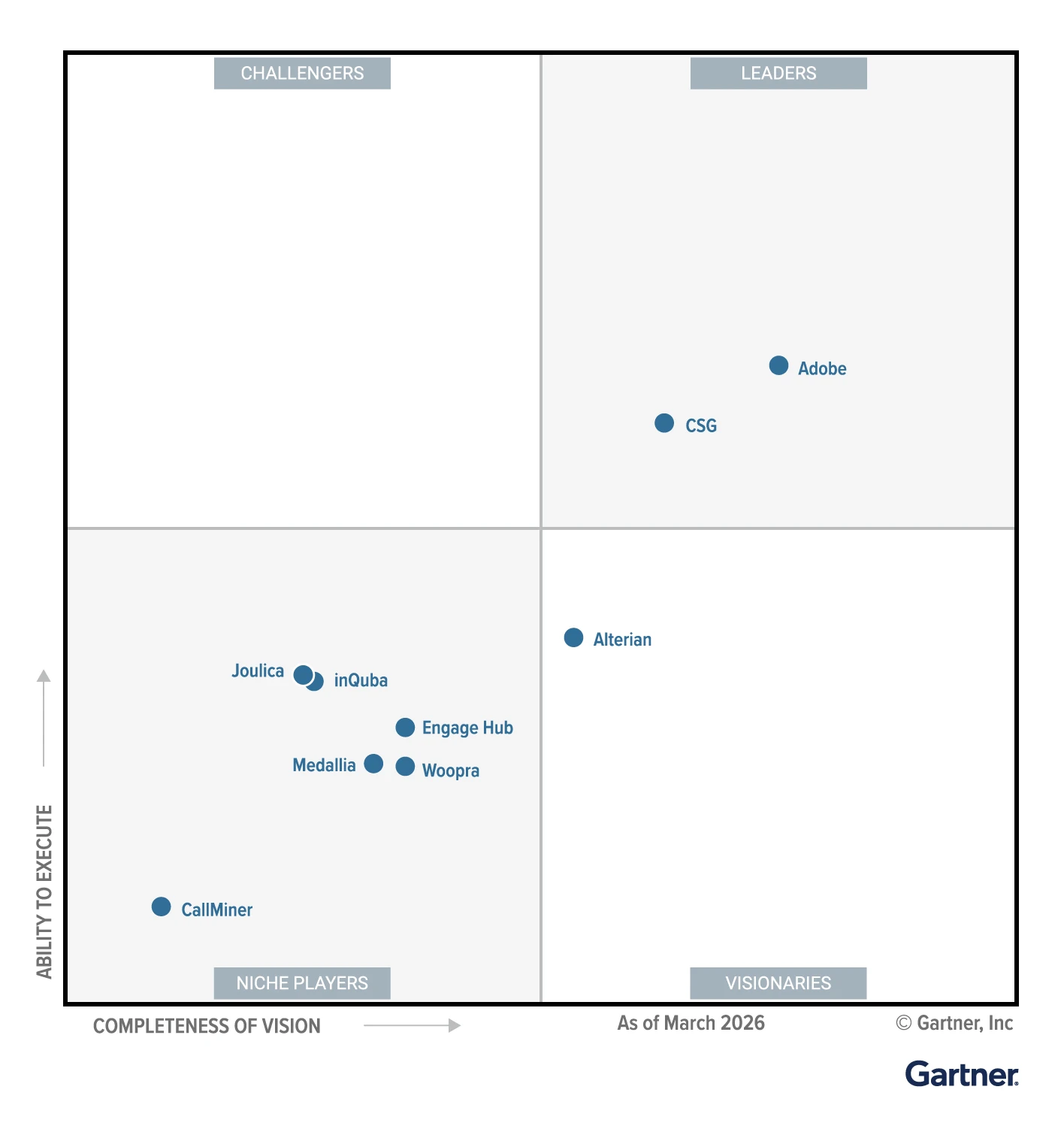
Most “journey tools” can show you what’s happening across the path. What they can’t do is act on it in the moment. CJA/O adds the layer of orchestration—so insights don’t just explain the journey, they change what happens next.
I’ll explain the difference, starting with the journey analytics side of the category.
Journey Analytics: Connecting What’s Happening Across the Customer Experience
Are your teams creating increasingly sophisticated dashboards, yet they keep seeing the same CX issues (like repeat billing calls)? This is a sign your enterprise-wide data isn’t connected in a way that reflects how customers move through your business.
Journey analytics brings those signals together. Instead of looking at interactions in isolation, it connects activity across channels and over time: You can see how an issue builds, where customers get stuck, and what leads them to reach out for help.
To do that, journey analytics has to carry two things consistently: the customer’s identity and their context. If you can’t recognize the same customer as they move from digital to billing to live support (and retain what’s already happened), you don’t have a true view of the journey.
That visibility matters. But on its own, it doesn’t change what the customer experiences next. It’s customer journey orchestration that acts on those insights.
Orchestration: The Journey Layer Where Change Actually Happens
Orchestration is where organizations move from knowing where a journey is broken to changing what happens next.
We tend to describe orchestration as the journey layer, which listens for events and coordinates actions across systems and channels. It’s how insights from journey analytics actually get applied in production. Here’s what that looks like across journeys:
Billing dispute resolution
A customer notices an unexpected charge and reaches out for clarification. The resulting journey typically spans account lookup, eligibility checks, policy application, and resolution.
Orchestration ensures those steps happen consistently and in sequence: triggering credits or fee adjustments, applying policy rules, and coordinating workflow handoffs (with human approval where required). The result is a faster, more predictable resolution without forcing frontline teams to manage every exception manually.
Service disruption and recovery
These journeys begin when a customer experiences an issue (like a service outage) and seeks updates or support across channels. This sets off a mix of inbound questions and outbound communication as the issue progresses toward resolution.
Orchestration coordinates email, SMS, and in‑app messaging with inbound interactions, so updates are timed to the customer’s situation and stay consistent across channels. Customers aren’t left guessing, and they don’t receive conflicting messages while the issue is still being resolved.
A Billing Recovery Moment Shows the Difference
Post-acquisition journeys don’t often break because of a single interaction, but because one event triggers a chain of responses across disconnected systems (which become incredibly hard to track).
Take a common contact center scenario: a customer’s payment fails, and the system posts a billing adjustment. The customer notices the change, tries to understand it, and contacts support.
For many organizations, that single billing event quickly turns into repeat calls, transfers, and conflicting messages, often without anyone realizing what triggered the chain reaction until after the fact.
Here’s how that same moment plays out in marketing-led engagement platforms, compared with a combined customer journey analytics and orchestration platform.
What Happens Next | Marketing-Led Engagement Platforms | Customer Journey Analytics & Orchestration Platform |
|---|---|---|
Event detection | The failed payment and adjustment appear in separate systems or reports, often reviewed after contacts increase. | The platform recognizes the combined event pattern in real time and flags it as part of a known problem journey. |
Customer context | Channel‑by‑channel views show recent activity, but live agents and systems don’t share a unified picture of what already happened. | Customer identity and billing context are unified, so every system sees the same history and current state. |
Contact handling | When the customer reaches out via chat, the interaction is handled in isolation, and key details often need to be re-explained. | The interaction carries forward relevant context, so the system or agent has a clear view of what already happened. |
Operational response | Agents rely on manual steps or escalations to resolve the issue, applying judgment inconsistently. | The next step is triggered automatically based on the situation (e.g., sending the right help content) so they can resolve the issue without delays or extra handoffs. |
Outbound communications | Automated reminders or marketing messages continue, even while the issue is unresolved. | Outbound messages are paused or adjusted until the billing issue is resolved, preventing confusion. |
Outcome | The issue shows up later in reports as higher repeat contact, longer handle times, and lower satisfaction persist. | Fewer repeat calls and handoffs and faster resolution. The customer can then be guided into a follow‑on journey (like learning how to avoid the issue). |
What Real Journey Orchestration Software Does
Most platforms that claim to “do journeys” can describe what happened and trigger a few actions inside a channel. That’s useful, but it doesn’t stop the operational chain reactions that drive repeat contacts and cost-to-serve (and eventually churn) that makes post-purchase experiences so difficult to turn around.
A combined customer journey analytics and orchestration platform changes the job in three practical ways:
It detects journey breakpoints as event patterns, not isolated interactions. You see the cascade early enough to intervene, not just report on it later.
It carries identity and context across systems, so the customer doesn’t restart the journey at every handoff. Live agents, self-service, billing, and outbound communications operate from the same current state.
It applies governed interventions in the moment, across functions, with measurement built in. The result is fewer transfers, fewer repeat contacts, and more consistent outcomes in onboarding, billing, service recovery, renewal, and other journeys.
That’s the difference between journey visibility and journey control, and it’s one of the reasons we think the Gartner category definition matters: CJA/O is defined to include both analytics and orchestration across the end-to-end life cycle.

Related Resources

CSG Named a Leader in the First Gartner® Magic Quadrant™ for Customer Journey Analytics and Orchestration

How to Cut Through ‘AI-Powered’ Claims in Customer Journey Management Using the QKS AI Maturity Matrix

The Customer Journey Management Market: What You Need to Know From the QKS SPARK Matrix 2025