
How Insurers Put Customer Journey Management Into Practice With CSG Xponent

Insurance teams have spent years building the pieces of better customer experience (CX), investing in everything from journey maps to analytics to AI capabilities. Yet so many insurers still struggle to combine those CX investments in ways that drive customer retention in critical moments.
Claims is a clear example of those moments. J.D. Power found that 80% of auto insurance customers who have a poor claims experience have already left or say they plan to leave their carrier. That’s what I mean by a “critical moment” in insurance customer journeys: One interaction that, when mishandled, creates an instant renewal risk.
It’s one thing to know your business’ critical moments and if they’re driving away policyholders. It’s another to translate that knowledge into timely action across systems, channels, and teams.
Customer journey management (CJM) is a framework for doing that. Insurers can use CJM to connect journey insights, communications, and operational decisions, so they can improve outcomes while the journey is still in progress.
What Customer Journey Management Means in Insurance Experiences
Customer journey management is often misunderstood as another platform or methodology. It’s really an operating discipline. In insurance, customer journey management is the discipline of detecting where a policyholder is getting stuck and coordinating the next best communication or action—across channels and teams—often in real time.
Insurance teams might ask themselves, Is customer journey management something we’re already doing? That depends.
Can you...
Detect when a claim has gone quiet and then automatically trigger the right status update before the customer calls?
Identify underwriting delays and then coordinate reminders, task ownership, and communications that keep the application moving?
Recognize when billing confusion is generating repeat contacts and then quickly adjust messaging, workflows, or guidance to reduce friction?
When insurers practice CJM, they’re not just identifying friction. They’re coordinating a response in the midst of a journey.
It’s fair, then, to ask: Do we already own the tools to coordinate these actions across channels?
The likeliest answer: Yes and no.
How Customer Journey Management Relates to CX Capabilities You Already Have
In theory, insurers can do customer journey management when they already own many tools it involves. Journey mapping, customer data platforms (CDPs), voice of the customer (VoC) platforms, and contact center platforms, to name a few, play an important role in coordinating actions across channels
In practice, most can't do CJM effectively because those tools often operate independently.
Tool | What it’s great for | What it doesn’t do |
|---|---|---|
Journey mapping | Aligning teams around customer goals, pain points, and high-friction moments | Establishing the map doesn’t run the journey |
CDP | Unifying profiles and supporting segmentation | It doesn’t determine the next best communication, channel, or timing on its own |
VoC platform | Collecting survey feedback, sentiment, and experience metrics | It pinpoints where customers are dissatisfied but doesn’t coordinate the operational response |
Contact center platform | Managing interactions, agents (live or AI), and service workflows | It doesn’t coordinate the full experience across digital, service, billing, claims, and retention moments |
Customer journey management sits above these individual capabilities, helping insurers connect customer insights, communications, workflows, and operational decisions across the journey.
Insurers often use a customer engagement platform (CEP) to perform that work. Rather than forcing a rip-and-replace, the platform helps insurers bring those capabilities together in day-to-day operations.
RELATED ARTICLE: How to Cut Through ‘AI-Powered’ Claims in Customer Journey Management Using the QKS AI Maturity Matrix
What a Customer Engagement Platform Adds
A customer engagement platform connects customer signals, communications, workflows, and measurement across the journey. Rather than operating as another standalone system, it’s an overlay that helps insurers take information already flowing through their existing CX, service, and operational platforms and generate governed decisions and coordinated communications across channels.
Here are examples of how insurers use a CEP to overcome CX obstacles:
Connecting Fragmented Customer Identities
Insurance organizations often manage customer relationships across products, policies, channels, and lines of business. That can make it difficult to understand the full customer relationship when decisions need to be made.
Example: A policyholder with auto and homeowners coverage receives separate communications from different teams. A CEP can help unify customer context so communications and service interactions are coordinated across the broader relationship.
Catching Journey Friction Quickly
Many insurers can identify problems after they occur through surveys, reporting, or service metrics. They could mitigate loyalty-damaging friction by catching problems early, but that’s a struggle for even sophisticated CX operations in insurance.
Example: A claim enters a prolonged investigation stage, underwriting requirements remain unresolved, or billing questions begin to accumulate. A CEP can help surface those patterns and trigger the appropriate follow-up actions.
Scaling Proactive Communication
Identifying a problem is only part of the challenge. Insurers also need a consistent way to respond.
Example: A customer receives a claim status update, underwriting reminder, or billing clarification based on what's happening in the journey rather than a fixed communication schedule.
RELATED CASE STUDY: Insurance Company Boosts Outbound Call Accuracy to Reduce Churn
What Customer Journey Management Looks Like in Practice With CSG Xponent
CSG Xponent is CSG's customer engagement platform, designed to help organizations connect customer data, journey signals, communications, and operational actions across the customer lifecycle.
What makes Xponent well-suited for insurance is its focus on operationalizing customer journey management. It helps insurers connect customer context, journey signals, communications, and business rules so teams can coordinate experiences across the systems and channels they already use.
Here's what that looks like in common insurance journeys:
Keeping Claimants Informed
In P&C, claim investigations often create periods where policyholders hear very little. From the insurer's perspective, work may be progressing normally. From the policyholder's perspective, they've fallen into a black hole.
With Xponent, insurers can identify claims that have gone without recent customer communication and automatically trigger updates that explain the current status, expected next steps, and timing of future communications. Because those communications are tied to a shared customer profile and journey context, service, digital, and claims teams can work from the same view of the customer.
The result is a more transparent claims experience and fewer "What's happening with my claim?" calls.
Keeping Applications Moving
In life and annuity, applications don't always stall because customers lose interest. Sometimes it’s that requirements sit unresolved, and nobody's quite sure what needs to happen next.
Xponent helps insurers identify applications that may be at risk of stalling and coordinate reminders, checklists, and follow-up communications based on customer activity and journey status. Instead of relying on manual outreach, teams can deliver clearer guidance about what's missing and what comes next.
This means faster application progression and fewer service inquiries tied to underwriting delays.
Deepening Policyholder Relationships
The same capabilities can support growth and retention, not just problem resolution.
A lapse notice, repeated service contacts, reduced engagement, or activity on another policy may tell a broader story about the customer relationship. Viewed individually, those signals might not seem significant. Viewed together, they can reveal opportunities to strengthen loyalty or address risk earlier.
Xponent helps insurers connect customer context, engagement history, policy activity, and service signals to identify opportunities for more relevant outreach. Instead of relying solely on broad campaign rules, teams can coordinate communications based on what's really happening in the customer's relationship. That allows insurers to move beyond reactive servicing and build more timely, relevant retention and growth strategies.
What Insurers Should Look for in a Customer Journey Management Platform
Customer engagement platforms can vary in how they support customer journey management. When evaluating options, insurers should focus on the capabilities that determine whether journeys can be coordinated consistently across systems, channels, and lines of business.
Unified Customer Context
Can the platform...
Connect customer identities across products, lines of business, and channels?
Pull policy information, service history, journey activity, and communications into a shared view?
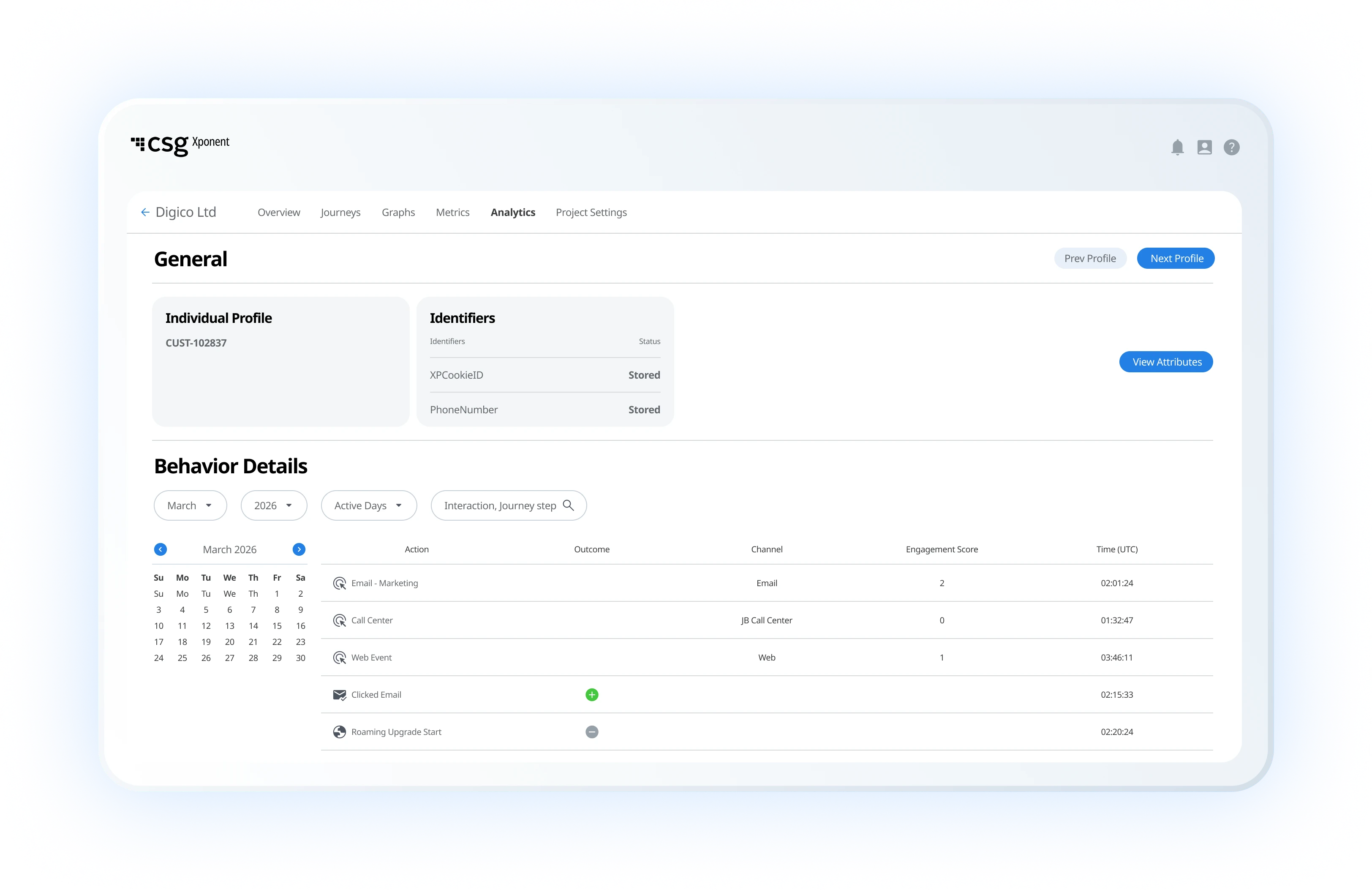
Xponent helps insurers connect profile information, identifiers, and engagement history so customer journeys don't become fragmented across systems. A unified customer profile helps insurers connect policy, service, engagement, and communication history across the relationship.
Early Detection of Journey Friction
Can the platform...
Identify stalled claims, unresolved underwriting requirements, or emerging billing issues while they're developing?
Consume signals and events from multiple systems?
Xponent helps insurers detect patterns and conditions across active journeys, creating opportunities to intervene sooner.
Governed Decisioning
Can the platform...
Apply business rules for timing, eligibility, suppression, and prioritization?
Explain why a communication or next step was triggered?
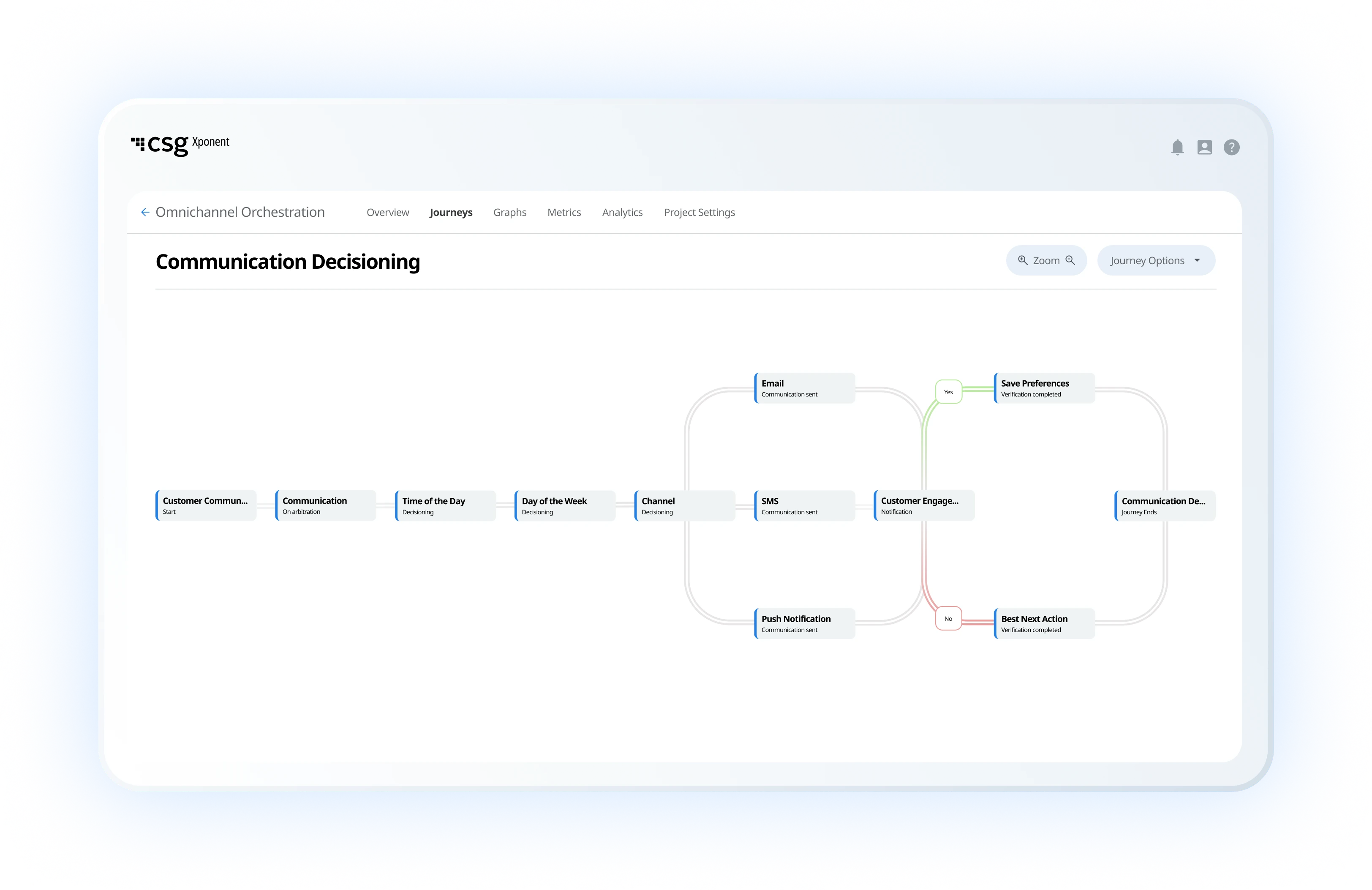
Xponent centralizes decisioning so communications and actions follow documented business rules. Journey signals can trigger different communications based on business rules, customer context, timing, and channel preferences.
Communications Controls for Regulated Environments
Look for...
Role-based permissions
Approval workflows
Version control
Audit history
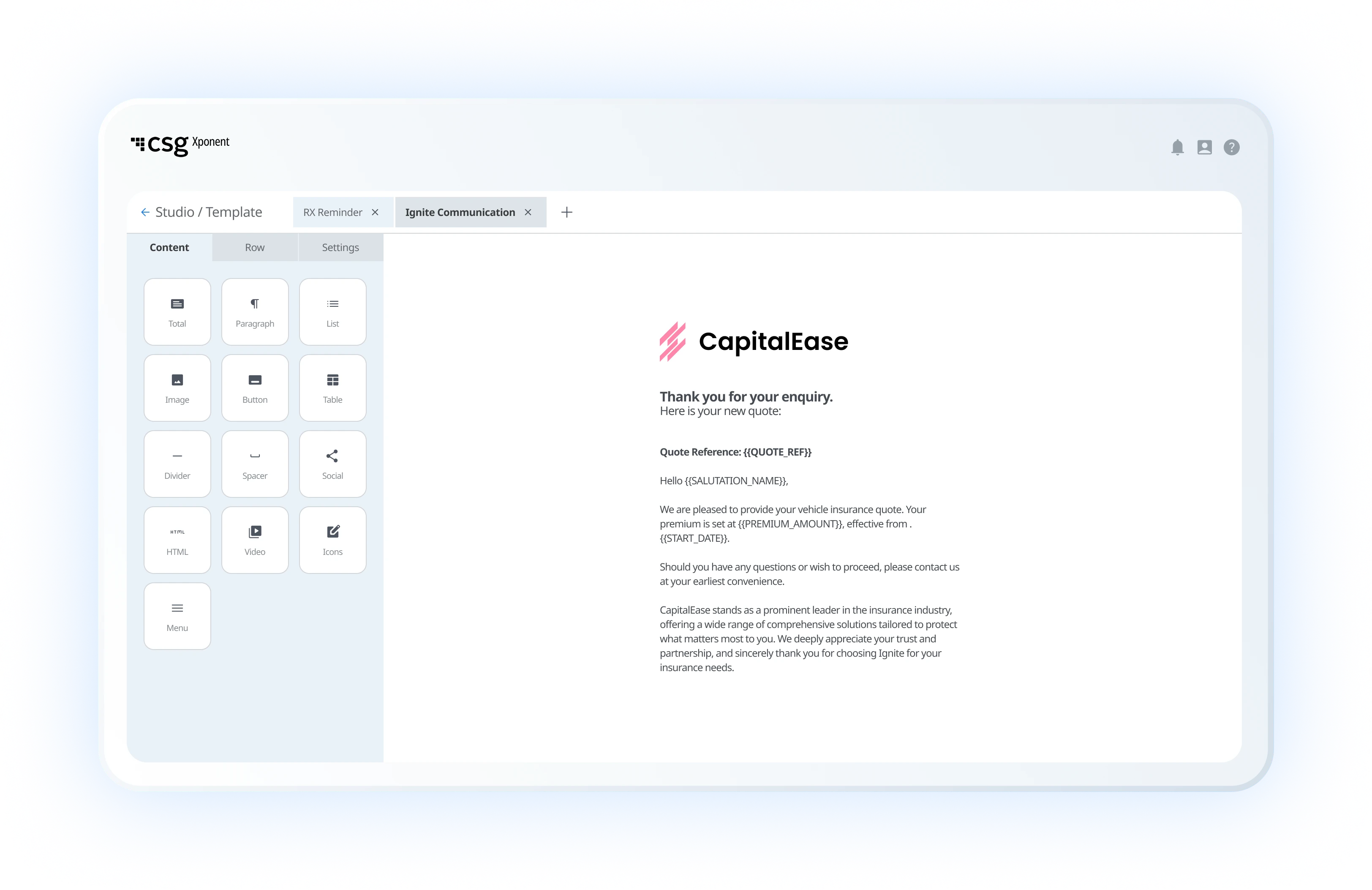
Xponent's governed templates and controlled publishing help insurers maintain consistency and oversight. Shared communication templates help insurers deliver the right information at the right time without relying on manual, one-off outreach from individual teams.
Cross-Channel Coordination
Can the platform...
Coordinate communications across email, SMS, print, push notifications, and contact center interactions?
Prevent duplicate or conflicting outreach?
Xponent helps coordinate communications across channels and journeys so policyholders receive more consistent experiences.
Measurement Connected to Operational Outcomes
Put simply: Can the platform connect Signal to Decision to Communication to Outcome?
Common insurance measures include...
Claim-status contacts per open claim
Quote, application, and document-submission completion rates
FNOL-to-payment cycle time
Underwriting requirement completion time
What to Ask for During a Demo
Make sure the CEP vendor can...
Show a claims, underwriting, or billing journey running end to end, from signal detection through decisioning, communication, and outcome measurement.
Demonstrate communication approval workflows and audit history.
Show how the platform handles situations where multiple journeys need to contact the same policyholder.
Explain how data moves between systems and where journey signals originate.
Define success metrics before the pilot begins and review results using journey-level reporting.
If a platform can demonstrate those capabilities within your environment, it's more likely to support customer journey management in day-to-day operations rather than adding another disconnected tool to the stack.

Related Resources

Fixing the Insurance Customer Journey at Renewal

Earning Renewal Through Clearer Insurance Communications

Insurance Company Boosts Outbound Call Accuracy to Reduce Churn