

Key takeaways
- Enterprise B2B proposals fail due to quote-to-cash complexity, not presentation quality
- A 5-step framework cuts proposal creation time from weeks to days while improving accuracy
- Automated requirements assessment and dynamic configuration eliminate technical feasibility errors
- Real-time pricing optimization maintains profitability while remaining competitive in enterprise deals
Most telecommunications companies believe their B2B proposal problems stem from poor presentation or inadequate sales materials. The real issue runs deeper: a quote-to-cash process involving many systems that can’t handle enterprise complexity.
When a large healthcare organization requests service across 200 locations with varying bandwidth requirements and strict HIPAA compliance needs, generic tools break down. Sales teams spend weeks gathering requirements, validating technical feasibility, calculating pricing, and assembling proposals—only to discover configuration errors that restart the entire process.
CSG’s framework transforms B2B proposal creation from a manual ordeal into a streamlined workflow that delivers professional, accurate proposals and accelerates deal closure.
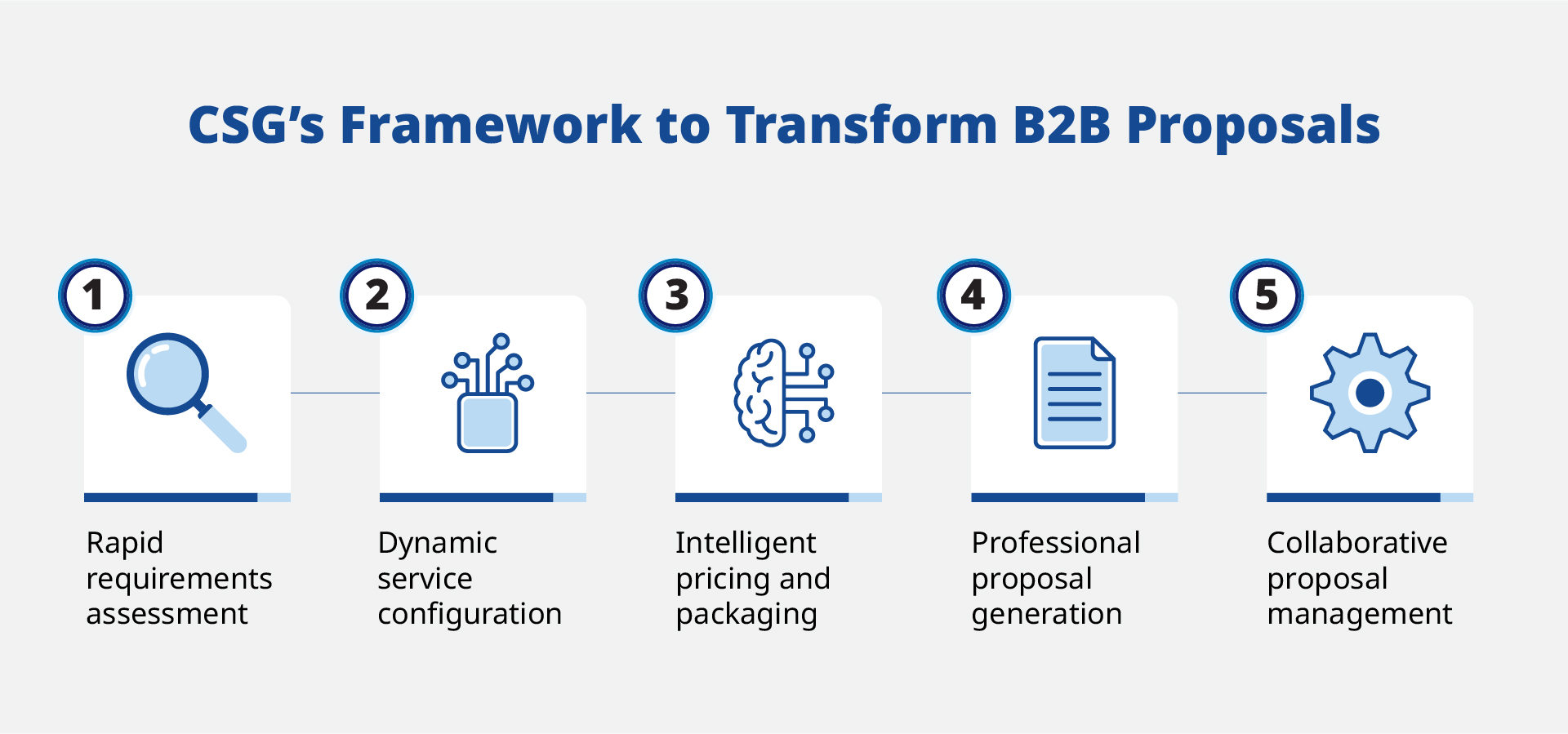
Step 1: Rapid requirements assessment
Traditional enterprise sales begin with spreadsheets, emails and multiple discovery calls that stretch across weeks. Automated discovery questionnaires capture complex enterprise needs—multi-site configurations, bandwidth specifications and SLA requirements—in structured formats that feed directly into configuration systems.
Intelligent recommendation engines analyze customer profiles and suggest optimal service configurations based on industry vertical, company size and usage patterns. A manufacturing company with 50 facilities receives different baseline recommendations than a financial services firm with similar locations.
Pre-built enterprise templates for common verticals further accelerate the process. Healthcare templates include HIPAA compliance requirements, finance templates incorporate data sovereignty considerations and manufacturing templates address industrial IoT connectivity needs.
Technical feasibility validation occurs in real-time during requirements gathering. Sales teams know immediately whether requested configurations are possible, eliminating the costly cycle of proposing impossible solutions and rebuilding quotes after technical review.
Step 2: Dynamic service configuration
Enterprise B2B proposals involve orchestrating services across dozens or hundreds of locations with varying requirements. Multi-site orchestration handles this complexity automatically, applying location-specific configurations while maintaining enterprise-wide consistency.
Service dependency mapping ensures technical relationships are captured correctly. When a customer orders SD-WAN services, the system automatically includes required network management, security services, and redundancy options rather than leaving sales teams to manually identify dependencies.
Bandwidth and capacity calculations flow automatically across the entire enterprise footprint. The system calculates aggregate bandwidth needs, identifies potential bottlenecks and recommends upgrades before they become deployment problems.
Industry-specific compliance checking validates proposals against regulatory requirements. Financial services proposals automatically verify data residency requirements, healthcare proposals confirm HIPAA compliance and government proposals check FedRAMP certification needs.
Step 3: Intelligent pricing and packaging
Volume-based pricing tiers calculate automatically as sales teams configure services. Adding the 51st location triggers tier-two pricing across all locations, not just the incremental site. Sales teams see real-time pricing impacts as they adjust configurations.
Multi-year contract modeling incorporates escalation clauses, renewal options and commitment-based discounts. Three-year contracts with annual 3% increases calculate automatically, showing customers total cost of ownership while maintaining carrier profitability.
Partner service integration brings third-party solutions into the overall package. Cloud connectivity, security services and managed applications from ecosystem partners appear as unified offerings with consolidated pricing rather than separate negotiations.
Real-time margin optimization ensures profitability while remaining competitive. The system flags configurations that fall below target margins and suggests alternative approaches that maintain competitiveness while protecting revenue.
Step 4: Professional proposal generation
Branded, executive-ready templates combine detailed technical specifications with business justification. C-level buyers receive strategic overviews emphasizing business outcomes, while IT leaders access comprehensive technical documentation—both generated from the same underlying configuration.
Interactive digital proposals allow customer exploration and configuration adjustments. Prospects can model alternative scenarios, adjust service levels, and see real-time pricing impacts without returning to sales teams for revised quotes.
Multi-format delivery accommodates diverse customer procurement processes. Some enterprises require PDF proposals for offline review, others prefer web portals integrated with their evaluation workflows, and sophisticated buyers want API integration with procurement systems.
Automated compliance documentation includes SLAs, security certifications and regulatory attestations. Rather than manually assembling compliance evidence, the system generates complete documentation packages that meet enterprise procurement requirements.
Step 5: Collaborative proposal management
Enterprise buying involves multiple stakeholders across weeks or months of evaluation. Real-time collaboration tools enable customer feedback and iterative refinements without the chaos of version control.
Version control and approval tracking maintain proposal integrity throughout extended negotiations. Sales teams track which stakeholders have reviewed specific versions, what changes were requested and when approvals were received.
Automated follow-up workflows keep deals moving through complex enterprise buying processes. When proposals sit idle for predetermined periods, the system triggers appropriate follow-up actions based on deal stage and customer engagement patterns.
The transition to contracting preserves all proposal details for order creation. No re-entering data, no transcription errors, no lost configuration details—everything flows directly from approved proposal to executed order.
Transform your B2B proposal process
Enterprise telecommunications sales rarely fail because of poor salesmanship. But they can fail because quote-to-cash systems can’t handle the technical and commercial complexity of modern B2B proposals.
CSG’s quote-to-cash optimization platform handles multi-site orchestration, complex pricing structures and enterprise compliance requirements that generic systems miss. Sales teams create accurate B2B proposals in days instead of weeks, technical feasibility is validated automatically and proposals transition to orders without manual intervention.
Is your CPQ helping or hindering your telco business? Download our buyer’s guide to evaluate whether your current system can handle the complexity of modern enterprise telecommunications sales.