
From Collection to Connection: Reimagining the Tolling Customer Journey

How printed invoices can become gateways to faster payment, trusted digital engagement, and permission-based communication
All-electronic tolling has removed the toll booth from more and more roads. Traffic moves faster, but something else disappeared from the booth: the moment when a driver sees the charge and pays it on the spot.
For drivers without a toll account, the first interaction with an agency may come days or weeks after travel through a mailed invoice from an unfamiliar sender. Because that invoice is often the agency's only direct customer touchpoint, it must make payment clear, convenient, and easy to complete. When customers are unsure how to pay or face unnecessary friction in the payment process, agencies can see additional notices, increased customer inquiries, collections activity, and lost revenue.
Many agencies view this as a channel decision. Some continue to rely on traditional print communications, while others focus on driving customers to digital and view the mailed invoice as a cost to be minimized. Both approaches miss the bigger opportunity. The goal is not to choose between print and digital, but to use each channel's strengths to make payment clear, convenient, and easy to complete. Print remains an effective way to reach customers that digital channels cannot, while digital offers the speed and convenience many customers prefer when it's time to pay.
The future of tolling isn’t print versus digital. It’s print and digital working together.
By connecting the printed invoice to a trusted, mobile-friendly payment experience, agencies can reduce friction, accelerate payment, and create the foundation for continued digital engagement.
The Problem with Traditional Toll Billing
Toll agencies are essentially strangers to non-account holders. Unlike utilities, telecommunications providers, or subscription services, they often lack an ongoing relationship with the customer. The first interaction may occur only after a toll transaction has already taken place.
This creates several obstacles to collecting payment:
Long delays between travel and billing
Customers may not remember the trip that generated the invoice
Limited trust in unfamiliar digital payment experiences
Inconvenient payment methods
High print and postage volumes
Increased reliance on collections processes
Higher rates of uncollected tolls and revenue leakage
For customers, these challenges create friction and uncertainty. For toll agencies, they increase costs, operational complexity, collection activity, and the risk of unpaid tolls. Both sides need a better way.
Turning Print into a Digital Gateway
Print helps agencies physically reach more non-account holders. Digital tools add the speed and convenience customers expect from modern brands. By bringing both pieces together, toll agencies can maximize collections with every communication.
That’s the idea behind the Digital Billing Journey: an approach that turns the printed toll invoice into an entry point for digital payment and ongoing engagement. It works in three stages. The invoice gives customers a fast path to pay digitally, the payment experience keeps paying simple, and the payment moment becomes a chance to earn permission for future digital communication. QR codes and text-to-pay options create an immediate path from the printed invoice to a mobile-friendly payment experience while preserving the broad reach of mail.
Rather than asking customers to search for a website, create an account, or manually enter extensive information, the invoice guides them to a simplified digital experience at the moment they are most likely to act.
The result is a more connected and intuitive journey without requiring agencies to abandon a printed channel that remains important for reaching many customers.
How the Digital Billing Journey Works
The journey begins when a customer receives a printed toll invoice with a QR code, a text-to-pay option, or both. These features connect the familiar printed invoice to a convenient digital experience.
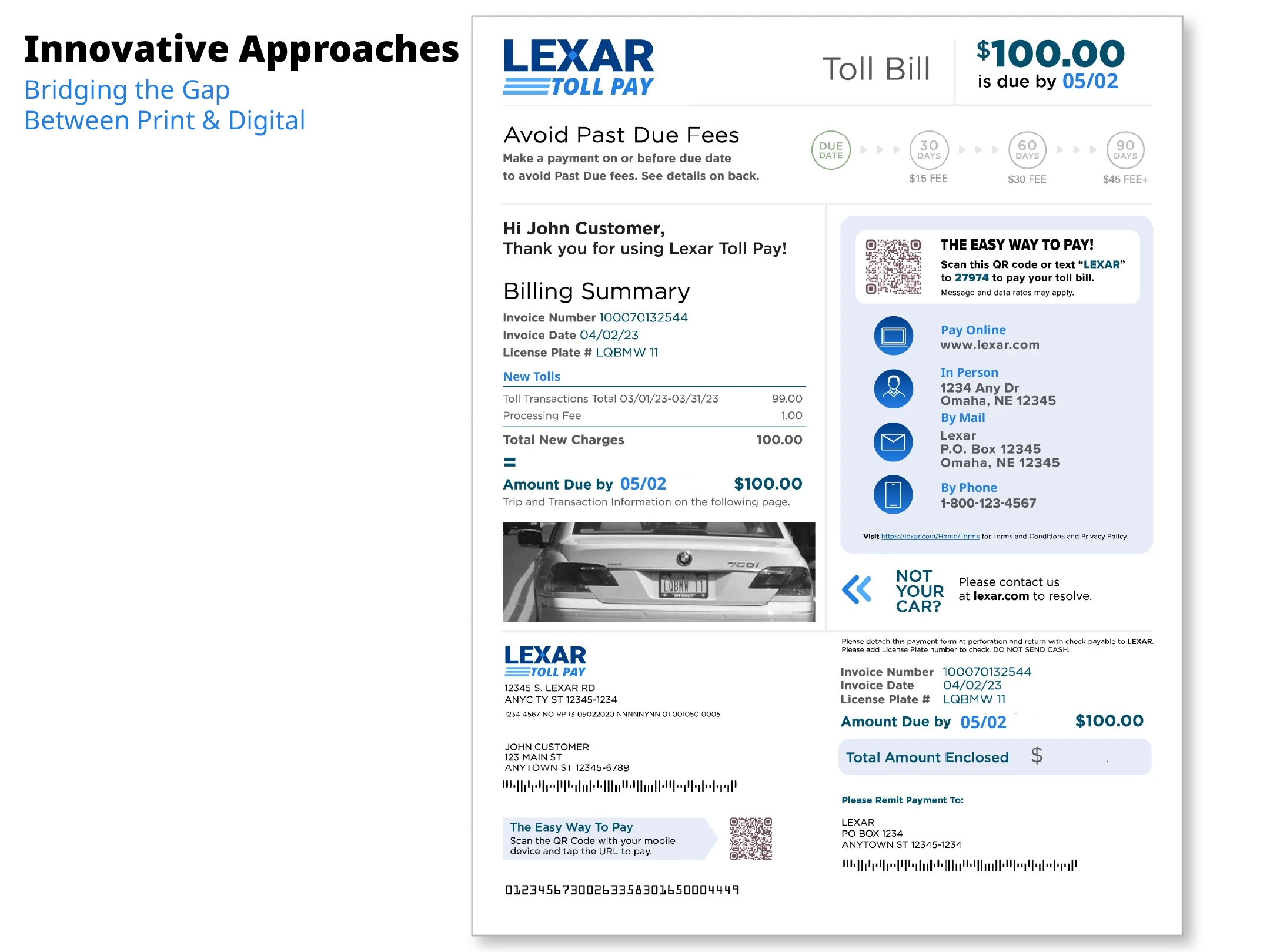
When customers scan the QR code or use the text-to-pay option, they are directed to the agency’s existing online payment experience or a dedicated mobile-friendly payment site. Using information associated with the invoice, the experience can pre-populate applicable fields and reduce manual entry.
Whether the journey connects to an existing customer portal or a purpose-built payment experience, the transition from print to digital should feel consistent. Aligned branding, colors, terminology, and design elements can help customers recognize that they have reached an official agency payment site.
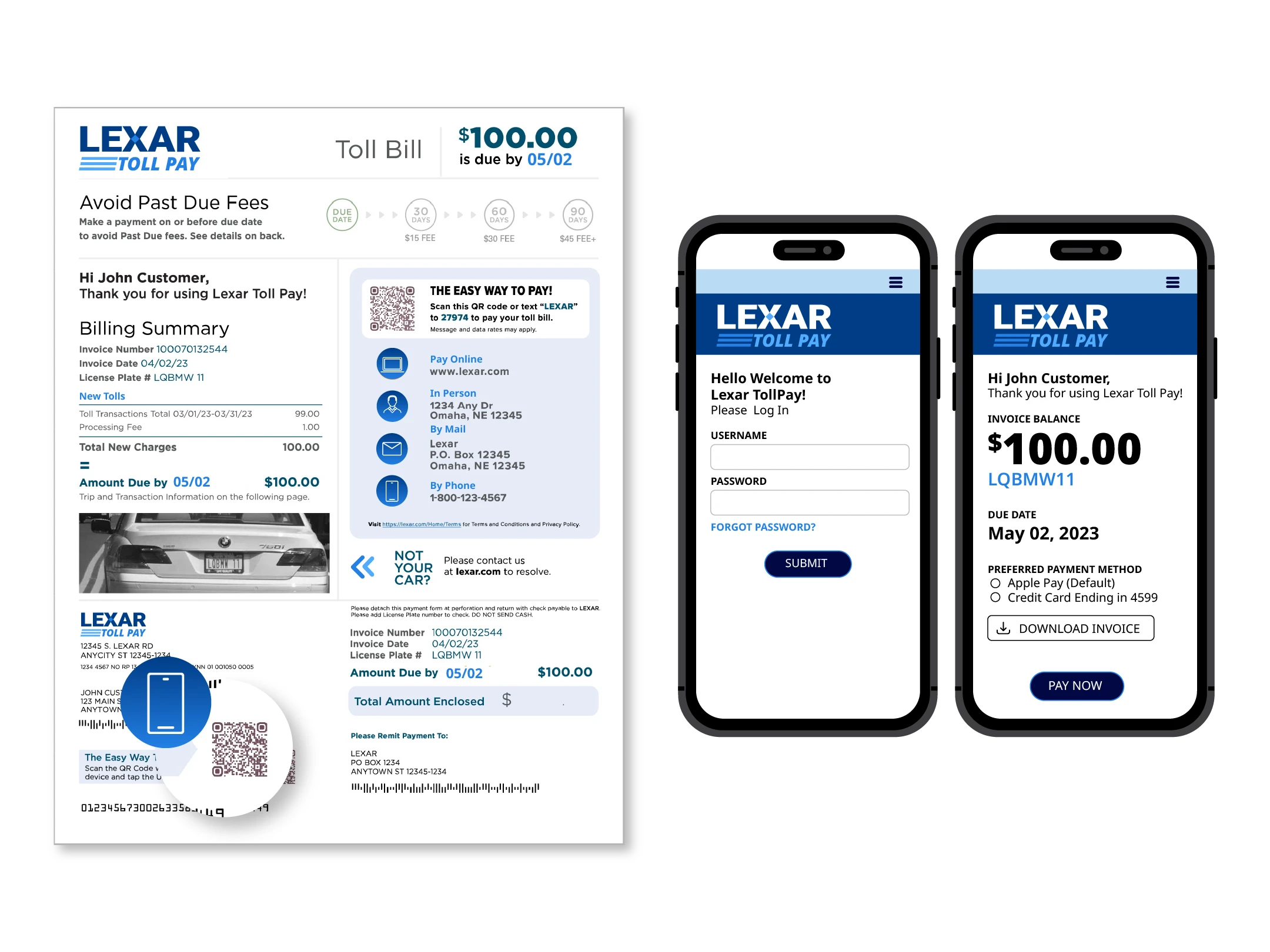
Customers can then pay using supported methods such as credit cards, debit cards, or digital wallets. A dedicated payment experience can complement existing systems and support additional payment options. Mobile optimization helps customers complete the transaction conveniently from a smartphone.
Building a Permission-Based Relationship
One of the most powerful legs of the Digital Billing Journey is the one that follows the initial payment.
Historically, toll agencies have had limited opportunities to build an ongoing relationship with non-account holders. Once a payment is made, communication may stop until another toll transaction generates a new invoice.
The Digital Billing Journey creates an opportunity for customers to opt in to future digital communications. Appropriate consent is important because certain automated communications, including some SMS and RCS messages, are subject to legal and regulatory requirements.
During the payment process, customers may choose to save payment information and consent to receive future toll notifications through eligible digital channels. Capturing and managing that permission as part of the journey can help close the consent gap that often limits digital engagement with non-account holders.
Agencies should align consent language, recordkeeping, preference management, and messaging practices with applicable legal, regulatory, and compliance requirements.
This step can turn a one-time payment into the beginning of a permission-based digital relationship. Rather than waiting for the next printed invoice, agencies can provide consenting customers with relevant reminders, payment options, and account information.
From Notifications to True Engagement
Moving from one-time billing notices to an ongoing, opt-in relationship aligns with a broader shift taking place across many industries.
Customer communications are evolving from static notifications to ongoing engagement models built around personalization, digital convenience, and two-way interaction. Industries such as telecommunications have adopted digital-first, permission-based strategies that work within regulatory frameworks while meeting customer expectations. Tolling can follow a similar path by treating consent as the foundation for trusted engagement rather than as a barrier to digital communication.
Once a customer has opted in, future toll transactions may trigger proactive digital outreach. Depending on the agency’s capabilities and communication strategy, SMS or RCS messages could provide payment notifications and reminders. When customers respond digitally, agencies may be able to avoid unnecessary printed invoices. When no digital action occurs, print can remain available as a fallback channel.
This approach can create a more responsive customer experience while helping agencies reduce unnecessary print and postage costs.
Addressing Trust in a Digital World
Trust is critical to any digital payment experience.
Toll-related phishing and SMS scams can make customers cautious about clicking links or responding to payment messages. The industry’s challenge is not simply to expand SMS and RCS communication, but to make legitimate outreach recognizable, consistent, and secure.
Verified messaging technologies, including RCS, may help agencies reinforce brand authenticity and distinguish legitimate communications from fraudulent messages. A trusted Digital Billing Journey should also include:
Consistent agency names, logos, colors, and terminology
Secure and recognizable payment destinations
Clear explanations of why the customer received the communication
Transparent consent and preference controls
Consistent information across invoices, messages, and payment pages
Accessible customer-support and fraud-reporting options
Consistency across the printed invoice, digital communication, and payment experience can reinforce customer confidence and help reduce the risk of abandonment.
Delivering Value for Agencies and Customers
The Digital Billing Journey creates value for both agencies and customers.
For agencies, most of that value comes from shortening the distance between the invoice and the payment. When customers can scan a code or use text-to-pay from their phone, fewer invoices age into second notices, collections, or write-offs. And every customer who pays digitally and opts in to future messages is one less printed invoice to produce and mail next time.
For customers, the value is simpler: a bill they recognize, a payment that takes a few taps, and fewer chances to rack up late fees for a trip they’ve already forgotten.
Potential agency benefits include:
More digital-payment and conversion opportunities
Lower print and postage volume
Faster collection cycles
Reduced reliance on collections
Scalable digital engagement without requiring account enrollment
Potential customer benefits include:
Faster and easier payment
Mobile-friendly payment choices
A more consistent and recognizable experience
Greater convenience
Reduced risk of late fees and collections activity
The results can be significant. In one tolling implementation, this approach reduced time to pay by 18% and generated $15 million in revenue within the first nine months.
To measure that impact, agencies can track:
Digital-payment adoption
Payment-completion rates
Time to payment
Printed-invoice volume
Print and postage costs
Consent-capture rates
Customer-service contracts
Establishing a baseline before launch allows an agency to measure results and refine the journey over time.
By helping customers engage, pay, and stay connected, agencies can reduce operational friction and build a stronger foundation for digital adoption.
The Future of Tolling Communications
Tomorrow’s tolling leaders aren’t going to leave print in the past. Just the opposite: they’ll be investing in it by modernizing communications for a better customer experience.
By connecting the printed invoice to a trusted digital payment experience, agencies can give customers a faster path to action while preserving a channel that remains essential for reaching non-account holders. With appropriate consent, that initial interaction can also become the foundation for future digital communication.
Agencies do not need to transform every part of the journey at once. They can begin with clear digital entry points, measure customer response and operational performance, and expand permission-based engagement as adoption and internal readiness grow.
The toll invoice of the future is more than a request for payment. It is the first step in a connected customer journey. By combining the broad reach of print with the convenience of digital payments and permission-based engagement, agencies can reduce friction, improve collection outcomes, and build more trusted customer relationships
About the Author
Christine Korenek is a Senior Sales Executive at CSG, helping toll agencies modernize customer communications through integrated print, digital, and payment solutions.