
5G Network Deployment: Monetization, Policy, and Migration

A standalone 5G network deployment has three major layers: the radio access network (RAN) that connects users and devices, the 5G core that manages connections and enforces the policies that govern them, and the business support systems (BSS) that decide the business side of the network—what’s for sale, what it costs, who bought it, and what they’re allowed to use.
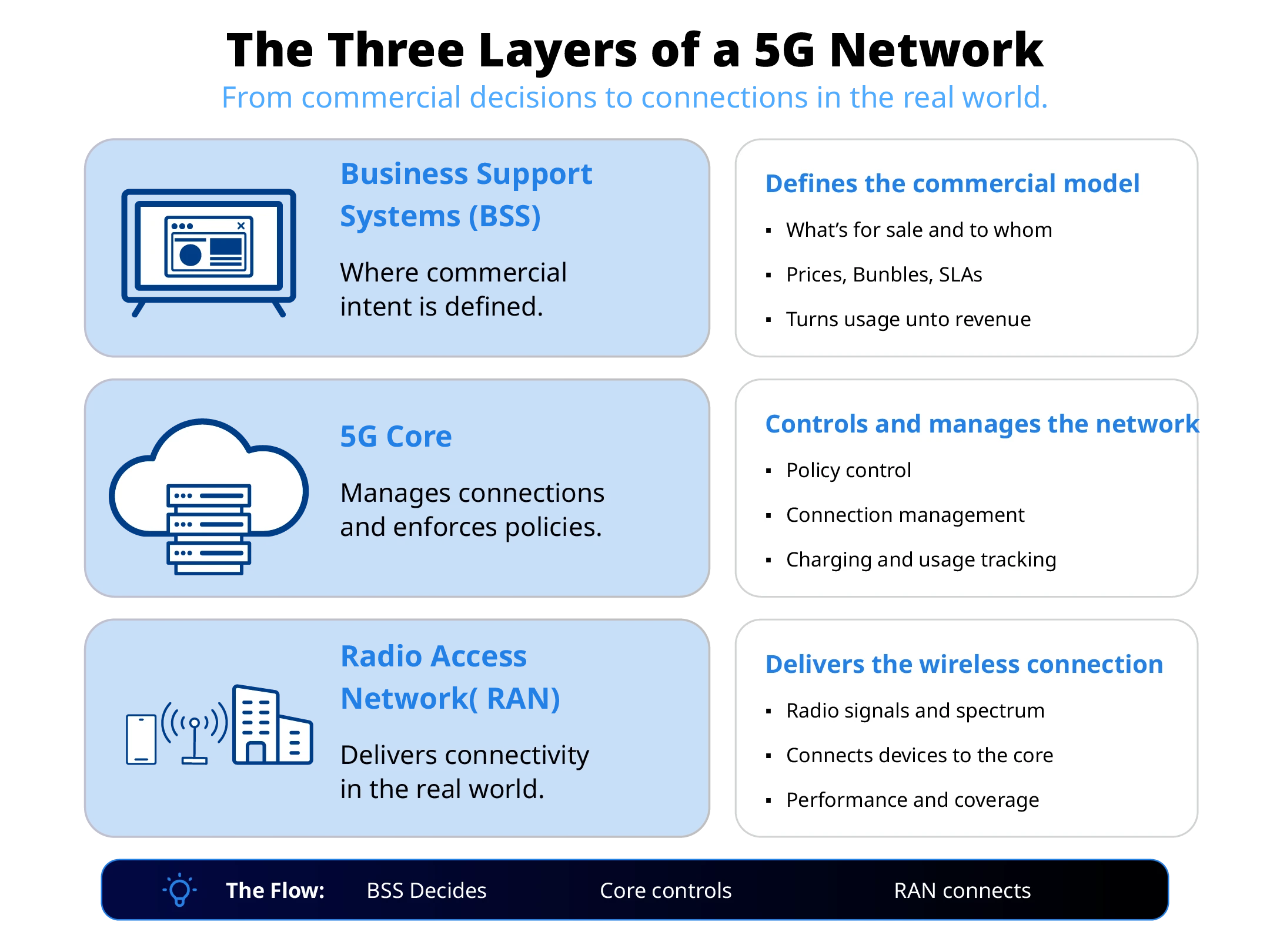
Out on the network, the charging functions carry those decisions out by metering usage, pricing it, and billing for what customers consume. All three layers—RAN, 5G core, and BSS—must be in place to monetize services with the precision that advanced 5G offerings require. How well an operator monetizes them depends largely on which core it builds on: a legacy 4G core (non-standalone, or NSA) or a new standalone core (SA) designed for 5G.
Most operators run 5G on the 4G core to start (NSA), which already earns—premium data plans, fixed wireless access, speed tiers—but the enterprise services that justify standalone 5G (slices, service-level agreements (SLAs,) per-service pricing) need the SA core. Migrating is possible, but no operator switches over all at once; they run 4G and 5G side by side, moving subscribers and services to the standalone core in phases.
What does 5G network deployment require beyond radio buildout?
Say “network deployment” and most people picture the radio access network: the radios, antennas, small cells, and RAN functions that connect users and devices. But a network that runs isn’t a business, any more than a car that runs is a taxi service. It needs a fare system.
Beyond the radios, any network needs that fare system: charging, policy, mediation, and the BSS. These systems decide what's for sale, meter what gets used, and turn it into a bill. What changes with 5G is what that layer can do—starting with the core it runs on.
Does it matter whether you run NSA or SA?
It does—because which services an operator can charge for depends on the core. An operator can run 5G radios on a legacy 4G core (NSA) or build a new standalone core (SA) designed for 5G. Both perform the same jobs—charging a session, applying a policy, managing a connection—but they’re built differently:
A 4G core (NSA) connects those pieces to each other over fixed, purpose-built telecom interfaces.
A 5G core (SA) works the way modern cloud software works: each piece is an independent service, talking to others over standard web interfaces.
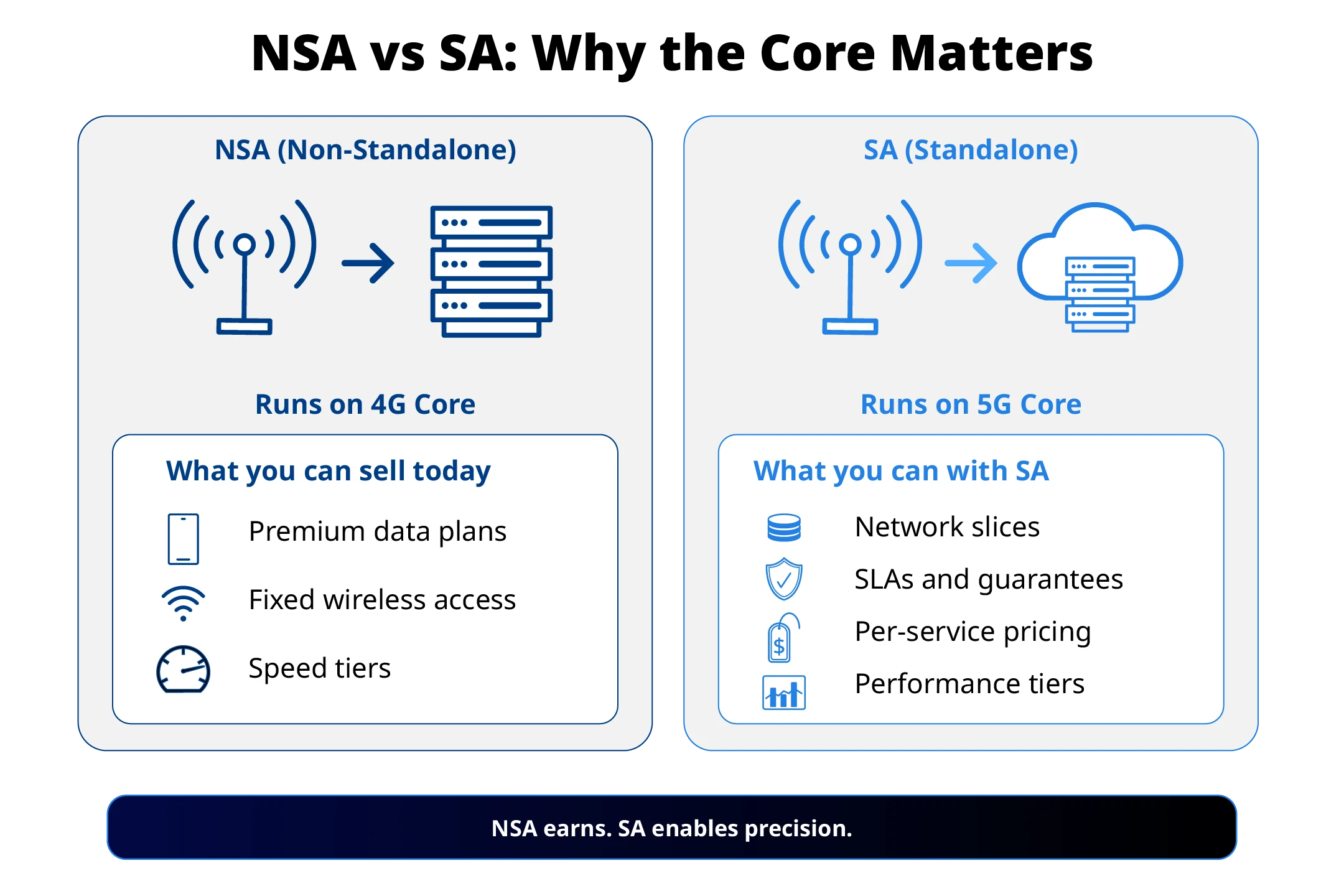
That architecture changes the economics. Because services are independent, operators can meter and price them separately—charging for a specific service instead of a bucket of data, or selling performance with a guarantee attached.
That doesn’t mean an operator on NSA earns nothing: they can sell premium data plans, fixed wireless access, and speed tiers. What NSA can’t do is sell with precision, such as a price attached to one service, a slice backed by a service-level agreement (SLA), or a quality tier that an enterprise will pay a premium for.
BY THE NUMBERS: As of early 2026, global 5G subscriptions had passed 3 billion—about one-third of all mobile subscriptions—per the June 2026 edition of the Ericsson Mobility Report, which projects it will be two-thirds by 2031. But most operators can’t yet fully monetize that growth. Some 390 providers have launched 5G, but fewer than a quarter—about 90—have launched standalone 5G. The rest continue to rely on a 4G core: they have 5G speeds, but not the architecture that supports slicing, per-service charging, or SLA-backed performance.
What makes 5G charging different from 4G?
The big change in 5G is convergence: where 4G ran prepaid and postpaid on two separate systems, standalone 5G handles both in one.
The convergence: One system, different products
The two systems were built around different assumptions:
The prepaid system (pay-as-you-go) checked balances in real time, counted them down as the customer used the network, and stopped the service when the balance reached zero.
The postpaid system (billed after use) was built to record usage and get billed at month-end. Operators added real-time controls, such as spending limits, roaming controls, and credit control (cutting off usage before a customer runs past their limit).
Standalone 5G brings the two under one converged charging architecture, where prepaid and postpaid can run as different products on the same system. That lets an operator apply the same real-time control across both—live spending caps for an enterprise, alerts tied to department budgets, or usage quotas for a fleet of connected devices.
UNDER THE HOOD: 3GPP—the global body that sets mobile standards—gave these systems their formal names. Prepaid charging ran in real time through the online charging system (OCS); postpaid billed from records through the offline charging system (OFCS). Standalone 5G introduces the Converged Charging System (CCS), where the Charging Function (CHF) handles both. Most operators will run the CHF alongside their existing OCS and OFCS rather than replacing them.
The interface: How the network talks to charging
In 4G, the network reported usage to the charging system over Diameter, a protocol built for carrier signaling. It could carry a lot: volume, duration, events, service identifiers, roaming, and quality of service. In standalone 5G, the network uses ordinary web technology instead—the same HTTP that runs the internet, built on standards the whole software industry already uses.
UNDER THE HOOD: The 5G charging interface is called Nchf—the CHF's service-based interface, running over HTTP/2 and JSON.
The result: Pricing the connection, not the volume
Standalone 5G can price a connection for what it is—the device on it, the quality it needs, and whether it belongs to a slice—not just how much data it uses.
Use case: One operator, many ways to charge
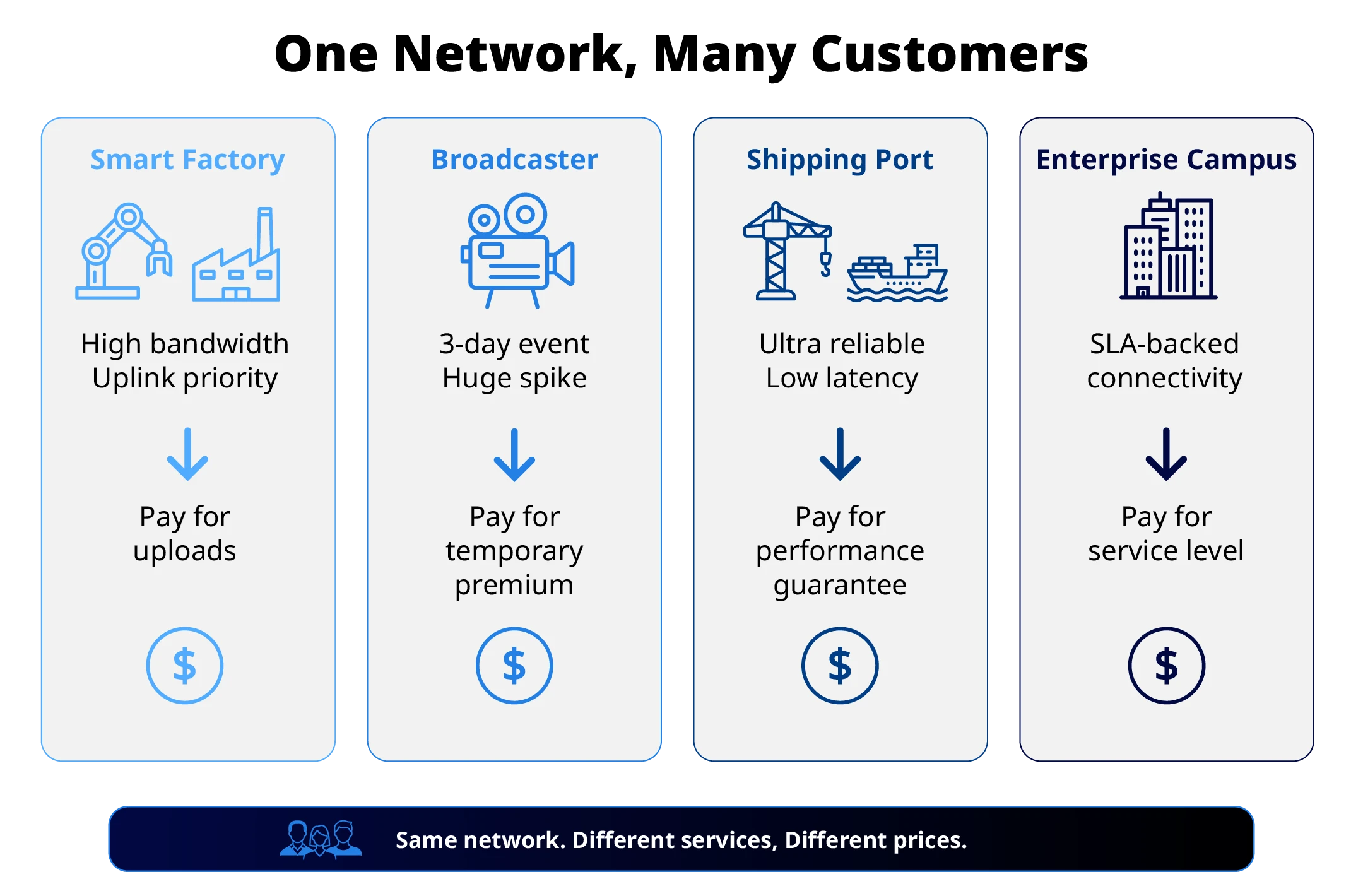
With standalone 5G, an operator can sell the same network to different enterprises on terms that fit what each is doing:
A factory streaming the inspection video from the production line needs to push a lot of data out, reliably, and pays for the uplink (data flowing from the site) and priority rather than for a share of a data bucket.
A live broadcaster covering a three-day event buys guaranteed performance for the days it’s on the air, and stops paying for it when the event ends.
A shipping port running automated cranes needs the network to respond in milliseconds, every time. If the signal is lost, even for a moment, the crane may stop for safety reasons and back up everything that follows.
An enterprise buying a slice with an SLA isn’t paying for bandwidth. It’s paying for the guarantee—a performance floor in writing, with consequences if the operator misses it.
One network, four customers, four ways to charge—because the price follows what each connection is for.
UNDER THE HOOD: 4G charging already looked at more than data volume: event, service identifier, and access type among them. Standalone 5G adds finer dimensions, including the network slice a connection runs on and the specific service it’s using. The Charging Function (CHF) generates the charging data records (CDRs) that billing runs on.
How do you bridge 4G and 5G during migration?
No operator can go from 4G to 5G overnight. Instead, they run the two side by side: old and new systems operate at the same time, a translator passes signaling between them, and the switchover happens in phases.
The parallel: A translator keeps 4G running while 5G comes online
“Big bang” migration—switching everything over at once—is something most operators avoid because the 4G systems still carrying live revenue can’t be taken offline to make the change. So 4G and 5G run in parallel: 4G keeps doing its job while 5G comes online next to it, and a connector lets them work together.
That connector is the interworking function (IWF)—the translator between Diameter (the language 4G speaks) and the web-based signaling 5G uses. With the IWF, a 5G session—a phone call, video stream, or a connected device’s data upload—can be charged by the 4G charging systems an operator already runs. Those systems bill the new 5G sessions and keep serving 4G customers at the same time, so an operator adds 5G without new charging infrastructure.
The mapping: Charging and policy connections have 4G equivalents
Running side by side is only half of it—eventually each function has to move from 4G to 5G. That's possible because 4G and 5G carry the same kind of information, just in different languages. The connections aren’t exact one-to-one matches, but they do broadly the same jobs, so an operator can move them over one function at a time—charging first, then policy, then the rest—with the IWF translating between them.
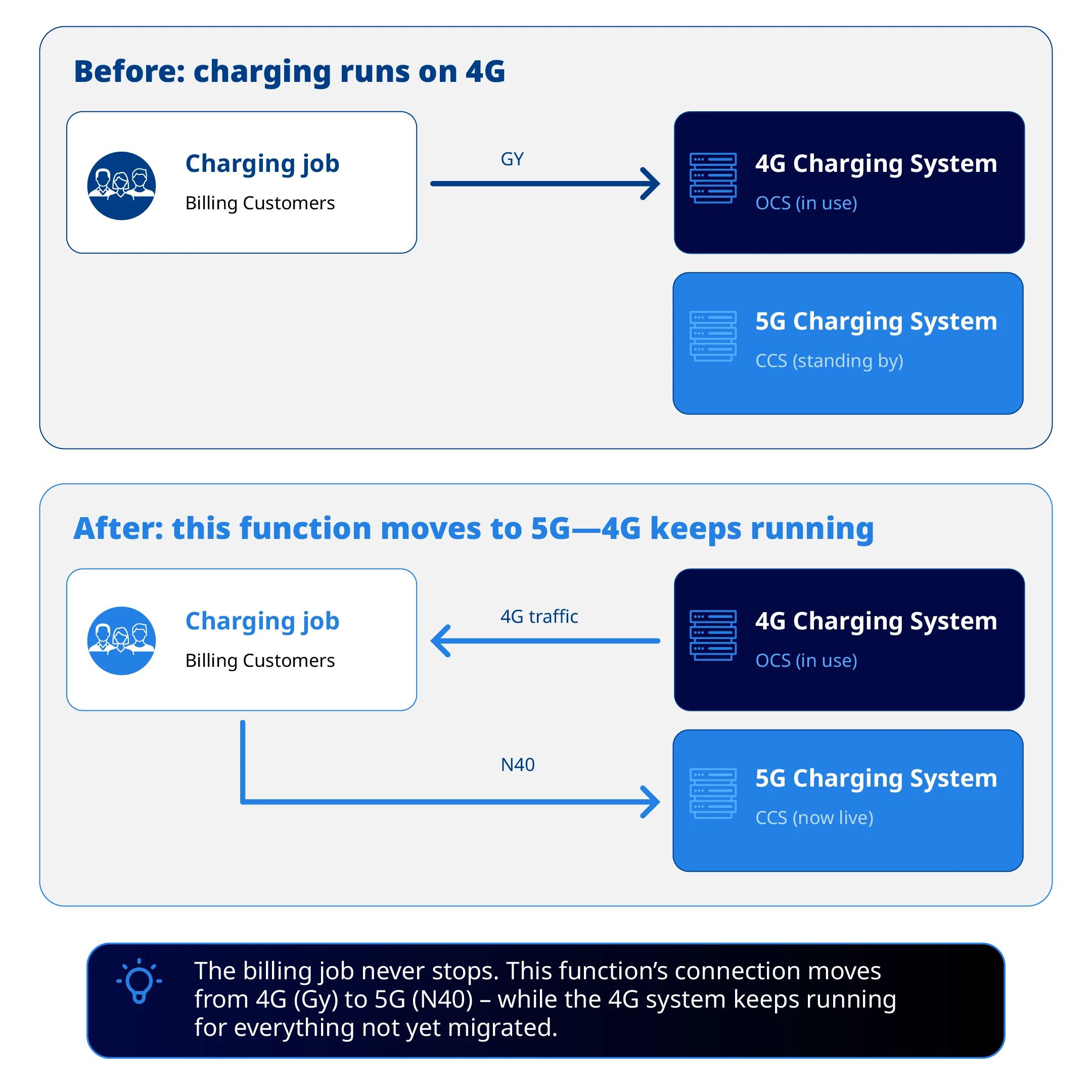
UNDER THE HOOD: Each of these connections has an official name set by 3GPP, the standards body. The 5G names start with "N"; their 4G equivalents use older letter-based names.
5G connections and their 4G counterparts | ||
|---|---|---|
5G connections | 4G counterparts | |
Charging usage | N40 | Gy |
Policy rules | N7 | Gx |
Spending limits | N28 | Sy |
Subscriber data | N36 | Sp |
App-triggered sessions | N5 | Rx |
The sequence: Monetization migrates in phases
Monetization comes online in stages, each one adding more services the operator can sell.
Phase 1: 5G runs on 4G billing. The operator sets up the 5G charging function and an interworking function, so 5G runs but is billed by the 4G charging and policy systems it already trusts. 5G speeds are live and for sale, but billed the way 4G always billed—the new pricing models come later.
Phase 2: Real-time charging goes live. The operator brings its Converged Charging System (CCS) online—the single 5G system that prices usage and tracks balances across both prepaid and postpaid. Now it can charge across services in one place, such as enterprise spending caps, IoT quotas, and usage-based plans. It typically rolls these out to part of the subscriber base first, so the new system proves itself under real traffic before everyone depends on it.
Phase 3: The full model goes live. All subscribers move to standalone 5G charging and policy—the CCS plus a policy control function (PCF)—and the 4G systems can begin to retire. Now the operator can sell the full range with 5G-native granularity: quality tiers, SLA-backed slices, and per-event pricing. The migration is done, and the network finally earns from all that a standalone 5G network can sell.
Why does policy control matter for standalone 5G?
Policy control decides what each connection—a user or device—is allowed to do, moment to moment. It’s what lets an operator charge for better service. In standalone 5G, that authority belongs to the Policy Control Function, or PCF.
The control: The PCF is what sets premium tiers apart
The PCF decides the rules for a connection: its quality (priority and speed), its service type, whether it counts against a data cap, and which network slice it runs on. Other network functions enforce those decisions, and the charging system prices and bills them.
Together, that’s what lets an operator offer different levels of service—priority lanes, performance guarantees, plans matched to what each connection needs—and charge for the difference. Without the PCF drawing those distinctions, a hospital monitor, a video stream, and a fleet of sensors all look the same to the network—and there’s nothing for the charging system to price differently.
UNDER THE HOOD: 5G is designed around three broad service categories. The PCF applies different rules to each:
Enhanced mobile broadband (eMBB) – speed: High-bandwidth data for homes and phones; streaming, video calls, web browsing—largely live on NSA today.
Massive machine-type communication (mMTC) – scale: Small amounts of data from huge numbers of low-power devices; sensors, smart meters.
Ultra-reliable low-latency communication (uRLLC) – reliability: Connections that can’t fail or lag; remote surgery, connected vehicles. This is where standalone 5G's guarantees matter most.
The continuity: Policy migrates the same way charging does
The 4G version was the Policy and Charging Rules Function (PCRF); the 5G version is the PCF, and the two run together until the PCRF can retire. Why this matters: a customer moves between 4G and 5G constantly, so policy has to enforce their plan on both—or a premium tier stops working the moment they leave 5G.
UNDER THE HOOD: The 4G PCRF and 5G PCF are often combined into a single dual-mode PCF/PCRF engine, so one system enforces a customer’s policy whether they’re on 4G or 5G—and it adjusts in real time. If the network congests, connections that paid for priority keep it.
What is network slicing, and why does it matter for monetization?
A 5G network slice is a logical network—a self-contained virtual network running on shared 5G infrastructure, configured to deliver a specific level of speed, latency, and reliability for a particular user or customer.
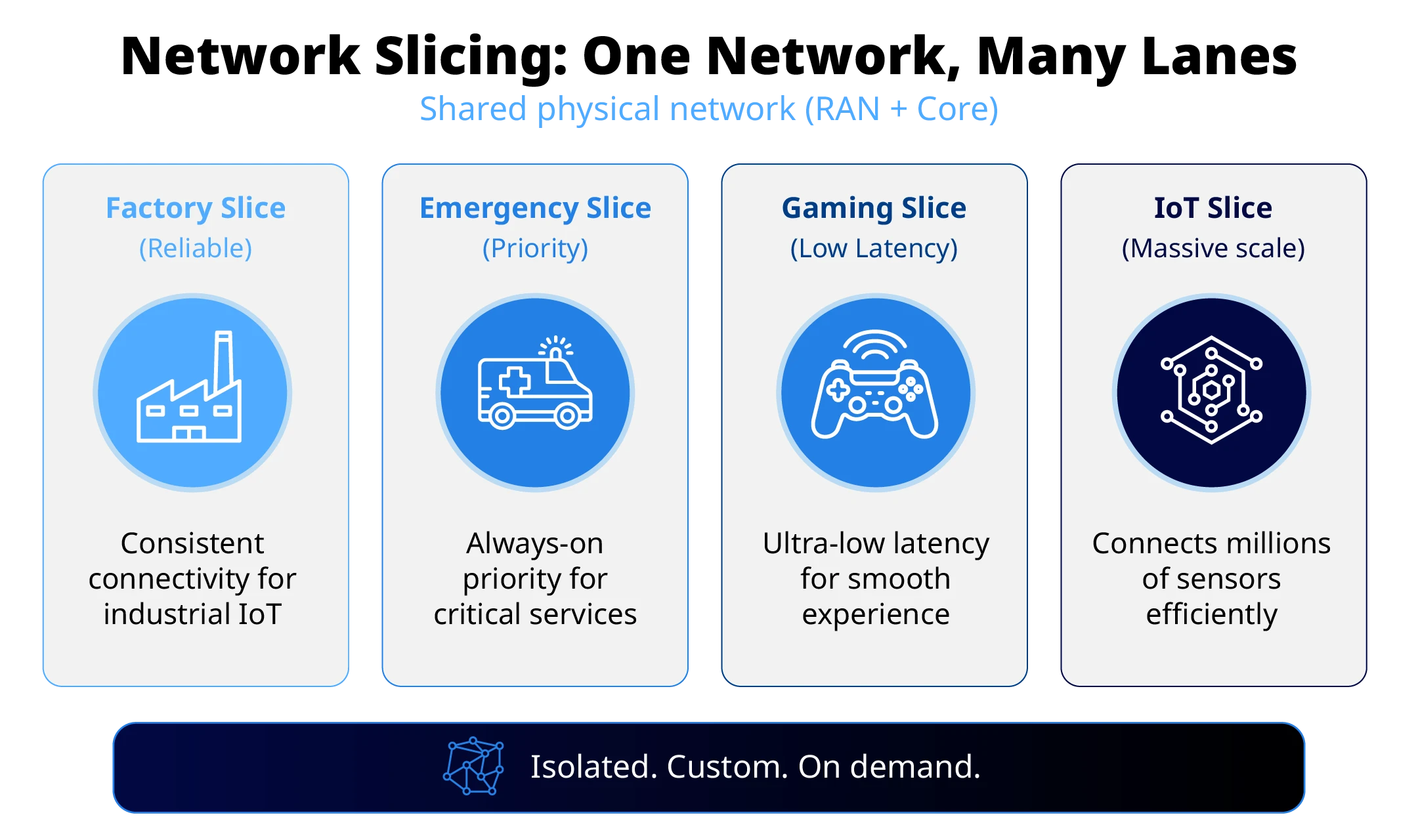
Standalone 5G can divide one physical network into many logical ones, each tuned and priced differently. It takes more than the core to do it—the RAN, transport, and orchestration all play a part, but it’s the standalone architecture that makes it possible.
The problem: A slice only earns if you can charge for it
If an operator builds a slice but can't bill for it, it’s spending money on something that earns nothing back. The money comes from selling it with a promise attached: an SLA, a written guarantee of the speed, latency, or uptime that the customer pays a premium for. Delivering that guarantee takes charging and policy working together—policy enforces the performance the SLA promises, and charging meters it, prices it, and bills for it.
BY THE NUMBERS: Slicing is moving from customer trials to real products. Commercial 5G standalone slicing offerings rose from 65 to 84 in six months, per the June 2026 Ericsson Mobility Report. The furthest along is fixed wireless access (FWA): Opensignal reports that operators including Odido, Elisa, and Cosmote are using standalone 5G capacity and slicing to sell tiered home broadband—an early example of charging for differentiated performance rather than flat access.
The model: Charging in a slice, across slices, and through resellers
Once a slice is metered, an operator can charge for it in several different ways:
Within a slice: The operator can meter it per device, per use, or per event. For example, a utility company’s smart meters can be billed per device for their everyday reporting, while a one-off firmware update pushed to all of them is billed once as a one-time charge—both on the same slice.
Across slices: One enterprise might run several slices at once, each on a different plan but on the same bill. A logistics company could put its offices on one slice, its warehouses on another, and its truck fleet on a third—each with the performance that part of the business requires.
Through a reseller (B2B2X): Business-to-business-to-anyone is when an operator sells a slice to a business, which builds its own service on top and resells it to its customers. For example, a cloud-gaming company buys a low-latency slice and resells guaranteed performance to players at a premium—the operator bills the gaming company, and the gaming company bills the players.
The market: Who buys slices?
Typical slice buyers are customers who can’t run on a “best-effort” connection—the kind with no performance promise. Hospitals, factories, emergency services: these are operations where the connection has to work every time.
Hospitals: A hospital that runs remote patient monitoring or connected operating-room equipment needs guaranteed reliability because lives depend on it.
Smart factories: Robotics and automated lines need guaranteed low latency, because a temporary pause can stop the line.
Emergency services: First responders need guaranteed priority, staying connected even when a cell is jammed with everyone else's traffic during a crisis.
These buyers are buying certainty, and a slice with an SLA is what sells it.
UNDER THE HOOD: Slicing also serves V2X (vehicle-to-everything—connected cars, traffic systems, road safety) and enterprise IoT (large connected-device fleets), across public and private 5G. One network can run many slices at once, each with its own SLA and its own price.
How do operators scale for 5G and IoT transaction volumes?
Every 5G service an operator sells generates charging events—a record each time something billable happens. A network of phones produces a manageable stream of them. But add millions of sensors, meters, and trackers all reporting at once, and the volume of charging events can outpace the core charging systems, which get slow and expensive to scale as the load increases.
The problem: Too many events to process
The issue isn't the size of each event—it's the number of them. IoT devices are individually tiny (a sensor sends just a few bytes) but collectively huge (millions of them, generating events nonstop).
And many of those events don't need rating or billing: a flat-rate device is charged the same no matter what it does, and some usage is zero-rated—free to the customer because the operator chose not to charge for it, like a bundled app that doesn’t count against a data plan. They may still be recorded for reporting, audit, or fraud checks, but they don’t need the full charging treatment.
Sending the full stream to the core means paying to scale systems for events that mostly don’t need full charging.
The fix: Mediation sends only billable events
A high-throughput layer called mediation sits in front of the core charging systems and sorts the flow of events. It sends the events that need rating and billing to the core, and routes the rest to reporting, audit, or analytics—so the core sees a filtered stream instead of a flood of events.
The proof: High volumes already run on live networks
Live 5G networks already process billions of charging events a day:
A single mediation site can process16.5 billion charging records per day.
Real-time charging runs at 100,000 transactions per second with low latency.
UNDER THE HOOD: Mediation sits between the network and the core charging functions—the rating function (RF), account balance management function (ABMF), and OCS. It normalizes, aggregates, and routes events, so only the records that need rating and billing reach the core, while others move on to reporting, settlement, or analytics.
How does a 5G deployment keep every service running?
Continuity is the part of a deployment a customer only notices when it’s not there. Most of the attention in a 5G deployment goes to new things: new core, new charging, and new services. But a deployment also has to keep existing services running—calls connecting, texts arriving, a subscriber's service active the moment they sign up—across old networks and new.
The challenge: The customer expects one service, not three
An operator runs 5G alongside earlier generations—4G almost always, and 3G or 2G in some markets—and the customer never knows the difference:
A call starts on 5G and hands to 4G as the subscriber drives out of 5G coverage.
A text has to go through whether the phone is on 5G or an older network.
A new device has to activate the moment it's switched on, joining whatever network it finds.
The deployment has to make one seamless service across whatever generations are live—and the systems holding that together (messaging, voice, provisioning) have to speak all of them.
The handoff: A call can't drop when it moves between networks
Voice is the clearest example: A subscriber on a call walks out of a building, and their phone shifts from 5G to 4G—the call should keep going without them noticing. A 5G call uses one technology, a 4G call another, a Wi-Fi call a third, and the subscriber moves between them mid-conversation. If the systems handling voice can't pass a live call cleanly from one to the next, the call drops—and the customer blames the operator.
Messaging is the same: A text has to arrive whether the person receiving it is on 5G, 4G, or an older network in a weak-signal spot. Customers just expect it to work, but making that happen takes systems that bridge every generation, so a message gets through no matter where each person is.
The activation: Service has to turn on the moment it’s sold
Continuity also means a new subscriber or device works the instant it's activated. On older networks, activations arrived in a steady, moderate stream. IoT changes that: an enterprise can bring a whole fleet of devices online at once—thousands activating in a burst. If the provisioning systems that turn service on can’t handle the burst, the customer is paying for devices that don’t work yet—and for a business rolling out a fleet, that holds up the deployment.
UNDER THE HOOD: Continuity takes more than charging and policy:
Messaging: SMSC for texts, USSD gateways for short-code services (the #123# menus).
Voice: IMS-based services—VoLTE (voice over 4G), VoWiFi (voice over WiFi), and VoNR (voice over 5G)—which keep a call alive as it moves between networks. Legacy service control point (SCP) still handles voice where older services remain.
Activation: Scales from the steady volumes of 3G and 4G to whole device fleets switching on at once.
How CSG supports 5G network deployment
This article started with a problem: a 5G network can be fully built and still not set up to charge for what makes it most valuable. Getting past that takes monetization, policy, and migration working together—plus the continuity that keeps it all running. CSG builds the systems that support each one, and does so from a single platform instead of a patchwork of vendors.
For an operator that's built the network but hasn't turned it into revenue, here's where CSG fits in.
Monetization: Turn the 5G you’ve built into revenue
If your 5G is up and running but not earning what it could, chances are you haven’t set the charging to sell its most valuable services. CSG offers a converged charging system (CCS) that fills that gap.
Where 4G needed two separate systems—one for prepaid and one for postpaid—the CCS does both in one. It uses the Charging Function (CHF) to collect usage from the network and the Charging Gateway Function (CGF) to turn it into records billing can use, so you bill with the granularity 4G made hard: quality tiers, per-use plans, and slice-based SLAs.
More charging means more events to process. CSG’s mediation layer sorts those events before they reach the core, so the CCS isn’t overwhelmed. It’s proven to handle 16.5 billion records a day and 100,000 transactions per second.
Policy: Sell premium tiers across 4G and 5G
Charging lets you bill for 5G service, but it's policy that decides what each connection is allowed to do. CSG's Policy Control Function (PCF) sets the rules for connection quality, charging control, and which slice a connection uses. It runs in dual mode across 4G and 5G, so you can sell premium tiers during the migration, not just after.
Migration: Add 5G without replacing your 4G stack
CSG’s interworking function (IWF) lets you run 4G and 5G side by side, moving over in phases without downtime. It translates between Diameter (the language your 4G systems speak) and your 5G signaling, so the 4G and 5G systems can work together. That means you can earn revenue during migration without disrupting the services your customers depend on.
Continuity: Keep every service running while you migrate
Calls, texts, and activations all have to keep working across whatever generations are still live. CSG covers those systems too—messaging, voice, and real-time activation that keeps up when whole fleets of devices come online together. Because it all runs on one platform with charging and policy, the services stay in step while you migrate.
Frequently asked questions
Can operators launch 5G SA without replacing their 4G charging and policy stack on day one?
Yes. An interworking function (IWF) translates 5G signaling into the Diameter interfaces that 4G's OCS and PCRF already understand, so 5G usage can be charged by the legacy systems while the operator migrates in phases. The 4G and 5G systems run side by side, and each function moves over one at a time—no big-bang switchover.
How does CSG support 5G network slicing monetization?
A slice only earns if the operator can meter and bill it. CSG's policy and charging systems work together to do that—policy enforces the performance an SLA promises, and charging meters and prices it—whether the operator bills within a single slice, across several slices on one account, or through a reseller (B2B2X) model. That's what turns a network slice from capacity into a sellable product.
How can operators protect legacy charging systems from 5G and IoT transaction volumes?
A high-throughput mediation layer sits in front of the core charging systems and sorts the flow of events. It sends the events that need rating and billing to the core, and routes the rest—flat-rate and zero-rated events, which don't need full charging—to reporting, audit, or analytics. The core sees a filtered stream instead of the full volume, so it doesn’t have to scale to peak device load. CSG's mediation runs at production scale: 16.5 billion records per day at a single site, and 100,000 transactions per second.
How do low-band, mid-band, and mmWave spectrum compare?
They trade range for speed. Low-band (under 1 GHz) reaches a long way and gets through buildings, so it's good for rural and wide-area coverage, but it's the slowest of the three. mmWave (above 24 GHz) is fast and high-capacity but barely travels and is easily blocked, so operators use it in packed places like stadiums and downtowns. Mid-band (roughly 1 to 6 GHz) lands in the middle—decent reach, strong speed—which is why it carries most everyday 5G. No single band does it all, so operators run a mix.
What are the biggest challenges in a 5G deployment?
There are real ones on the radio side: securing the right spectrum, building out enough small cells to cover high-band areas, and paying for all of it. Those are hard, but they're well-understood—operators have been solving coverage problems for decades. The challenge that catches more of them off guard is commercial. A network can be live, fast, and fully built and still leave most of its value unsold if there's no way to charge for what it does. Standalone 5G needs new charging, policy, and migration systems to turn what the network can do into revenue, and that's the piece deployments most often shortchange.
What changes when moving from a 4G core (EPC) to a 5G standalone core?
The biggest change is architectural. The core stops being built as fixed, specialized telecom equipment and starts working like modern cloud software does—independent services communicating over standard web interfaces. That one change opens up the rest: a software core can be split into many virtual networks (slices), can commit to a specific level of performance per service, and can charge for far more than data and minutes. The two separate charging systems 4G kept—one prepaid, one postpaid—converge into one. And the old telecom-only signaling gives way to the same web standards regular software uses. Together, those shifts are what make standalone 5G worth deploying.