
How the FCC Onshoring Rule Would Complicate Call Center Optimization

In the U.S., the Federal Communications Commission (FCC) is making a clear statement: that offshore contact center models are hurting customer experience (CX). That’s the rationale the FCC is putting forth with its recently proposed onshoring rule for communications service providers (CSPs).
For what it’s worth, callers want to be understood and don’t want to repeat themselves, and the cultural and language barriers in many offshore contact center interactions can pose obstacles to that. Academic research has found that when the service itself is identical, customers rate interactions more positively when communication is clearer and culturally aligned. And from the consumer’s perspective, bringing jobs back home so you can have someone who better understands you might seem like a positive change.
But since significant onshoring moves would cause a jump in operating budget, CSPs would have to choose how to pay for it.
They could...
A. Raise bills to cover the cost (unwelcome to any consumer)
B. Accept longer wait times through overall head count reduction
C. Steer toward even more automation and self-service and further prioritize call deflection
C is going to be a popular response among CSPs. But when you dig into a strategy that increases automation to offset onshoring costs, you can very likely make the contact experience worse, introducing more customer friction and rework (notably doing the opposite of what the FCC purports to promote with this rule).
CSPs could adapt well to these requirements, though—as long as they’re intentional in how they use AI for contact center interactions end to end.
What the FCC Is Proposing, and Why It Would Change How Contact Centers Operate
Keep in mind that what ultimately gets finalized could look different from what’s on the table today. But as proposed, the rule would introduce some pretty significant constraints around how U.S. CSPs use contact centers.
At a high level, CSPs would be expected to:
Limit the use of offshore resources for certain customer interactions
Disclose when support is handled outside the U.S.
Offer customers a path to a U.S.-based agent
Keep sensitive data handling within domestic operations
Taken together, these requirements do more than change location. They take away the levers CSPs have relied on to keep service levels stable when volumes spike or issues trend. CSPs would have to design for disclosure prompts, transfer-to-U.S. agent flows, and data handling boundaries that dictate where work can be performed and how interactions can move between teams. When every interaction has to follow stricter handling rules, misroutes and failed self-service become even more expensive.
When CSPs respond to this by expanding AI and automation, what matters is how disciplined that rollout is. If it’s not, automation just spreads the problem around.
It comes down to:
Knowing which requests automation can handle without breaking things
Escalating earlier when a live, U.S.-based agent is the better option
Making sure the next step in the interaction picks up where the last one left off
What Consumers Want From Contact Center Automation
A strategy for increasing contact center automation should account for more than just cost savings. Consumer trust should be a priority, too.
Here’s what the data says from the 2026 State of the Customer Experience Report:
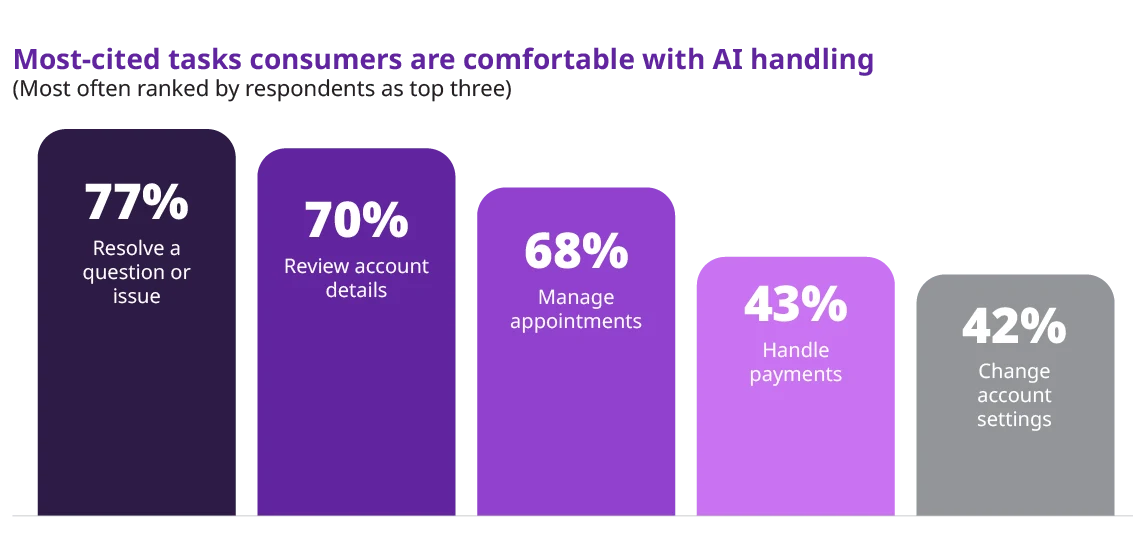
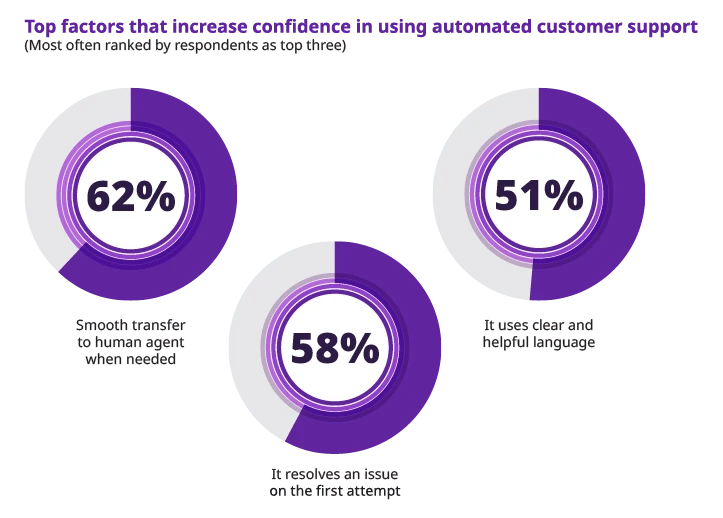
Read the 2026 State of the Customer Experience Report for more insights.
Why More Automation Alone Wouldn’t Solve the Problem
Organizations tend to expand AI-based support without changing how decisions are made at the front end. More bots are introduced. More self-service paths are created. But automation creates trade-offs. One is that it eliminates the “easy” calls, leaving the human agents to field complex, high-touch calls almost exclusively, which can create a burnout risk for businesses to manage. Another trade-off is that more customers are left to figure out the system. As automation expands, they’re asked to choose the right path to their resolution on their own—often without enough context or coordination behind the scenes to help them make that choice.
As a Forrester analyst told the Wall Street Journal, “Poorly executed or rushed AI deployments could create the very problems regulators are trying to solve.” And as we’ve found repeatedly in our research, consumers want the option to easily reach a human when they’re interacting with any AI agent or automated support system. In a survey of telecom customers, 61% agreed that a top trait they looked for in an AI tool was a more seamless handover to a human agent.
So while AI is getting better, there remains a gap between AI channel implementation and customer adoption. Without a more considered approach, increased automation can introduce new points of friction:
Customers routed into the wrong experiences
Failed or incomplete self-service attempts
Repeat contacts when issues aren’t resolved the first time
Loss of context between automated and human interactions
Those problems aren’t new. What changes in an onshore-first model is how expensive they become. A failed self-service attempt doesn’t end in containment: It becomes a second, higher-cost interaction. A misrouted call doesn’t just slow things down: It pulls a more expensive agent into resolving the wrong issue, while increasing handle time and the likelihood of another follow-up from the customer.
What a More Structured Approach to Call Center AI Looks Like
So how can CSPs be more deliberate about how AI is used at the start of every interaction? It starts by rethinking two things: what automation is handling before a customer reaches out, and what happens when they do.
The first step is improving how automation intervenes before the interaction reaches the contact center. Instead of relying on static self-service flows, CSPs can use agentic automation: systems that can identify issues earlier, resolve simple requests proactively, and guide customers through tasks with more context.
Example: A customer tries to activate a new device through your mobile app, but they run into an error partway through the process. Instead of requiring them to call in and start over, orchestrated AI agents pick up where the interaction left off: One agent retrieves the incomplete activation request, another checks provisioning status across systems, and a third identifies a mismatch in how the device was registered. From there, the system corrects the issue by updating the registration, completing the provisioning step, and confirming activation has gone through. The customer receives a notification that the device is ready to use, without needing to restart the process or contact support.
Of course, not every issue can (or should) be resolved through automation. The second step is introducing a more intelligent front end to the contact center. Instead of pushing customers into menus or queues, and asking them to figure out the right path, CSPs can use a decision layer that understands intent and guides the interaction from the outset.
At that point, the system needs to answer some basic questions:
What is the customer trying to do?
Should this be handled through automation or a person?
If it’s a person, who should that be?
Where should this interaction go?
That shift changes how call center AI is applied. Automation is still used, but it’s targeted. Self-service is still available, but it’s introduced in the right situation. And when a live agent is needed, the interaction starts with more context and a clearer understanding of what the customer is trying to accomplish.
How Intelligent Routing and Intent Detection Make the Model Work
Once a decision is made about how an interaction should be handled, you still need to execute it: route it correctly, escalate at the right time, and make sure context carries over. That’s the role of intent detection and intelligent routing.
Solutions that perform intent detection identify what the customer actually needs (not just what they say). This requires natural language understanding (NLU) that goes beyond just transcribing words or matching keywords.
Example: A customer calls for help with an account update after trying to make the in the app. The system should recognize what they’ve already done, skip the unnecessary steps, and connect them directly to the right team. At that point, routing is doing its job: getting the customer to the right person, quickly, with the right context already in place.
Keep in mind, this type of routing doesn’t fix a broken automation strategy. But it does make sure you’re not wasting time once an interaction needs to be handled by a person, and when a greater share of calls get handled in the domestic U.S., wasted time becomes much more costly.
How Should This Change an Onshore Call Center Strategy?
Customers have been asking for support that’s easier to interact with, and bringing more interactions onshore can help address that. But the cost of more U.S.-based support would put pressure on providers to offset it.
When expanding contact center automation in response, CSPs could make experiences even worse unless they get these two things right:
1. Automation needs to handle the right kinds of issues early (or prevent the need for a call altogether) instead of pushing more interactions into self-service paths that don’t resolve anything.
And when a customer does reach out:
2. The system has to understand what they mean, route them to the right place on the first attempt, and pass along enough context so the agent can finish the job.
When automation and routing are applied with the end-to-end contact center experience in mind, onshoring becomes an advantage instead of a tradeoff.

Related Resources

AI in the Telecom Customer Experience: Five Insights From Consumers

The AI Balancing Act in CX: Meeting Business Goals Without Alienating Customers

What Is Intelligent Routing?