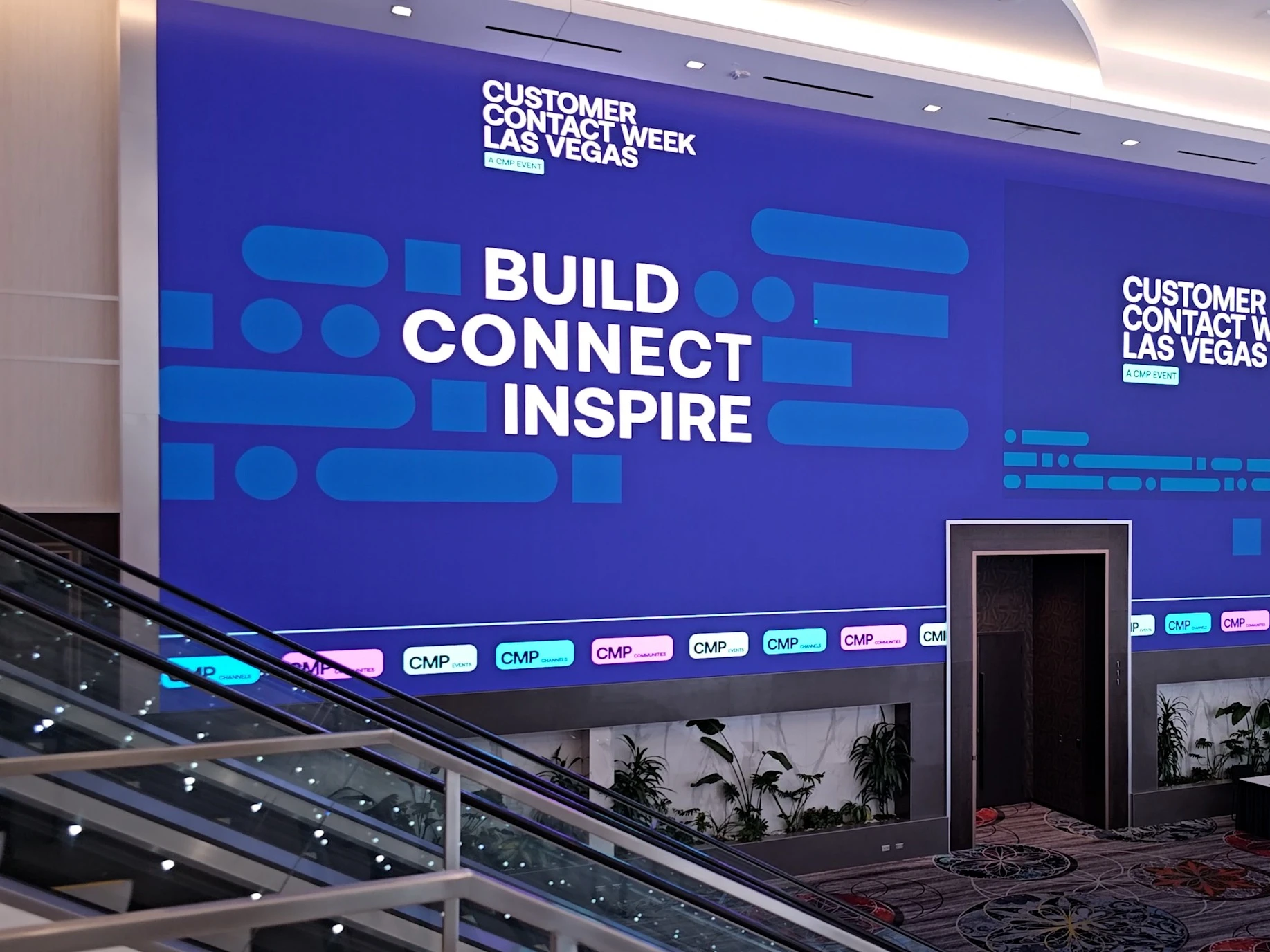
CCW Las Vegas 2026: The AI Conversation Is Growing Up

There was one phrase nobody could escape at Customer Contact Week (CCW) Las Vegas 2026: agentic AI.
It was on keynote stages and splashed across booths. It came up in conversations with contact center leaders, CX practitioners, and industry analysts. Every corner of the show seemed to point back to the same idea: autonomous systems that can reason, decide, and act with less human intervention.
But after several days on the show floor (and an analyst session hosted by CMP Research) what stood out wasn't how much people were talking about agentic AI in customer experience (CX).
It was the range of questions practitioners were asking about it. What's working? What's making it into production? What results are organizations truly seeing? How do we even know where to get started?
If you were at CCW Vegas this year, the impression you’d have gotten is that the AI conversation is finally starting to mature: Now we’re getting somewhere.
Where are we going exactly? Here are my four biggest takeaways from CCW Las Vegas 2026.
1. Buyers Aren't Confused About AI. They're Waiting for Proof.
At last year's show, talk centered on what AI agents could do in theory. This year, the conversation shifted toward what AI is delivering in practice.
Teams are building roadmaps and deciding which use cases deserve deeper investment. But many are also discovering that moving from a promising pilot to a production-ready solution isn't as straightforward as it first looked. Deloitte found that more than two-thirds of organizations expect 30% or fewer of their AI experiments to reach full scale in the near term.
I heard practitioners saying they still wanted proof. They wanted examples operating in real customer environments, not just the rosy, idealized demo scenarios. They wanted to understand how AI use cases perform when they're constrained by messy data, compliance requirements, and all the other limitations that come with running an enterprise.
Frankly, I hope practitioners keep applying that pressure to AI conversations. That's how organizations make smarter investment decisions, and how the market as a whole moves forward.
RELATED ARTICLE: Why Overwhelm Is Driving Major Customer Experience Trends of 2026
2. The Buying Committee Just Got a Lot Bigger—and That Makes Starting Harder
One of the most revealing insights I heard came from CMP Research: only 30% of customer contact purchasing decisions are now owned by a single department.
Several speakers and analysts touched on the growing complexity of technology decisions throughout the week, and this statistic helped explain why. For practitioners, that raises the bar for every technology decision.
It's no longer enough for a solution to solve a CX problem. IT is weighing integration and security. Operations wants efficiency. Legal and compliance have their own checklist. Finance is scrutinizing cost and return. Each team is asking good questions. But the more voices in the room, the harder it gets to agree on what a good investment looks like, let alone where to begin.
And that's the part I think gets underestimated. When one department owned the decision, the starting point was obvious: Solve the CX problem in front of you. Now, with a committee, there's no single problem to anchor on. Every stakeholder is optimizing for something different, so the first move—the "where do we pilot this, and why"—becomes a negotiation before anyone's evaluated a single vendor.
AI purchases add layers to this. A solution that thrills a customer contact leader because it cuts customer effort can immediately raise flags from security, or draw questions about governance and oversight. Suddenly the conversation isn't "is this a good tool," but "are we even ready to deploy something like this, and who owns it if it goes wrong?"
So committees are adding teams, evaluations are adding months, and organizations are getting more disciplined about the hard questions up front. The bottleneck isn't the technology anymore. It's building enough internal alignment to know where to start.
RELATED REPORT: CCW DIGITAL 2026 Vertical Market Study for BFSI
3. Customers Are Still Picking up the Phone. They Just Don't Trust What Answers.
The industry spent years treating voice as a cost to contain rather than an experience to invest in. They automated the front end, deflected what they could, and trimmed the budget everywhere else. At CCW Vegas 2026, that bet looked shaky.
In fact, one of the most consistent themes I heard across conversations and sessions was that voice still remains the channel customers turn to when the stakes are high.
Contact center leaders know this already: When an issue is urgent, confusing, or emotionally charged, people often want to speak with someone. What surprised me wasn't the continued importance of voice, but how often the channel was tied to trust. Or more accurately, the lack of trust: One CMP stat I found especially jarring was that only 14% of customers trust the IVR.
It's a sign that many organizations still have work to do in one of their most important touchpoints with customers.
4. This Isn't the Year of Innovation. It's the Year of Execution.
The consensus is that 2026 was CCW's biggest innovation year ever. Based on everything I saw on the vendor floor, I agree.
Yet the conversations about the next AI use case always came back to the work: what organizations still need to do before the use case can produce value. Analysts and practitioners focused on governance, data readiness, operational consistency—the less exciting but essential components of making their current programs succeed, let alone what’s coming on the horizon.
This was also true with non-AI topics. While there was excitement around emerging channels like RCS, we heard a lot of practitioners talk about their unresolved challenges in their more established channels like web and voice (like I mentioned above).
Before expanding into the next channel, the organizations seeing success are focused on fixing what's already in front of them. They're modernizing knowledge that's fragmented, outdated, or difficult for AI systems to use. They're establishing governance before deployment instead of scrambling to build it afterward.
None of that generates flashy headlines, but it does determine whether AI initiatives stick—and expand—once they move beyond a pilot.
A More Mature Conversation
Even if agentic AI was the inescapable phrase at CCW Las Vegas 2026, the show and its interactions could all be underpinned by a different word:
Accountability.
CX leaders want evidence. Customers want experiences they can trust. Organizations want results they can measure.
You could view those expectations as slowing down AI adoption in CX. I think it’s more that they’re helping the market mature. And that's a good thing.
The future of customer experience won't be determined by who makes the boldest predictions. It’ll be shaped by organizations that connect technology investments to real customer outcomes and real business value.
That's where the conversation should be heading next.

Related Resources

Want Customers to Trust Your AI? Ease Your Team's AI Fatigue, First.

The AI Balancing Act in CX: Meeting Business Goals Without Alienating Customers

Agentic AI in CX: How We Got Here and What You Need to Know About It