
Effort Inflation: The Customer Experience Trend Defining 2027

There’s a paradox at the heart of customer experience right now.
Organizations have added more ways to engage, more ways to get help, and more ways to take action. With all of that advancement, why do so many customers feel like it's taking more work than ever to get something done? Why is it harder than ever to pay a bill? Or manage their internet plan? Or schedule an appointment?
If you ask me what the defining customer experience trend of 2027 will be, it’s the quest to reduce Effort Inflation.
Effort Inflation is our term for the growing time, steps, and cognitive load it takes customers to get something done with a brand. Think of it like economic inflation: the same task costs more than it used to, and due to a dozen contributing factors (or frictions, in the case of CX) that stack to make the whole thing expensive.
We’ve known that customer effort presents costs to the business. Customers call the contact center. They complain online. They leave.
What’s new is that customers feel their effort increasing despite all the tools and processes that brands roll out to reduce it.
The more perplexing part for brands is it’s often because of those tools.
"For customers, time is money. Hidden steps are like hidden fees."
— Keith Wilson, VP, GTM Strategy
Why This Is the CX Trend to Watch in 2027
We surveyed 1,800 digital consumers across North America, Latin America, and EMEA for the 2027 State of the Customer Experience Report, and 74% say resolving an issue with a brand now takes as much or more effort than it did a year ago. And 86% said they would likely leave a brand if they felt it required too much effort to resolve service issues.
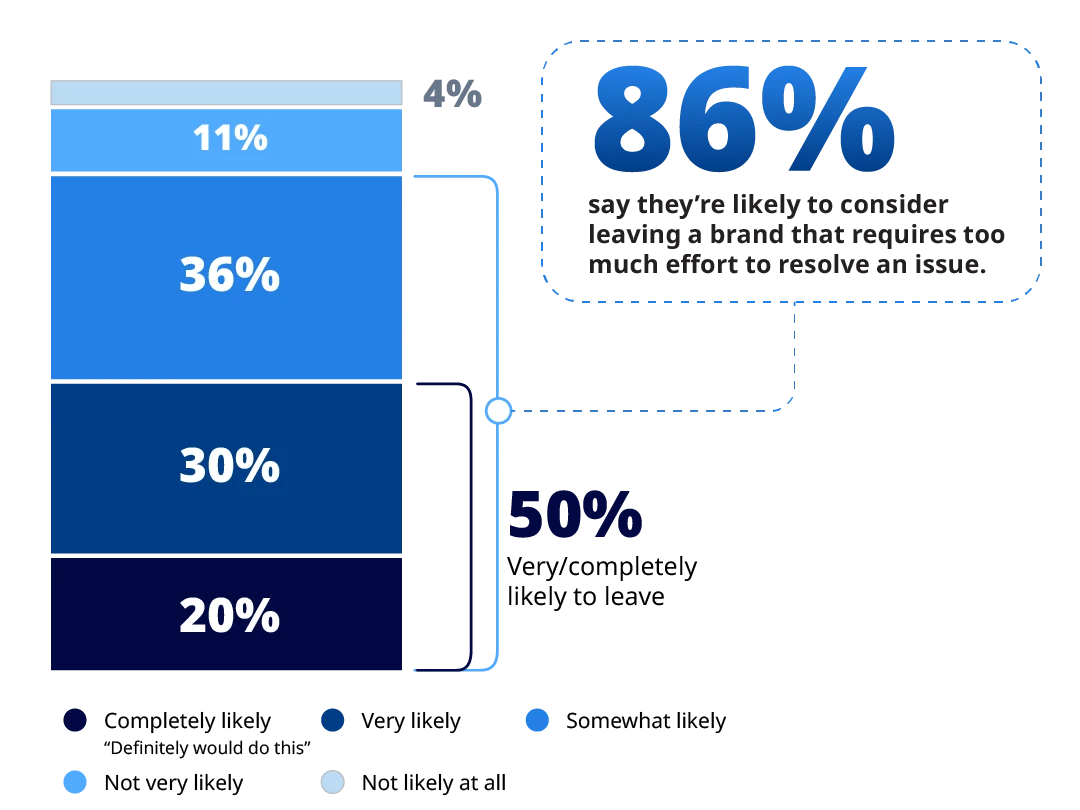
In the data, we saw consumers prioritize effortless experiences to a striking extent. But if the target of CX is to deliver "effortless experiences," organizations can’t just aim at a buzzword. So we asked consumers to define it for us: Among respondents who had what they’d call an effortless experience, what made it so?
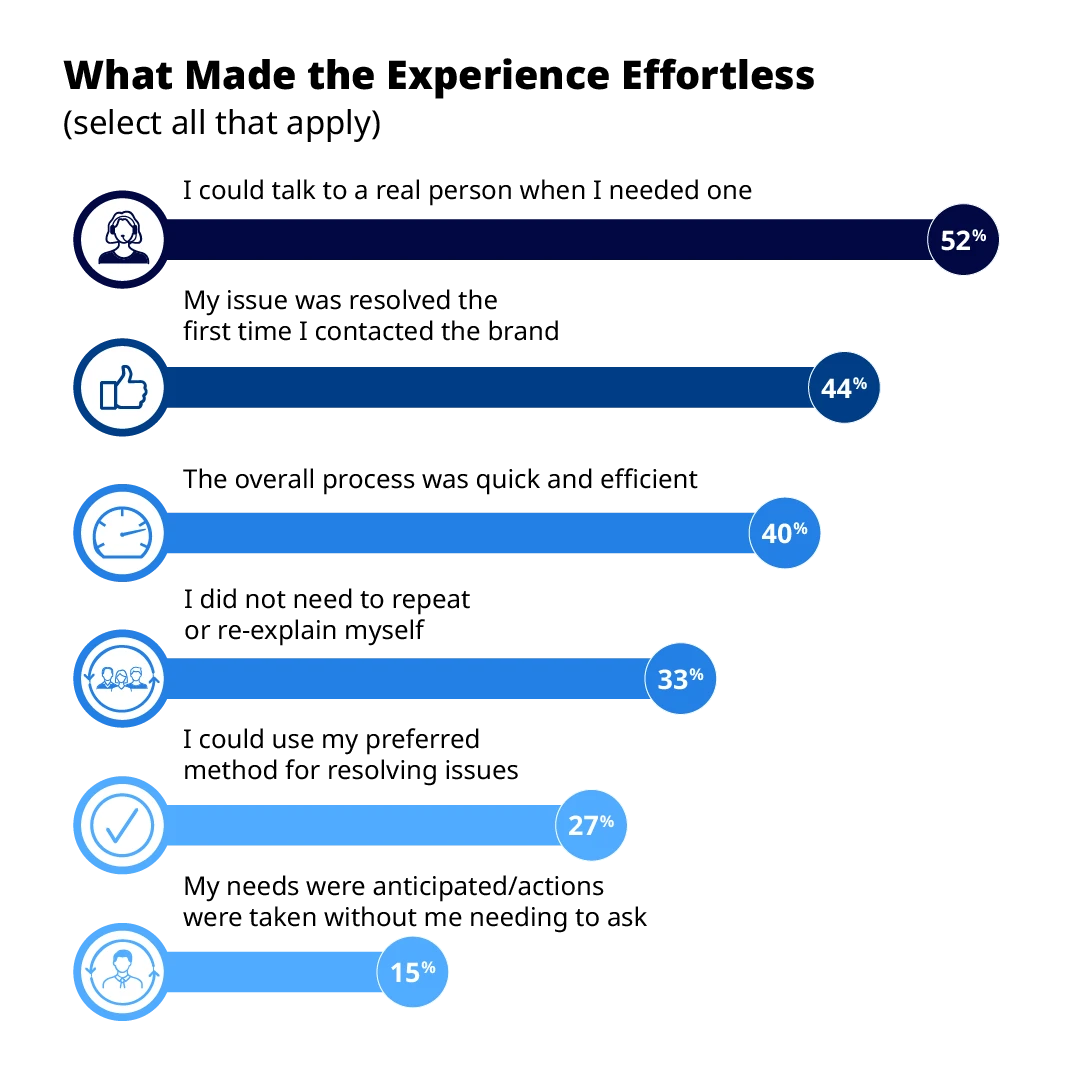
Consumers’ top two answers:
They could reach a real human if they needed to.
They got the issue resolved on first contact.
This is why the report's guidance focuses on how brands can give customers the fastest, shortest routes to the things they need to get done, whether that's adding a line to their phone plan, starting a payment arrangement, refilling a prescription.
What Effort Inflation Looks Like
I’ll give you an example of how Effort Inflation happens to a customer:
A customer wants to dispute a duplicate charge on their monthly bill. They try to log into their account but have forgotten their password. A one-time passcode and password reset later, they’re in. The self-service tool can’t handle the dispute, so it initiates a chat. The chatbot confirms the duplicate charge but can’t reverse it and puts the customer in a live-agent queue. The agent picks up, re-verifies their identity, and asks them to repeat the issue. Then the customer gets transferred to billing, where they have to explain the issue again. The billing agent submits a credit request and says the credit will post within one to two billing cycles. The customer sets a reminder to check the next bill and starts to wonder how much all that time and effort was worth.
What you see happening at each touchpoint is a system that doesn’t know enough about the customer or what the customer needs right now. The portal, the verification, the chatbot, each live agent—none of these steps is necessarily “bad at its job,” the steps just aren’t talking to each other. So the customer is the one who absorbs all the effort, taking the detours and repeating information.
Being transferred and repeating information, by the way, were the top two answers consumers gave for the most frustrating aspects of getting support from a brand.
Disconnected systems and functions pass real costs onto customers. For customers, time is money. Hidden steps are like hidden fees.
Three Takeaways From the Report
In the State of the Customer Experience Report, we have consumer input on everything from their channel preferences to their disposition toward AI and personalization. A lot of it validates what we’ve been tracking in consumer attitudes, but there are also surprises.
I’ll give you three of the takeaways I think are most important from the research.
1. The AI grace period is over
The CX axiom of the digital era is that customers compare your brand’s experiences to the best experiences they’ve had anywhere. Today, we can also say they compare your brand’s AI interactions to the best ones they’ve had anywhere. When a virtual assistant fails to assist them, customers don't blame the AI technology anymore, but the brand providing it.
Brands are working against history here. Consumers spent the better part of a decade encountering the bottom-right-corner chatbots that felt designed to contain service demand. They don’t have the best associations with the virtual assistants on a website or app, or confidence the automation will solve their problems. This is what I thought of when I saw that 81% of consumers say AI-assisted support takes more effort than speaking with a person.
But there’s a silver lining: 44% say they've stayed with a brand longer because automated support successfully resolved a task. AI-assisted support is a channel worth doing right.
2. Customers are building a shadow CX layer with AI
Another finding that stood out to me immediately: customers are increasingly solving problems before they ever engage with the brand.
More than three-quarters (77%) of consumers say they've used an external AI assistant (like Claude or ChatGPT) to help resolve an issue they experienced with a brand, and 1 in 4 say they do this most or all the time. When that happens, you don't know what information the AI provided, where it came from or whether it was accurate.
When they hit an obstacle in a customer support journey, consumers are now just as likely to consult their own AI tool as they are to Google an answer or use an online forum/review site.
With increasing personal AI use, even more of the customer journey is taking place in venues the brand doesn't own. It will be interesting to see how brands adapt to that reduced control.
3. Brands and customers disagree on key channels
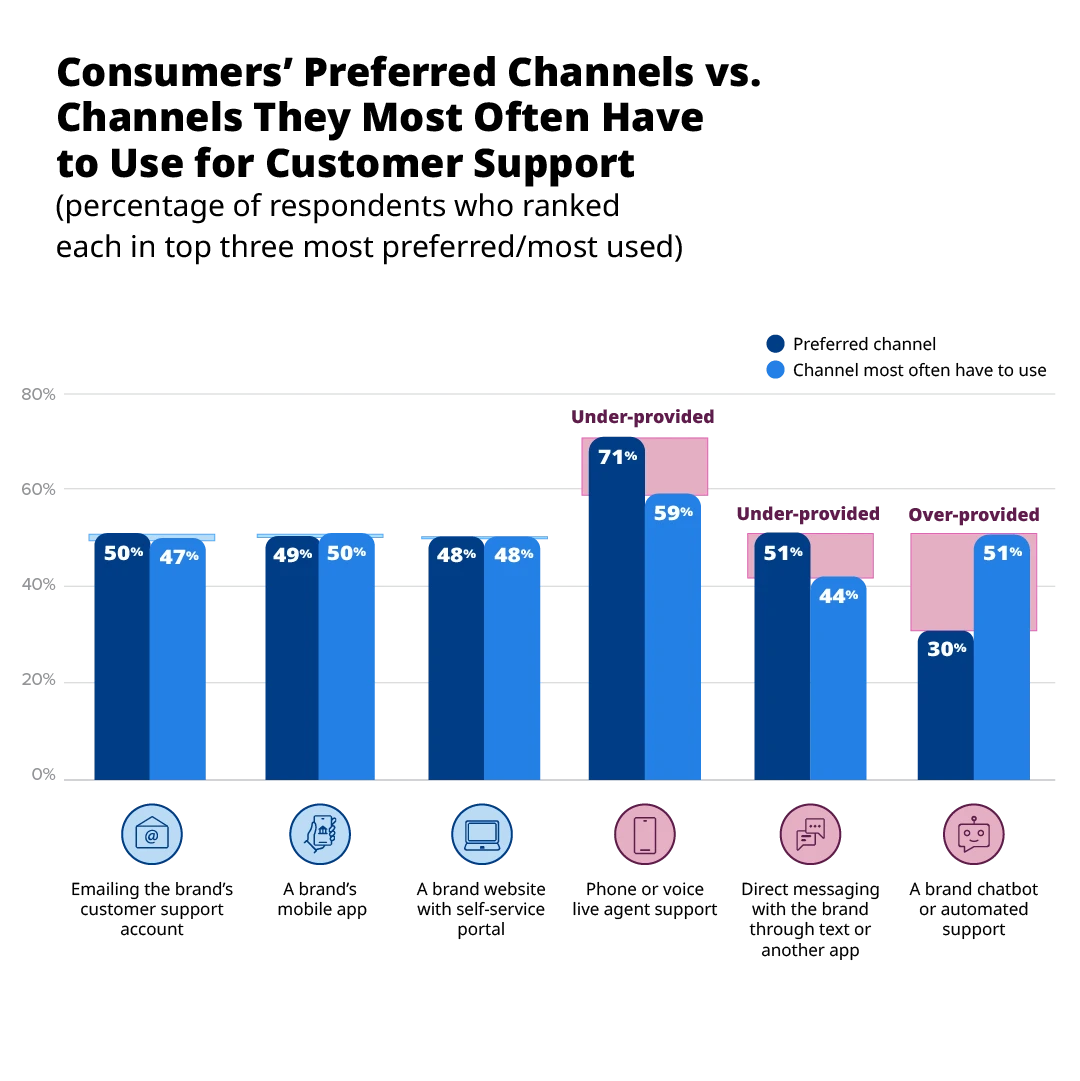
Customers can feel they're working harder than they should if they have to use channels they don't want. So if brands are funneling customers toward or away from specific channels, there's a risk they're causing friction.
We saw some key channel mismatches in the survey: 71% of consumers rank phone or live-agent support among their top-three preferred channels, but it's in the top-three most used for only 59%. Chatbots run the opposite direction: Only 30% rank them among their top choices, yet it's a top channel 51% get routed to. Customers clearly notice how brands are sending them toward chatbots, often with the goal of keeping them out of the contact center.
Meanwhile, there's an opportunity sitting in plain sight: 51% have mobile messaging in their top-three favorite channels, yet it's a top-three most-used channel for only 45%. That's a highly cost-effective channel that brands could be offering at more touchpoints to align with customer preferences.
My Tips on Curbing Effort Inflation
Trying to fix every source of customer effort at once can send brands straight back into the trap that created Effort Inflation. They risk finding a thousand "paper cuts" of friction, prioritizing them one by one, and then adding another layer of technology for every problem they solve. Instead, I'd focus on three things.
Pick a few high-friction moments and fix them completely
Start with the moments where extra effort has the biggest consequences, whether that's a delayed shipment, billing dispute, or service outage. Understand why customers struggle, then simplify the experience from beginning to end. Don't build another isolated fix that solves one piece while adding complexity somewhere else.
Make the journey continuous across channels.
Customers are going to move between the website, app, messaging, and contact center. Design for that movement instead of treating each channel as its own experience. Carry the customer's context, what they've already done and what the brand already told them into the next interaction. The customer should always know what happened, what's happening next, and what they need to do.
Measure the whole journey, including the "invisible" effort.
Metrics won't tell the full story if measurement begins when a customer reaches an assisted channel. Their "effort clock" may have started much earlier, while they were trying different ways to solve the problem on their own. Look across the journey to find where customers get confused, double back, or need help to keep moving.
What You'll Get From the Full Report
I’ve only scratched the surface of the rich insights inside our latest report. The 2027 State of the Customer Experience Report digs into where Effort Inflation is coming from, where it costs brands most, and what they can do to reduce it. Use the findings to decide where to focus first and make the case for the investments that can make a difference.
Related Resources

CSG Named a Leader in the First Gartner® Magic Quadrant™ for Customer Journey Analytics and Orchestration

What It Takes to Connect Your CX Tech Stack: Perspectives From the Field

Voice Is the Last Line of Defense in CX. Time to Treat It That Way.