
What It Takes to Connect Your CX Tech Stack: Perspectives From the Field

Most organizations aren’t lacking for customer experience technology. They’ve accumulated plenty of systems in the CX tech stack, ranging from CCaaS to CPaaS to CRM to digital channels and AI-driven point solutions.
The issue is those systems aren’t talking to each other effectively. As a result, customers still encounter inconsistent communication and disconnected interactions across channels.
As Keith Wilson, Director of Product Management at CSG, put it in a recent CX Network webinar, “Customers are still receiving conflicting updates. They're still being overwhelmed with irrelevant communications. Channels are still not aligned.”
In “How to Fix Disconnected CX With an Orchestration Layer,” Wilson was joined by Adrian Swinscoe, CX advisor and author of Punk CX, and James Cuthbertson, Chief Revenue Officer at Relative Insight, to discuss how integrated systems, orchestration, and evolving architectures are shaping how organizations manage and improve complex CX environments.
You can watch the on-demand webinar here or read the breakdown below for these takeaways:
Why disconnected systems still churn out inconsistent customer interactions
How orchestration helps coordinate data, channels, and workflows
What better CX looks like when systems share context across the journey
Why functional alignment is just as important as integration
Disconnected CX Technology and Unclear Goals Are Hampering Outcomes
Keith opened by acknowledging a familiar pattern: After years of investment in people, process, and customer experience technology, brands still struggle to deliver an integrated customer experience. Even as organizations simplify their CX tech stack by reducing vendors, the experience hasn’t meaningfully improved.
Then he posed a straightforward question: “Why is it that experiences just aren't improving at a rate that we might expect?”
Adrian Swinscoe suggested that the root issue often comes down to a lack of clarity at the outset.
“I do not think that many brands have a clear enough… vision of what sort of experience they want to deliver to their customers.”
Without that level of definition, decisions about data, systems, and technology can get disconnected from the intended outcome—which makes it difficult to answer a fundamental question: how can integrated systems improve the customer experience?
Adrian emphasized that without a shared CX vision, organizations prioritize technology inputs rather than the experience itself.
“If we're not experience-first, and then thinking about what data and tech we need to deliver that, then we're in danger of having the tail wag the dog.”
Related eBook: Tackling Tech Stack Sprawl in CX
More Data and Analysis Tools Don’t Equal Better CX Decision-Making
Relative Insight CRO James Cuthbertson focused on how the growth of analytics and AI has changed how organizations approach CX. LLMs have now put what feels like analytics capabilities in the hands of every professional—which has had drawbacks.
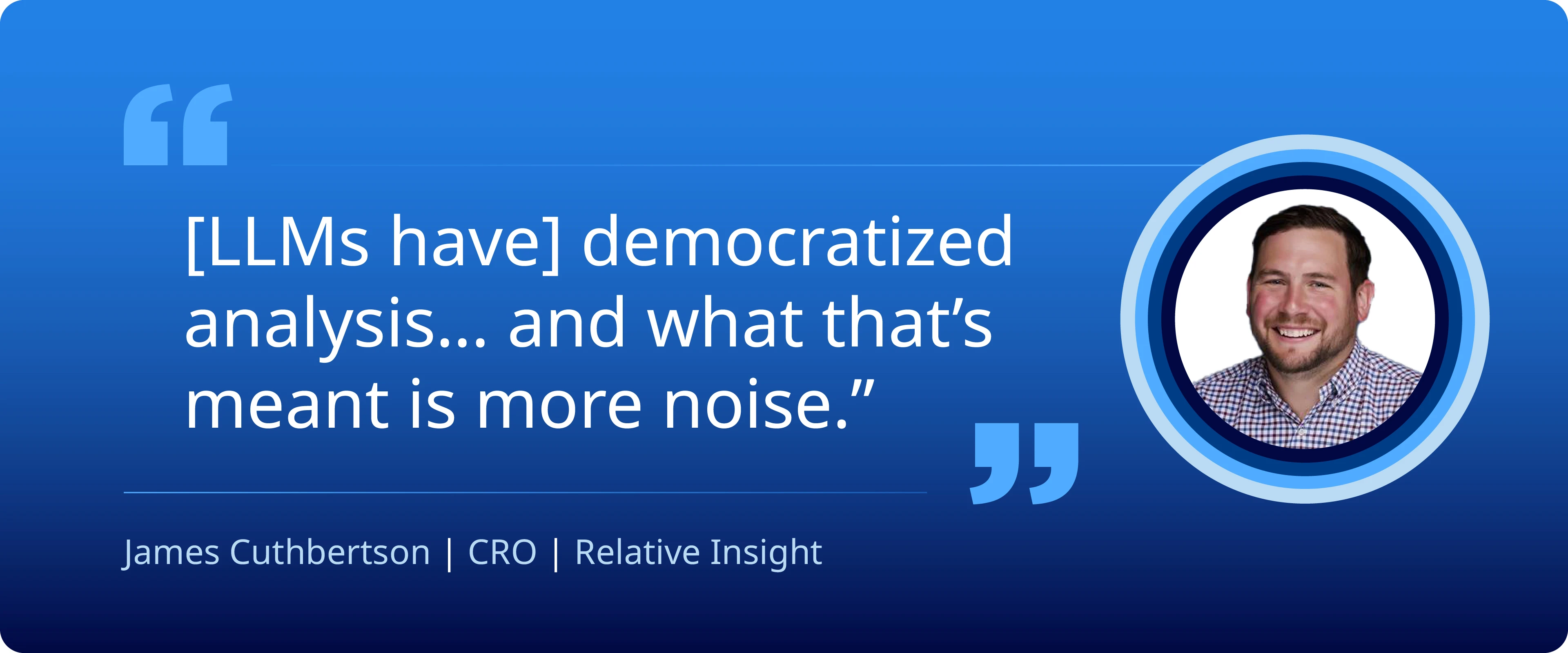
“It’s democratized analysis… and what that’s meant is more noise,” James said.
While more people can now analyze data, it’s contributed to “an erosion of trust by senior leaders to use [data] to make decisions,” James said.
When insights aren’t fully traceable, and stakeholders bring those insights to senior leaders, they can’t explain how those insights were created, so they “lose the boardroom,” James explained. This matters because the “analytics noise” can prevent teams from winning approval for the cross-system changes necessary for integrating solutions and orchestrating customer journeys.
Journey Orchestration: Connecting Omnichannel Customer Engagement to Real Customer Behavior
The conversation turned to customer journey orchestration: a technology for connecting system, data, and customer interactions. Journey orchestration coordinates how systems and interactions work together across the customer journey, so that each step reflects context from the previous one, and then triggers a desired action (or suppresses an undesired action).
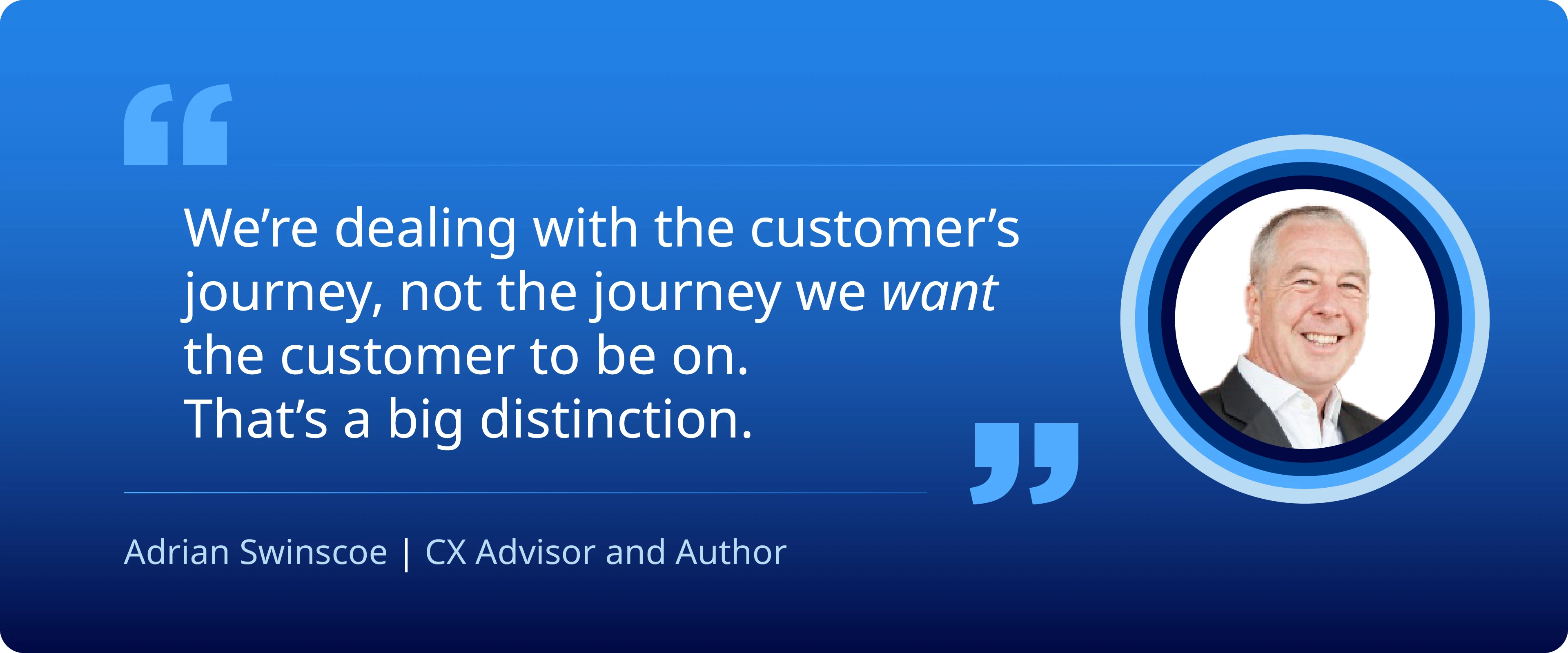
When discussing journey orchestration, Adrian emphasized that organizations must ground it in real behavior, not ideal workflows. “We’re dealing with the customer’s journey, not the journey we want the customer to be on. That’s a big distinction.”
Keith said that this requires breaking away from channel-specific thinking. “You have to be able to build a new customer journey… in a channel-agnostic way.” Systems such as customer records, contact center platforms, and communication channels need to operate in a coordinated way so that interactions reflect a shared understanding of the customer.
What improves with journey orchestration, according to the panel, isn’t abstract experience quality but specific, observable outcomes. These include reducing conflicting communications, improving continuity between interactions, and ensuring that the next step a customer encounters reflects what’s already happened.
Focused Use Cases Outperform Big-Bang Changes
Adrian said journey orchestration is often thought of as a large, complex initiative because of the connotation of “orchestration:” people picture a philharmonic of nearly 100 musicians all needing to perform in concert.
The panelists agreed that progress using journey orchestration is often made incrementally.
“If you can orchestrate something small and prove it works… then [senior leadership] will allow you to orchestrate something big,” James said.
Keith said organizations can identify starting points by looking at where processes begin to break down, and then addressing those issues before they escalate.
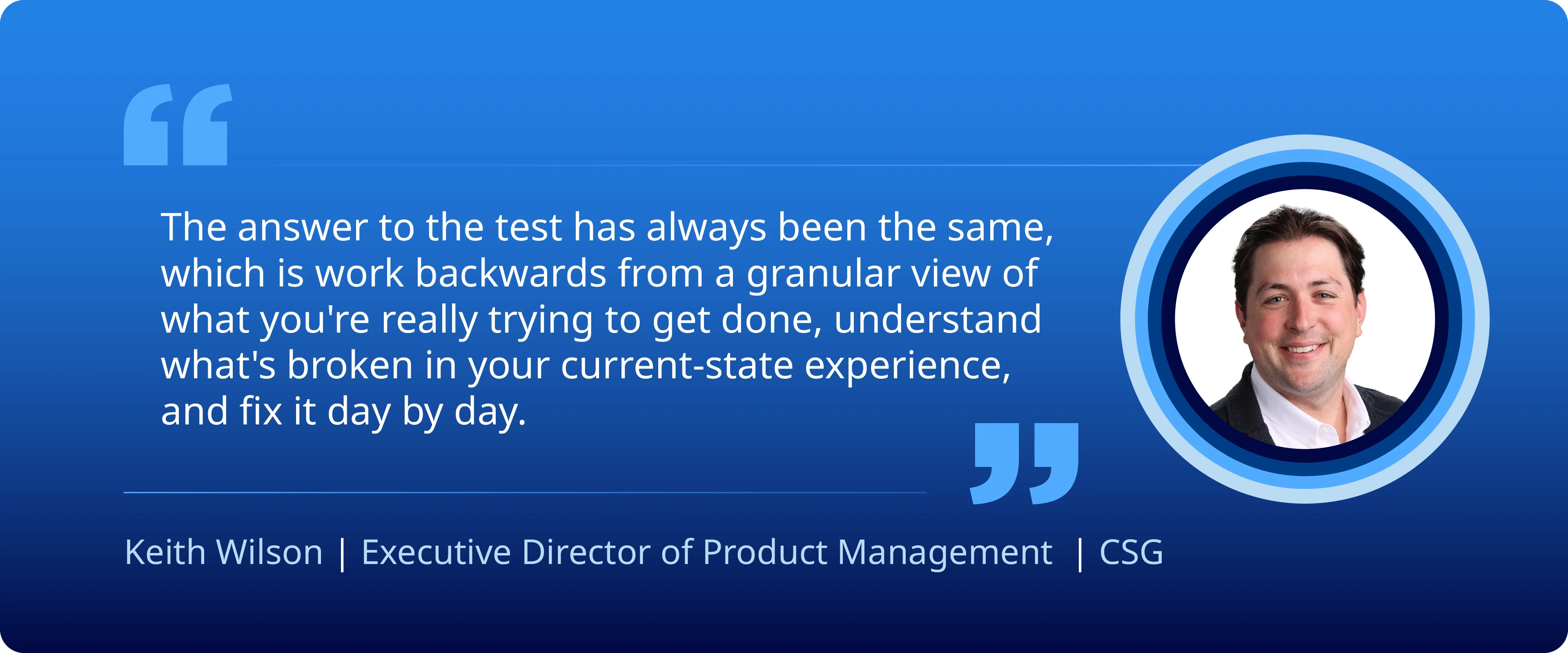
“The answer to the test has always been the same, which is work backwards from a granular view of what you're really trying to get done, understand what's broken in your current-state experience, and fix it day by day.”
Real-World Example: The Claims Process in Insurance
Keith pointed to the claims process in insurance as an example—a journey that typically spans multiple internal and customer-facing systems. In one case, an insurance provider that CSG worked with focused on a specific gap in that process: overnight claims, like if a policyholder suffers a loss in a nighttime housefire. Overnight claims were initiated through a third-party contact center, Keith said, and “all of that data… comes over in a packet, and human beings have to pick it up from there” the next morning. Rather than redesigning the full journey, the team targeted that breakdown point: the delay between initial contact and follow-up.
The insurer introduced a simple orchestration step using data already being generated: send a reassurance message to the customer and notify the agent who sold the policy so they can follow up directly. As Keith noted, the use case affected “a smaller population,” but still offered “a huge opportunity… to just wow customers.”
That example highlights a repeatable approach teams can apply:
Trigger: A known breakdown point in the journey (e.g., overnight claim intake)
Data needed: Existing interaction data passed between systems
Orchestration step: Route that data to the right systems and people in real time
Customer message: Send proactive communication that reflects the situation
Internal handoff: Notify the relevant agent or team to act
Metric: Track the average time-to-follow-up, inbound call reduction, and CSAT of the claims journey.
As Keith summed it up, teams should “look for the places… things start to go off the rails… [and] 3 to 5 steps before that.”
Related Article: Finding and Fixing Broken Customer Experiences with Journey Analytics
Technology Connects the Stack. Alignment Connects the Outcome.
The panelists noted that integrating the customer experience technology with an orchestration layer is only part of the equation, as it’s not just the CX tech stack that needs to be connected. The teams do, too.
“Achieving alignment across different domains and disciplines is absolutely key,” Adrian said. This includes aligning technology, operations, product teams, and incentives to support the same goals.
That alignment starts with shared ownership of the problem and a clear direction. As James pointed out, without “a clear and granular mission” paired with leadership support, “it just doesn’t get off the ground.” That often means CX initiatives need a senior sponsor who can connect customer experience improvements to business priorities and drive accountability across teams. Otherwise, organizations risk making platform decisions or process changes that don’t address the underlying issues.
Adrian reinforced that alignment isn’t just about agreement at the top level—it has to translate into coordinated activity across teams. Organizations need a “grand vision” and a more detailed, working view of how that vision plays out across journeys, roles, and systems. Without that, teams can end up optimizing in isolation, which makes it impossible to create a fully integrated customer experience.
The alignment of people and platforms can be a challenge, but it’s not an insurmountable one when it comes to CX. James noted that improving CX can influence broader business outcomes:
“You can win hearts and minds and revenue.”

Related Resources

The Real Test of Journey Orchestration Software: Post-Acquisition Experiences

How to Cut Through ‘AI-Powered’ Claims in Customer Journey Management Using the QKS AI Maturity Matrix

Meeting Customer Expectations in 2026: Experts Shed Light on ‘Overwhelmed’ Consumers