
What Is Omnichannel Customer Experience? The Complete Guide
The ideal omnichannel customer experience (CX) happens when a company deliberately connects every touchpoint—website, app, phone, chat, or physical location—so customers can pause an activity on one and pick it up on another without starting over.
It feels effortless to the customer, but requires extensive planning and coordination behind the scenes. The company has to consolidate customer data scattered across systems into a single profile, give every channel access to it, and make sure functions such as marketing, service, and billing work from the same information.
Customers increasingly expect companies to remember them and pick up where they left off, but delivering that kind of connected experience remains difficult. In PwC's 2025 Customer Experience Survey, 70% of executives said customer expectations are evolving faster than their companies can adapt.
This guide breaks down how omnichannel customer experience works, why it matters, and what it takes to build and sustain it—including what it costs, where initiatives fail, and what it looks like in telecom, utilities, banking, and retail.
The definition of an omnichannel customer experience
An omnichannel customer experience connects all of a company's channels into one continuous experience. The customer is recognized on every channel and can switch from one to the next without repeating everything or restarting from square one. Someone might ask a question in a mobile app, follow up by text, and finish the conversation on a call, with each handoff carrying the full history forward because every channel is reading the same customer record.
What's the difference between omnichannel and multichannel?
People often use these two terms interchangeably, but they’re quite different. Multichannel means a company offers several ways to interact—an app, a website, a phone line—that operate independently of each other. Omnichannel connects those channels, so what happens on one is available to the others.
The table below shows where they differ.
Multichannel | Omnichannel | |
Definition | Several separate channels | Several connected channels |
Channel connectivity | Channels run in isolation | Channels are linked |
Data sharing | Data is siloed in each channel | Data comes together into a single view of the customer |
Customer experience | Broad, but disjointed | Continuous, picks up where the other left off |
Use case: Two nurses, two operators, two different experiences
Magda and Luis are nurses on the same floor, both working busy 12-hour shifts. They recently noticed the same thing: their mobile bills had gone up, and neither of them knew why. So they reached out to their mobile operators.
Magda’s multichannel experience
During a short break, Magda starts a chat in her operator’s app. She gets halfway through before returning to the floor.
Later that day, she calls customer service—and they have no record of the earlier chat. She has to explain the problem all over again. She gives up, figures she'll deal with it another day, and even thinks about switching operators.
Luis’s omnichannel experience
Luis does the same thing with his mobile operator. He opens the app when he gets a few minutes, starts a chat, then has to go back to work.
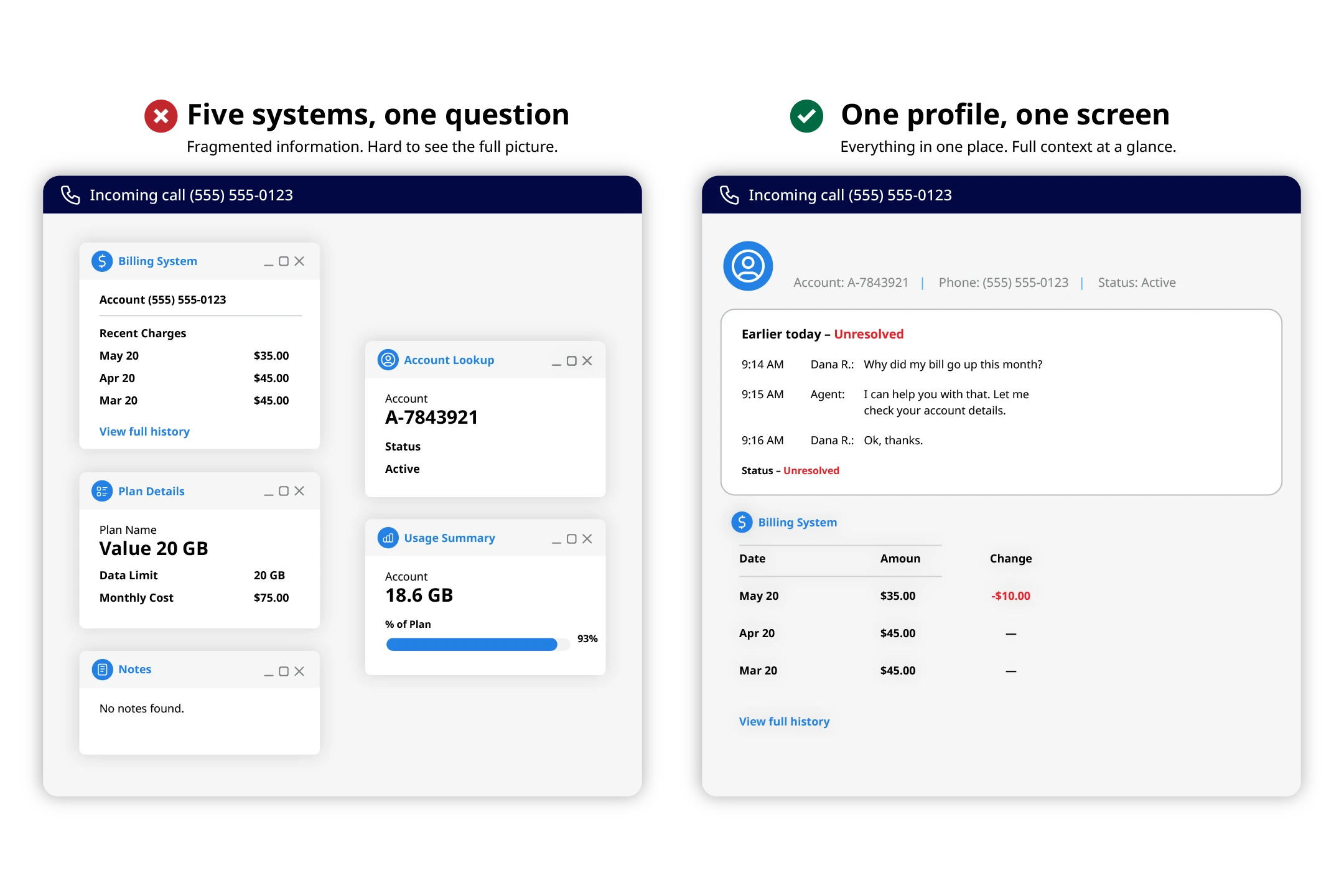
When Luis calls back later, the customer service agent already knows why he’s calling. His previous chat, billing history, and account details are on the screen before the conversation starts. The agent explains the increase, and it’s quickly sorted. The difference isn't that Luis's operator had more channels. It's that his operator connected them.
Same job, same problem, same schedule. Completely different experiences.
What are the benefits of an omnichannel customer experience?
When the underlying identity, data, and journey design are solid, a well-executed omnichannel CX can deliver these five benefits: higher customer retention, increased revenue, greater agent productivity, richer customer insights, and lower operating costs. Each benefit traces back to the same thing—the experience works better when what a customer did on one channel is visible on the next.
Higher customer retention
If a customer is forced to repeat their whole story or restart a transaction, the company is raising their risk of churn.
Think back to Magda: After one frustrating call, she is already considering other mobile operators. She's not unusual—PwC's 2025 Customer Experience Survey found that 29% of customers stopped using a brand due to poor CX online or in person.
Increased revenue
Customers who can move from an app on their phone to a website on their laptop without losing their place are more likely to finish what they started.
An online shopper adds hiking boots to a cart on the morning train, reaches their stop before checking out, and gets a reminder text later that brings them back to the retailer's website with the cart intact. The cart is still there because it’s saved to their account rather than the browser session on their phone. After noticing the boots are still in their cart, they buy the boots and add a pair of wool socks while they're at it.
A connected experience also creates openings the company wouldn't otherwise have. When Luis calls about his bill, the agent can look at how his usage has changed since he signed up three years ago and offer him a plan that fits better and costs less. A call that started as a complaint ends with Luis on a better plan and one more reason to stay.
Greater agent productivity
Live agents spend too much time reconstructing who the customer is and what happened.
When the systems aren’t connected, the agent has to ask the customer to explain—even if the customer was using the chatbot on the app a few minutes earlier. When channels share the same customer information, the agent starts a call with that history already on screen, instead of a series of identifying questions.
Richer customer insights
Disconnected data hides customer patterns; connected data reveals them.
Imagine a customer who looks for answers in the help center twice, starts a chat, abandons it, then cancels service the following week. No single channel saw anything unusual.
When those three events attach to the same customer profile, they show up as one sequence instead of three unrelated records. That's what makes the pattern visible—and what tells a company where the experience is failing, not just that a customer left.
Lower operating costs
Every disconnected customer interaction comes with a cost—in customer trust, agent hours, and money spent fixing what connected systems could have prevented.
Companies can reduce that cost in two ways: letting customers do more on their own through connected channels, and reaching out to them before an issue becomes a service call. When the billing system and the messaging system are connected, an unusual charge can trigger a text explaining it before the customer picks up the phone. An outage alert works on the same connection—the system that knows about the outage reaches the customer without anyone placing a call.
Why do omnichannel initiatives fail?
Omnichannel strategies often fail for organizational reasons, not just technical ones. Connecting channels, sharing customer data, and keeping every interaction in sync might sound straightforward, but delivering it takes multiple systems, departments, and teams—many of which have operated separately for years. These obstacles come up again and again:
Legacy systems that were not built to share data
Information trapped in departmental silos
Service quality that varies from channel to channel
No one monitoring the experience as a whole
Channels that launch when they’re not ready
Change management and training burdens
How to build or improve your omnichannel customer experience
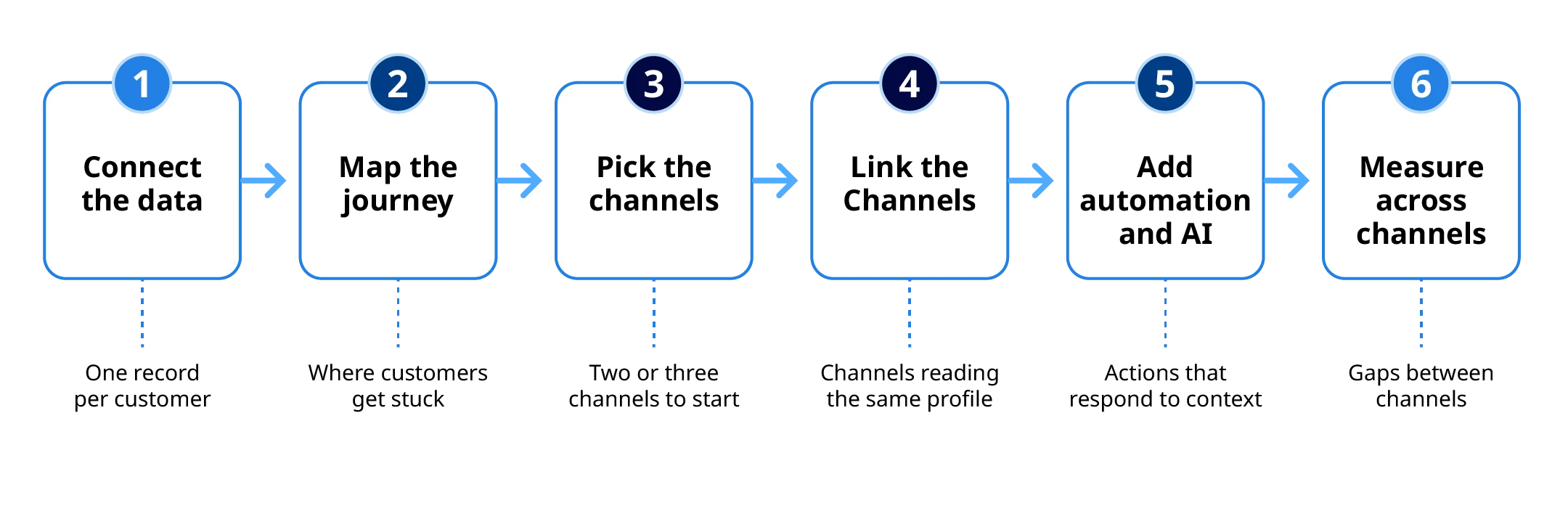
Building an omnichannel strategy takes six steps, and they work best in order.
Step 1: Prepare and connect customer data
Every step that follows depends on getting this one right. Identify the customer data each channel needs and ensure each one can reliably ingest it. That may include account and billing records, interaction history, digital activity, messages, transcripts, and links to call center recordings. The key is to create unified customer data profiles that provide the authoritative context for each customer—across whatever channels they use, at whatever point they’re at in a journey.
Step 2: Map how customers move through your channels
With your data in order, the next step is to understand and track your customer’s actual journey, not just the one you assume they have.
A few questions will tell you most of what you need to know:
Where do they get stuck or abandon the process?
Which channels or channel combinations most often end in a completed purchase or transaction?
How many contacts does it take to resolve a typical issue, and how many of those cross channels?
Step 3: Prioritize the channels that matter most in the journey
Now that you know where your customers are and what they do there, plan on connecting the highest traffic or most impactful channels to the unified customer profiles and then integrating others later. Two or three carefully integrated channels are better than six or seven poorly connected ones.
A mobile operator might begin with an app and the call center, since billing questions often start in the app and escalate to a call.
A retailer might connect the app, website, and email, so that a cart started on a phone triggers an email and is completed on a laptop.
Step 4: Connect the channels and standardize the messaging
Connecting channels doesn’t necessarily mean connecting them to each other. It often means giving each channel access to the same customer information in the customer data profiles. When each one is reading and writing to the same place, each interaction builds on the last instead of starting from scratch.
The experience should feel consistent, too. Every interaction should sound like it came from the same company. Granted, each channel won’t deliver the same exact same content. The channel packaging will vary—for example, including more detailed information in an email and more condensed, topline information in a push notification—adjusting the format to the customer’s need and the channel’s job. But the brand voice and information should match across channels.
Step 5: Add automation, orchestration, and AI
With your channels connected, you can start automating the customer journey and using AI to personalize it.
Automate routine tasks
Automation works best when it has access to a complete view of the customer. That's why it comes after the first four steps. Without connected data and channels, automation can only act on what happens within a single system instead of the entire customer journey.
Coordinate the next step
Orchestration is layered on top of the channels and decides what should happen next based on the customer's current situation—which message, which channel, and when. It also decides when to do nothing. For example, if a customer is in the middle of a billing dispute, orchestration can suppress the marketing email that would otherwise go out that morning.
Use AI to make better decisions
Automation does what you tell it to do; AI notices the patterns that need attention. AI might spot that customers who check their bill twice in a week usually call within a few days, so a text goes out before the call happens. When Luis calls, AI ranks which of six plans best fits his usage instead of putting all six on the agent's screen.
Step 6: Measure, test, and refine across channels
Measure across channels, not one at a time. A channel can look healthy on its own while the experience between channels is broken. Watch the gaps (especially in the handoffs) between channels rather than the numbers inside them—the metrics worth tracking are covered later in this guide.
As you can tell from these steps, it takes certain technological capabilities to keep your channels connected to unified customer data. Organizations often rely on an omnichannel customer experience platform to do this.
What is an omnichannel customer experience platform?
An omnichannel customer experience platform is software that unifies customer data and communication channels in one place, so every channel can draw on the same customer profile and every interaction builds on the last.
In practice, though, one system rarely does it all. Most companies end up with several integrated tools—a CRM, a customer data platform (CDP), a contact center platform, marketing or communications tools, analytics, and orchestration. Some vendors sell those together as a suite. Other companies assemble them from pieces they already own (taking what’s often called a “best-of-breed" approach) and connecting them with an orchestration layer.
Core components of an omnichannel platform
These components fall into three groups: the systems that store customer data, the channels that reach customers, and the layer that helps decide what happens next. Companies usually own several of them. The harder part is getting them to work together.
Component | Layer | What it does | What happens without it |
CRM | Data | Stores core account, contact, and relationship history. | Teams rely on disconnected records and have limited shared context |
CDP | Data | Helps consolidate customer data from multiple sources into a profile | The same person looks like a different customer on every channel |
Contact center system | Channels | Runs voice, chat, and messaging and routes work to live agents | Each channel runs its own queue, and handoffs lose context more often |
Marketing automation | Channels | Triggers outreach across channels based on customer behavior, timing, and business rules | Outreach is harder to personalize and coordinate across journeys |
Interactive voice response (IVR) and conversational AI | Channels | Captures caller intent, provides self-service options, and passes context on to agents | Callers work through more complex menus to get routed, then explain the problem again once an agent answers |
AI and analytics | Decisioning | Finds patterns and predicts what a customer is likely to do next | Patterns across channels go unnoticed until they become major churn drivers |
Orchestration | Decisioning | Decides the next action across channels in real time | Each system acts on its own, with no coordination between them |
Many of these systems can make decisions on their own, but coordinating the next action across departments and channels takes orchestration.
What does orchestration do?
Orchestration looks at a customer's history and what they're doing right now, then decides what should happen next based on the customer’s context. A customer who's late on a bill and also has an open service ticket shouldn't hear from collections while service is still fixing the problem.
That coordination is what separates orchestration from other systems. Nearly every platform will say it coordinates across channels, but some can only trigger one action at a time.
What role do contact centers play in omnichannel customer experience?
When a customer calls a company running a connected experience, they’ll usually notice a difference right away. More traditional call centers may present them with the "for account issues, press 1," while more modern systems might just ask them to describe their problem.
Most systems still keep the menu as a fallback, but intent-based routing takes the description first, using natural language processing (NLP) to understand it and send the customer to the right agent or to a self-service option that answers the question.
When the call connects, the live agent sees the customer’s full profile, including their recent failed purchase from that morning. The customer is relieved they don’t have to explain the situation all over again, and the agent solves the problem quickly.
What happens after the call matters just as much. If nothing from that conversation gets written back to the profile, the customer who calls again next week is right back where they started. When the whole journey sits in one profile, the company can also see what no single channel shows: which channels people give up on, and how many tries it takes them to get an answer.
How does omnichannel connect online and in-store retail?
In retail, omnichannel usually means the app, the website, and the brick-and-mortar store all read from the same customer and inventory data. A shopper can browse in one, buy in another, and pick up or return in a third without anything getting lost between them. Reward points earned at the point of sale show up in the app, and points accrued online work at the register.
Buy online, pick up in store (BOPIS) (click-and-collect, in some markets) is a purchase that crosses channels. The order has to reach the store system from the website or app, prompt an employee to pick the order, and send the customer a message when it's ready. For curbside, the store also has to know the moment the customer pulls up.
Done well, it pays off in conversions. Digital Commerce 360 reports that curbside pickup converts at 4.1% in its dataset—one of the strongest omnichannel features it tracks.
Consistency matters as much as fulfillment. A customer who gets different prices in different channels stops trusting all of them. In Forrester's June 2024 Consumer Pulse Survey, 60% of U.S. online adults said they’d likely stop shopping with a company that charged different prices in different channels for the same product or service. As Forrester notes, customers can't be expected to check every price in every channel before every purchase. Only the company can catch a mismatch, and catching it means making sure the app, the website, and the register all read the price from the same place.
What does omnichannel look like outside retail?
The stakes are different in industries where the customer relationship lasts for years instead of a single transaction—telecom, utilities, banking, and streaming.
What omnichannel looks like in telecommunications
Wireless bills have gotten harder to read as mobile operators bundle service, device payments, and promotions into a single statement.
J.D. Power's 2026 U.S. Wireless Carrier Satisfaction Study found that satisfaction and loyalty are closely tied to how easy a carrier is to deal with. Customers who said resolving a problem took minimal effort gave their wireless provider an ease-of-doing-business rating at 786 on a 1,000-point scale (on average). Those who didn't say their resolution took minimal effort rated their provider at 554. The study also found that customers who resolve an issue in 10 minutes or less through a provider's website or app report much higher satisfaction than those who take longer.
Someone who opens the app to ask about a charge should find an explanation there, not a phone number. And if they still call in, the agent should see what just happened in the app session instead of asking additional questions.
What omnichannel looks like in utilities
When a power outage hits a neighborhood, customers need answers fast—usually all at once. Automated alerts by text, phone, email, and social media reach them faster than a contact center can.
J.D. Power's Utilities Outlook 2026 found that utilities that proactively communicate about outages earn customer satisfaction scores an average of 52 points higher (on a 1,000-point scale) than utilities that don't.
Sending the alert is the easy part. The outage management system has to know which customers are affected, the notification has to reach them on a channel they regularly use, and the restoration estimate has to update in the app automatically as crews report back. A text that says when the power is expected to return answers the question. "We're aware of an outage in your area" just confirms what the customer already knows.
What omnichannel looks like in financial services
Applications for loans and accounts are long, and people rarely finish them in one sitting. They start on a laptop at work and pick up on a phone at home—and in many systems, switching devices means starting over.
When an application saves progress to the browser rather than to the customer's account, a customer who switches devices often has to start again from the beginning. When it saves to the account, a text can bring them back to exactly where they stopped, and nothing they already entered gets asked for again.
What omnichannel looks like in media and streaming
Subscription services lose customers quietly. Deloitte's 2026 Digital Media Trends report found that 41% had cancelled at least one paid streaming video service in the previous six months.
Some subscribers leave clues before they cancel: viewing drops off, a payment fails and the retry goes to an email address they no longer use, or a support request they made never gets answered. Each of those clues sits in a different system, so no one is looking at them together. When they attach to the same customer profile, the business can recognize the pattern while the person is still a subscriber—which means a retention offer can go out instead of a more costly win-back campaign.
How is AI used in an omnichannel customer experience?
AI doesn’t create a connected experience—it works from what the profile already knows to recognize customers, predict what they need, and help decide what happens next. Every recommendation, chatbot answer, and proactive text depends on the quality of the profile.
Most of what AI does in omnichannel today is unglamorous. A chatbot answers a billing question because it reads the same account history an agent would see. Routing sends someone to the right person because it read what they typed rather than what they clicked. A text goes out about an unusual charge because a system spotted the pattern before the customer did.
That dependency is where most AI initiatives stumble. Gartner found that 63% of organizations either lack data management practices suited to AI or aren't sure whether they have them. The obstacle usually isn't the AI itself; it's the data it has to work from.
Personalization is now expected
Personalization used to set companies apart. Now it's expected, and what separates companies is whether they can recommend something a customer would actually buy. BCG's Personalization Index found that leaders in personalization increase revenue 10 percentage points faster annually than laggards.
What is agentic AI and how does it fit in?
Agentic AI describes systems that can take action on their own across a customer journey, instead of answering one question or completing one task and stopping. An AI agent may detect the start of a problem, send a text to the customer about it, answer the reply, and issue an account credit if policy allows—steps that normally require three systems and a person.
Some companies are already using this with customers, though handling a complicated issue from start to finish without a person checking the work (i.e., human in the loop) is still uncommon.
How do you measure omnichannel success?
Measure the customer's journey, not the individual channels. In practice, that means tracking a common core of measures across channels, plus channel-specific KPIs where the job differs.
Most companies already track the measures below. What changes with omnichannel is you can often read them side by side between channels, where a gap tells you more than either number on its own.
Metric | What it measures | What to watch for |
Customer Satisfaction Score (CSAT) | How satisfied a customer is with one interaction | Chat that scores well while phone scores badly, or the reverse |
Net Promoter Score (NPS) | Loyalty and whether a customer would recommend the company overall, not just a single touchpoint | NPS dropping even though individual interactions are scoring fine |
Customer Effort Score (CES) | How much work it took the customer to get help or accomplish a task | Effort scores rising after a customer switches channels |
Average Resolution Time | How long it takes to close an issue | One channel taking much longer than the others |
Customer Retention Rate | Share of customers kept over time | Whether it moves once the channels are connected |
First Contact Resolution | Share of issues resolved in one interaction | The number falling, which means the next channel isn’t getting the context |
What does omnichannel cost, and what’s the return?
Omnichannel costs fall into four categories.
Cost category | Where the money goes |
Technology and licensing | Paying for the platform. This is the cost most companies plan for, but it's typically not the largest, depending on the pricing model and the stack. |
Integration and migration | Connecting systems that were never built to talk to each other, moving data out of silos, and deciding which record wins when two disagree. Often the largest cost, and the one companies underestimate most. |
Training and change management | Building and delivering the training, plus supervisor time reinforcing it for months afterward. The cost isn't the session alone—it's also the productivity dip while people learn to work differently. |
Ongoing optimization and operational overhead | Engineering and analyst time to keep the connections working as channels change, vendors update, and new systems come online. This never stops, so it belongs in the operating budget. |
Where the return comes from
Return on investment (ROI) in omnichannel comes from four places: cost reduction, agent efficiency, revenue lift, and retention.
Cost reduction is the easiest to work out, because a company already has both numbers it needs: how many customer contacts come in each year, and what each one costs. Gartner puts the median cost of an assisted contact at $13.50 against $1.84 for self-service—a difference of more than $11 per contact. So if a company handles a million contacts a year and figures a quarter of them could have been answered in the app, that's a savings of 250,000 contacts times $11.
Agent efficiency starts with how long it takes an agent to answer one question: who is this and what do they need? In a disconnected setup, that means opening the CRM, then the billing platform, then the order system. Let’s say that’s 90 seconds per contact. Across a million contacts a year, that's 25,000 hours of agents reading screens before they can help anyone. Most of those hours go away when the information is on one screen.
Revenue lift is harder to pin down. It comes from sales that wouldn't have happened otherwise: the better-fitting plan an agent offers because they can see how the customer’s usage changed, or the cart that remains intact during the transfer from phone to laptop. Both scenarios depend on the profile, and neither shows up in a report as a sale the company almost lost.
Retention is usually the largest of the four returns, and the one hardest to demonstrate. It’s easy to count the customers who left, but not the ones who almost left—but stayed—because of a benefit of omnichannel CX. One way to estimate it is to take a small reduction in churn—whatever seems defensible for the business—and multiply it by the customer lifetime value of those customers.
BY THE NUMBERS: McKinsey reports that companies implementing omnichannel transformations have seen revenue growth of 5 to 15 percent and cost-to-serve improvements of 3 to 7 percent, though that finding comes from B2B distribution and the outcomes are self-reported.
How do you handle privacy and compliance in omnichannel?
Handling privacy in omnichannel means protecting a single profile that holds everything a company knows about a customer. That concentration is what makes a breach more harmful, especially in regulated industries such as telecom, banking, and healthcare.
Start by treating privacy as part of the job
Customers expect both personalization and privacy at once. Companies often assume these are competing priorities, and that protecting data means having less of it to personalize with. But personalization doesn't fail from having too little data, but from having data that's wrong, incomplete, or used without consent. The bottom line is that good data governance is key to personalization as well as data privacy.
Omnichannel doesn’t mean everyone shares everything
In telecom or retail, more connection is almost always better. In healthcare, banking, and insurance, it isn't, because the same profile that makes an experience feel connected also becomes the single place where the most sensitive data lives, and channels aren't equally trustworthy. A hospital system connecting appointment reminders, billing, and portal messages doesn’t want to put a diagnosis in a text message. A bank connecting a cardholder's app, statements, and fraud alerts doesn’t want to text an account number to a phone that might not belong to that customer anymore.
The data has to match the trust level of the channel carrying it, not the other way around: authenticated channels, such as a logged-in app, a portal, or a verified call, can carry account balances, diagnoses, claim details, or dispute amounts, because the person on the other end has been confirmed, while unauthenticated channels, such as SMS, email, or a push notification, should carry a prompt: "You have a new message" instead of what the message says.
Know which rules apply
The rules change depending on where customers live and what kind of business it is. GDPR covers personal data for people in the EU. The California Consumer Privacy Act (CCPA) covers California residents, and the California Privacy Rights Act expanded it in 2023. HIPAA covers health information handled by healthcare organizations and the vendors that work with them in the U.S. Some countries also require certain data to stay inside their borders.
Four data privacy habits to build into every channel
Consent management records what each customer agreed to, so anyone using the data can tell what's allowed.
Data minimization limits collection and retention to what's actually needed, not everything available.
Access controls restrict sensitive information to the people and systems that need it.
Audit trails record who accessed a customer's data and when.
In omnichannel CX, it’s necessary to build apply these privacy habits on a consistent basis across channels, just as you would with the branding and information.
Who should own the omnichannel customer experience?
Omnichannel belongs to a cross-functional team, with an executive sponsor behind it, instead of a single department. Most companies want to hand the omnichannel strategy to whichever department is closest to the customer, usually service or marketing. But no single department sees the whole customer, so concentrating omnichannel CX ownership in one function can limit its effectiveness.
Marketing owns the campaigns, IT owns the systems, service owns the contacts. Nobody owns what happens between them, which is exactly where customers run into trouble. A team drawn from all three can see the whole journey and fix the parts that fall between departments.
Why executive sponsorship matters
Omnichannel decisions usually cost money that isn't dedicated in anyone's budget. Two departments bought systems separately, and now someone has to pay to connect them. When marketing and service want different things, someone has to decide which one wins. Those calls can't be made from inside a single department, which is what an executive sponsor is for.
Data ownership runs into the same wall. Each department collected its data for its own reasons and treats it as theirs. Someone above the departments has to decide that the customer's data is shared by default, not owned by whoever collected it.
How CSG powers omnichannel customer experiences
The unified profile, the connected channels, and the layer that decides what happens next—CSG Xponent brings those together in one platform.
Most companies have a CRM they’ve used for years, a billing system too critical to risk changing, or a contact center platform that serves its purpose but can’t integrate with enough channels. Xponent is built to connect them, not replace them.
Xponent's engagement channels handle real-time communication from a single place—voice and conversational AI, email, SMS, MMS, RCS, and push notifications—so a customer-facing representative sees one view of the interaction and the account behind it, instead of a separate window per channel.
Its customer journey analytics show where journeys break down, and its orchestration layer decides—and executes—what should happen next: which message, which channel, and when to hold off entirely. Because marketing, care, billing, and operations all work from the same profile, a customer doesn't get three unrelated messages from three departments in the same week.
CSG was named a Leader in the inaugural 2026 Gartner Magic Quadrant for Customer Journey Analytics and Orchestration, but what customers get out of the platform matters more than the recognition.
A global communications service provider using real-time contextual messaging saw a 336% increase in upsell success and an 887% return on investment.
A U.S. bank used intelligent decisioning to reach cardholders by voice and text when a purchase was flagged, cutting legitimate fraud cases by 25% and the average cost per call by 46%, with a 95% satisfaction rating for the fraud experience.
A regional cable and internet provider sent appointment reminders by voice and text at four points in the service journey, averting 1.76% of truck rolls and saving $3.6 million in a year.
CSG's 2026 State of the Customer Experience Report surveyed 1,200 customers across North America, Central and Latin America, and EMEA, and one finding stands out—59% of consumers surveyed said they accidentally deleted a critical message (like a bill or fraud alert) because they thought it was a marketing promotion. That's the cost of channels that don't coordinate. The one message that mattered looked like all the ones that didn't.
Learn how CSG helps organizations deliver consistent, personalized omnichannel experiences at scale.
Frequently asked questions
How do you let customers switch channels without losing context?
Attach the interaction to the customer rather than to the channel. When a chat, a call, and a store visit all write to the same customer profile, whoever picks up next can see what already happened. When each channel keeps its own record, the customer has to carry the context themselves, and that’s how they get asked frustrating questions like "tell me your account number again.".
How do you keep branding and messaging consistent across channels?
Consistency is about information first and tone second. A chatbot, a text message, and a live agent won't use the same words, but they should give the same answer about a price, a policy, or an account balance. That requires a shared source for the facts, plus content standards that travel with the message rather than living in each team's own templates.
What is omnichannel in simple terms?
Omnichannel means every channel a customer uses — your app, website, phone, chat, or store — is connected into one seamless experience. When a customer switches from one channel to another, their context and history travel with them. They never have to start over or repeat themselves, because the experience picks up right where it left off.
Can you give me an example of an omnichannel goal?
A great omnichannel goal might be: "Ensure that any customer who starts a support interaction on chat can continue it by phone without repeating their issue." That goal drives retention, reduces friction, and measures something real. It forces teams to unify data, align channels, and design the experience around the customer rather than internal systems.
What is an omnichannel customer journey?
An omnichannel customer journey is the end-to-end experience a customer has with a brand across every touchpoint — before and after purchase — designed as one connected journey where context carries forward across channels.
Channels are interconnected, data is shared, and customers can switch between them without losing their place or receiving conflicting information.
Can you give me some examples of omnichannel marketing?
A retailer sends a personalized email based on in-store browsing, then follows up with an SMS when the item goes on sale. A telecom provider detects a data overage and proactively reaches out via app notification, with a follow-up text confirming any plan change. In both cases, the message is timely, relevant, and consistent across channels.
What do omnichannel strategies mean?
An omnichannel strategy means deliberately connecting every channel a customer uses — digital and physical — so the experience is unified rather than siloed. It involves consolidating customer data into a single profile, coordinating messaging across teams, and using orchestration to deliver the right message at the right time. The goal is a customer-first experience, not just channel presence.
What is omnichannel customer engagement?
Omnichannel customer engagement is the practice of interacting with customers consistently and meaningfully across every channel they use, from email and SMS to voice and in-app messaging. It connects real-time data, behavioral signals, and journey context to ensure each interaction feels relevant and continuous — not like a cold start — no matter where or how the customer reaches out.