
Why Voice AI Is So Hard to Get Right

Every AI voice demo works beautifully. The room is quiet. The speaker enunciates clearly, waits their turn, and speaks into a good microphone. The system responds instantly and gets the intent right the first time.
Then you put the AI voice solution into production, and you never see it perform like that again. It collides with the reality of live conditions, both internally with your systems and externally with your customers.
If the voice AI project fails, then leadership looks at that and says, "AI isn't ready to take calls."
I would push back on that. When voice AI implementations fall short, it often has less to do with the technology's readiness than how the solution is engineered.
When that engineering is done right, the payoff is real: in one CSG deployment for a global technology company, AI-assisted routing improved customer self-service by 42% and reduced calls to live agents by 43%.
I say this having spent almost 30 years in two distinct fields that have finally come together. One is telecom, which provides the plumbing: the routing of calls, and the answering and keeping calls alive at scale. The other is AI: speech recognition, natural language processing, and models that attempt to understand what humans mean and what they want. I'm here to tell you that a successful voice AI implementation depends on bringing those two worlds together.
"Real calls happen from a car with the windows down... or from a parent half-listening while managing a crying child in the background."
— Gabriel Sjoberg, Director of Software Development, CSG
Why Voice AI Solutions Face Different Challenges in Production
What I've watched happen in production, again and again, is two disciplines—telecom and AI—that were never forced to work together under real conditions until now, with today's AI voice solutions. By voice AI solution, I mean any system that uses AI, rather than a fixed menu of prompts, to understand what a caller says and decide what should happen next. That covers a spectrum of solutions:
a conversational AI layer added on top of an existing IVR
a system that can carry a full multi-turn conversation
a more autonomous, agentic system that can complete a task on the caller's behalf without a human ever getting involved
The good news is that speech recognition is much better than it was even five years ago. And with large language models, people can speak in complete sentences instead of shouting keywords into the IVR, and the system can generally get their intent right.
There's a real opportunity here, because the voice channel still has an outsized impact on customer loyalty and operating costs, as I explained in my previous post.
But to deploy a successful voice AI solution today, you have to account for four structural realities that affect almost every voice AI implementation. I'll name them and provide tips for addressing them on the engineering side.
The Four Hidden Engineering Problems Behind Every Voice AI Implementation
For organizations figuring out how to implement voice AI in enterprise operations, these are the hurdles that tend to separate successful deployments from disappointing pilots.
Latency: In real time, there’s no rewind
Every other digital channel has a retry built in. A chatbot can sit with a garbled message for as long as it needs to. It can reread it, reparse it, ask a clarifying question, and the customer barely notices the delay. Email has no clock on it at all.
That's why low-latency voice AI isn't a nice-to-have feature. It's a fundamental requirement for maintaining a natural conversation. A lag of even one to three seconds is enough for a caller to assume the system didn't hear them, and so they repeat themselves. Now the system has two versions of the same input arriving in sequence, and it has to decide which one is real. Or worse, it treats both as separate statements and corrupts whatever context it was building. That sequence happens all the time once latency stretches past what a person's patience can absorb. Other channels get an easy retry. Voice doesn't, and every part of the system has to be built with that in mind.
You can address this by treating latency as something you measure and hold to a standard, and not something you only monitor once customers complain. That means setting a clear target for how fast the system needs to respond, testing it under real call volume rather than one call at a time, and tracking response times continuously in a reporting dashboard once it's live. That way, a creeping delay gets caught before it becomes a pattern of callers repeating themselves.
Handoffs: Human escalation is a design decision, not a safety net
Most teams treat the escalation to a live agent as a fallback for when the AI can't handle the issue. In practice, it's one of the most consequential tuning decisions in the whole system, and it's never something you set once and leave alone.
Make it too easy to reach a person, and customers route around your AI investment entirely. More calls end up in the queues you were trying to reduce. Make it too hard, and customers feel trapped in a system that won't let them escalate, which is precisely the kind of experience that turns a routine call into a lost customer.
It's hard to overstate how important the AI-to-human handoff is to customers. In our telecom customer survey, 61% of respondents agreed that a seamless handover to a human agent was a top trait they looked for in an AI tool. We saw this again in our research for the 2026 State of the Customer Experience Report, where 62% of consumers (of any industry) ranked smooth AI-to-human transfer in their top three most important automated customer support traits.
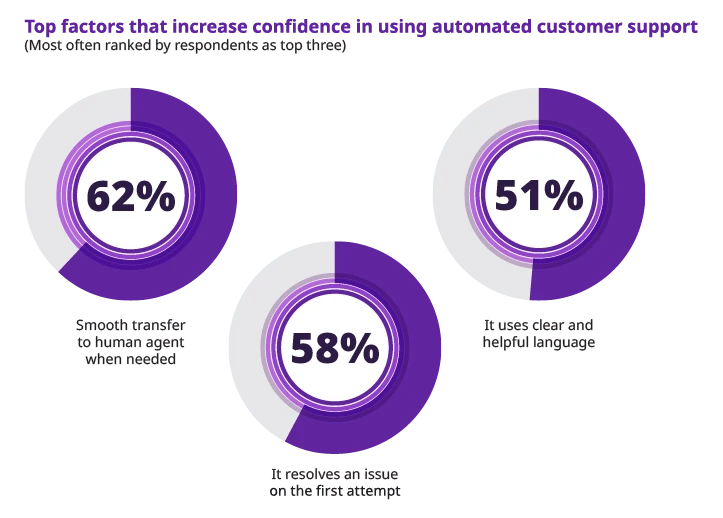
The right threshold for the live agent handoff isn't a fixed number you configure once at launch. It shifts as your model improves, as call volume changes, and as your system gets exposed to new intents it hasn't handled before. It has to be monitored and re-tuned continuously, the same way you'd tune any other live system that customers depend on.
Real Call Conditions: Accents, noise, and interruptions are table stakes
Demos are highly controlled environments that tell you almost nothing about how a system will perform on a real call.
Real calls happen from a car with the windows down, from a warehouse floor, from someone with a regional accent your training data underrepresented, or from a parent half-listening while managing a crying child in the background. Callers talk over the system, pause mid-sentence to think, and correct themselves without warning. None of that is unusual in a live phone line, and it means a system that only performs well in clean acoustic conditions isn't enterprise-ready.
Handling this reliably, at scale, across accents and noise conditions and interruption patterns, is a distinct and serious engineering discipline in its own right, not something you can leave for post-launch to refine. It's also why speech recognition tuning needs to be an ongoing collaboration between engineers and linguists. Accuracy across accents and dialects has to be tested deliberately.
In fact, a common reason that voice AI programs fail is that most don’t maintain a tuning loop. A voice model is maybe 20% of the work. The other 80% is the loop you build around it: pull real calls out of production, have humans measure error rates against what the system heard, retrain, redeploy, and measure again. And again, it has to be ongoing because language drifts. You launch new products. Marketing invents new promo names. Live agents rewrite their scripts. Your call mix shifts with the season. A model that nobody is tuning gets worse every month.
So when you evaluate a platform, the useful question is not what accuracy number it hits in a demo. You’ll want to know who runs the tuning loop after go-live, how often it runs, and what your accuracy looks like when it stops.
Integration: One call, many systems
From the caller's side, this is one phone call. From the enterprise side, it's several calls happening at once. A single voice interaction typically has to touch the contact-center-as-a-service (CCaaS) platform, the CRM, the agent's desktop application, and whatever's doing QA and monitoring in the background—all in real time, all in sync, and all without the caller ever knowing any of that coordination is happening.
If any one of those systems is slow, inconsistent, or simply unaware of what the others just decided, the caller doesn't experience "a backend sync issue." They get asked for their account number twice, or they get told something that contradicts what they were just told thirty seconds earlier. What looks like one conversation to the customer is your system juggling half a dozen conversations with itself. Orchestration across all of them, reliably, is its own engineering problem, separate from and just as hard as the language understanding piece everyone focuses on first.
The only way to catch this before customers do is end-to-end integration testing across every system a call actually touches (not just the AI layer in isolation) plus a clear incident-response process for when one of those five systems goes down or experiences a failure— expired certs, broken lookups, API timeouts, etc.—since those failures are common and need to be diagnosable.
RELATED ARTICLE: What It Takes to Connect Your CX Tech Stack: Perspectives From the Field
The Intelligence Has Gotten Good. The Engineering Is Where Implementation Lives or Dies.
None of these four challenges is about whether the underlying AI model is smart enough. Today's models are genuinely good at understanding language. What they're not automatically good at is surviving contact with a live phone line, a live human, and a live business system stack. They need to be engineered that way, continuously.
You might never see a vendor demo their voice AI solution with a crying baby in the background or from the middle of a busy restaurant. But you can still help ensure the solution performs under real-world conditions to deliver the results you need for your modern voice experience.
Next:
Once you've got a system that survives deployment, how do you prove it's working, and keep proving it, call after call, instead of taking an accuracy number on faith? That's where I'll pick this up next.

Related Resources

Don't Hide the Humans: Why a First Contact Resolution Approach to AI Will Be Key in Customer Care
CCW Las Vegas 2026: The AI Conversation Is Growing Up

What Is Intelligent Routing?